#以太坊验证者退出队列增392%
[Old Wigeon Observation] $ETH
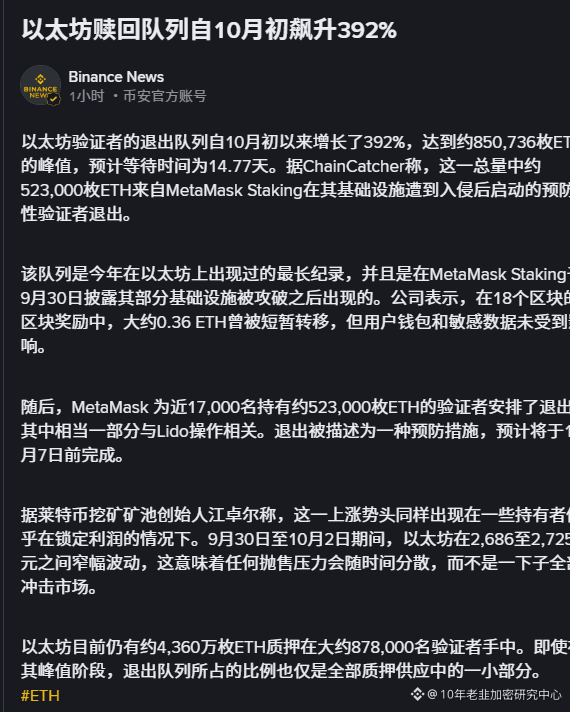
Ethereum validators exiting the queue suddenly surged by 392%, but that doesn’t mean 850,000 ETH are about to be dumped on the market immediately. Since early October, the Ethereum validator exit queue has been rising rapidly, and the peak reached about 850,000 ETH. The expected waiting time is close to 15 days.
It may look terrifying, but when you break it down, it’s not that simple. Of the roughly 523,000 ETH, about 523,000 ETH is related to a security incident involving MetaMask Staking. This is a precautionary exit, not a sudden decision by a large number of validators to sell their ETH. Also, validator exits must be processed in a queue; the ETH in the exit queue won’t all hit the market at once.
What really needs attention is: after this batch of ETH completes the exit, how much of it will flow to exchanges and ultimately form real selling pressure. So these figures are more like a short-term supply pressure warning—and they can’t be directly equated with “large-scale ETH dumping.”
If over the next few days the ETH price starts to weaken, and at the same time the exchanges’ net inflow of ETH increases, then that would be the signal worth truly worrying about.
[Old Wigeon Observation] $ETH
Ethereum validators exiting the queue suddenly surged by 392%, but that doesn’t mean 850,000 ETH are about to be dumped on the market immediately. Since early October, the Ethereum validator exit queue has been rising rapidly, and the peak reached about 850,000 ETH. The expected waiting time is close to 15 days.
It may look terrifying, but when you break it down, it’s not that simple. Of the roughly 523,000 ETH, about 523,000 ETH is related to a security incident involving MetaMask Staking. This is a precautionary exit, not a sudden decision by a large number of validators to sell their ETH. Also, validator exits must be processed in a queue; the ETH in the exit queue won’t all hit the market at once.
What really needs attention is: after this batch of ETH completes the exit, how much of it will flow to exchanges and ultimately form real selling pressure. So these figures are more like a short-term supply pressure warning—and they can’t be directly equated with “large-scale ETH dumping.”
If over the next few days the ETH price starts to weaken, and at the same time the exchanges’ net inflow of ETH increases, then that would be the signal worth truly worrying about.