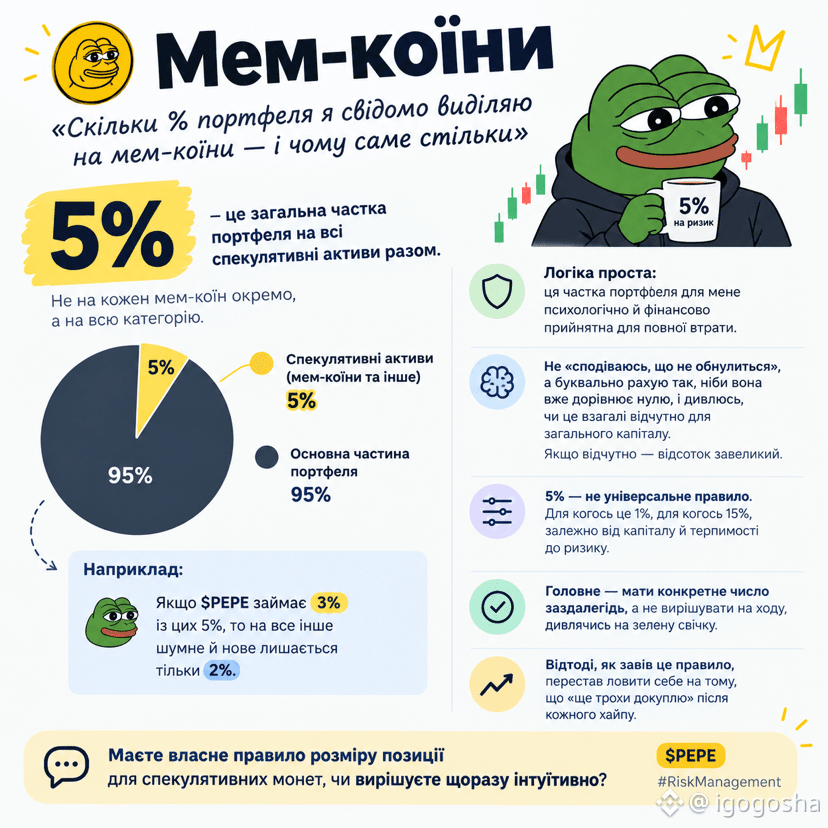
How much of my portfolio do I consciously allocate to meme coins—and why exactly that much🤓🧐
5%—no more. Here’s how much of my portfolio I consciously allow myself to risk on meme coins. 🎲
I didn’t have a clear rule for meme coins for a long time—I was buying spontaneously whenever something was buzzing in the chats. After a few unsuccessful attempts, I set a strict limit for myself.
I calculate it this way: I take the value of the portfolio and allocate exactly 5% to all speculative assets together, not to each meme coin separately. If $PEPE takes up 3% out of that 5%, then everything else noisy is left with only 2%.
The logic is simple: this portion is psychologically and financially acceptable for a total loss. I treat it as if it’s already equal to zero, and I check whether it’s noticeable for the total capital. If it’s noticeable, the percentage is too high.
5% is not a universal rule that suits everyone; for some it will be 1%, for others 15%, depending on capital and risk tolerance. The key is to have a specific number in advance—not to decide on the fly depending on the green candle.
Since I set this rule, I stopped catching myself thinking, “I’ll buy a little more” after every hype.
Do you have your own rule for the position size of speculative coins, or do you decide each time intuitively?
$PEPE
#RiskManagement
5%—no more. Here’s how much of my portfolio I consciously allow myself to risk on meme coins. 🎲
I didn’t have a clear rule for meme coins for a long time—I was buying spontaneously whenever something was buzzing in the chats. After a few unsuccessful attempts, I set a strict limit for myself.
I calculate it this way: I take the value of the portfolio and allocate exactly 5% to all speculative assets together, not to each meme coin separately. If $PEPE takes up 3% out of that 5%, then everything else noisy is left with only 2%.
The logic is simple: this portion is psychologically and financially acceptable for a total loss. I treat it as if it’s already equal to zero, and I check whether it’s noticeable for the total capital. If it’s noticeable, the percentage is too high.
5% is not a universal rule that suits everyone; for some it will be 1%, for others 15%, depending on capital and risk tolerance. The key is to have a specific number in advance—not to decide on the fly depending on the green candle.
Since I set this rule, I stopped catching myself thinking, “I’ll buy a little more” after every hype.
Do you have your own rule for the position size of speculative coins, or do you decide each time intuitively?
$PEPE
#RiskManagement