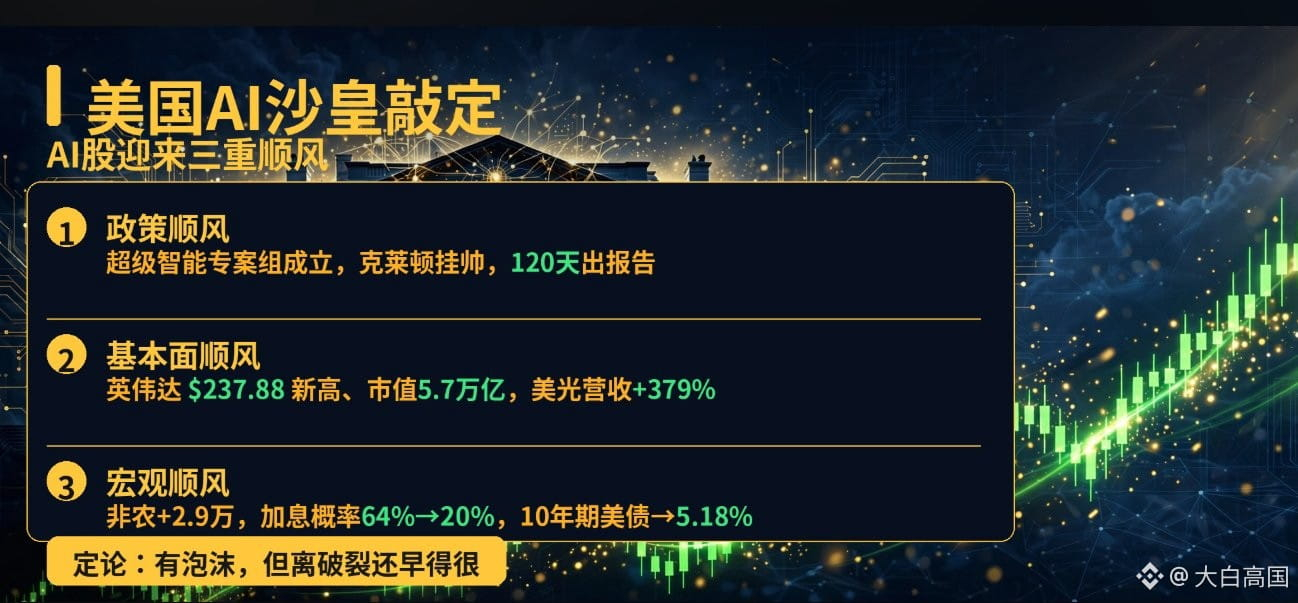
US AI czar confirmed, AI stocks see triple tailwinds
1⃣ Policy:
The White House establishes a “Super Intelligent Task Force,” with former SEC chairman Jay Clayton as the AI czar, delivering a report within 120 days.
Trump encourages and boosts morale: “I will never stifle the growth of technology.” Regulation shifts from “pressing the brake” to “pressing the accelerator,” focusing mainly on industry self-discipline.
In other words, aggressively develop AI so the stock market looks better—AI is still in a high-speed growth phase.
2⃣ Fundamentals:
On Friday, Nvidia hit a new all-time intraday high of $237.88, with a market cap of $5.7 trillion;
Morgan Stanley resumes its “preferred stock” rating and sets a $300 target price;
And on Monday, it just increased its buyback by $150 billion.
Micron’s earnings report shows revenue up 379% year-over-year, beating expectations. Synopsys and Lam Research each rose more than 14% over the week.
As expected, these are truly positive catalysts for AI stocks.
3⃣ Macro data:
Nonfarm payrolls came in cold (新增 29,000, vs. 90,000 expected). The probability of a rate hike in October fell from 64% to 20%. The 10-year Treasury yield eased to 5.18%, and a spring breeze for growth stocks is starting to blow in.
Conclusion: Does AI have a bubble? Yes—but it’s still far from bursting.
A bubble and a crash are two different things: the internet bubble was inflated from 1995 to 2000, and the stage of inflating the bubble is precisely when you make the most money.
Now, with policy pressing the accelerator, performance keeping up, and money still entering the market—none of the three conditions has gone bad. If there is a crash, it would likely be years or even a decade later.
Getting off now is like going to cash in 1996 and waiting with no position for the Nasdaq crash.
1⃣ Policy:
The White House establishes a “Super Intelligent Task Force,” with former SEC chairman Jay Clayton as the AI czar, delivering a report within 120 days.
Trump encourages and boosts morale: “I will never stifle the growth of technology.” Regulation shifts from “pressing the brake” to “pressing the accelerator,” focusing mainly on industry self-discipline.
In other words, aggressively develop AI so the stock market looks better—AI is still in a high-speed growth phase.
2⃣ Fundamentals:
On Friday, Nvidia hit a new all-time intraday high of $237.88, with a market cap of $5.7 trillion;
Morgan Stanley resumes its “preferred stock” rating and sets a $300 target price;
And on Monday, it just increased its buyback by $150 billion.
Micron’s earnings report shows revenue up 379% year-over-year, beating expectations. Synopsys and Lam Research each rose more than 14% over the week.
As expected, these are truly positive catalysts for AI stocks.
3⃣ Macro data:
Nonfarm payrolls came in cold (新增 29,000, vs. 90,000 expected). The probability of a rate hike in October fell from 64% to 20%. The 10-year Treasury yield eased to 5.18%, and a spring breeze for growth stocks is starting to blow in.
Conclusion: Does AI have a bubble? Yes—but it’s still far from bursting.
A bubble and a crash are two different things: the internet bubble was inflated from 1995 to 2000, and the stage of inflating the bubble is precisely when you make the most money.
Now, with policy pressing the accelerator, performance keeping up, and money still entering the market—none of the three conditions has gone bad. If there is a crash, it would likely be years or even a decade later.
Getting off now is like going to cash in 1996 and waiting with no position for the Nasdaq crash.