#crcl
Captured and studied again
CRCL has continued to fall recently, with sudden management changes that have sparked market concerns
On September 25, the company simultaneously announced the departure of CFO Jeremy Fox-Geen and that co-founder P. Sean Neville stepped down from the board. Although the official statement said the exits were “amicable” and without disagreement over operations, the market responded with a sharp sell-off. The CFO was a key figure in guiding the company through its IPO, and the co-founder’s departure has further intensified investors’ doubts about the company’s future stability.
Core financial metrics came in below expectations, putting pressure on the growth engine
The Q2 2026 results show that while earnings per share met expectations, revenue missed. More importantly, the circulating supply of the core product USDC fell 4.8% quarter-over-quarter to $73.3 billion at quarter-end. The market share also dipped slightly year-over-year; against a backdrop of tightening industry supply, this actually indicates a mild loss of traction.
Wall Street’s major banks have been cutting ratings in large numbers. Competition dynamics and regulatory uncertainty are also weighing on sentiment.
Most importantly, insiders have continued to reduce their holdings and cash out, dealing a blow to market confidence. On September 8, 2026, CEO Jeremy Allaire sold 22,100 shares. Since the IPO, President Heath Tarbert has made 73 sales and 0 buys, cashing out approximately $664M. Continued one-way selling by management is especially evident as a drag on market confidence when the share price is already at a low level.
Circle’s revenue largely comes from interest on USDC reserves; its income statement “tracks the Fed rather than customer growth.” Even though higher interest rates may boost revenue in the short term, a long-term high-rate environment can dampen economic activity and, in turn, constrain the circulation speed and growth of stablecoins.
Recent positive developments include: receiving OCC approval to establish a national trust bank; Binance investing $100M and renewing a five-year commercial agreement; issuing an additional 750 million USDC on the Solana chain over 24 hours; and acquiring Tazapay to expand its Asia-Pacific payments network.
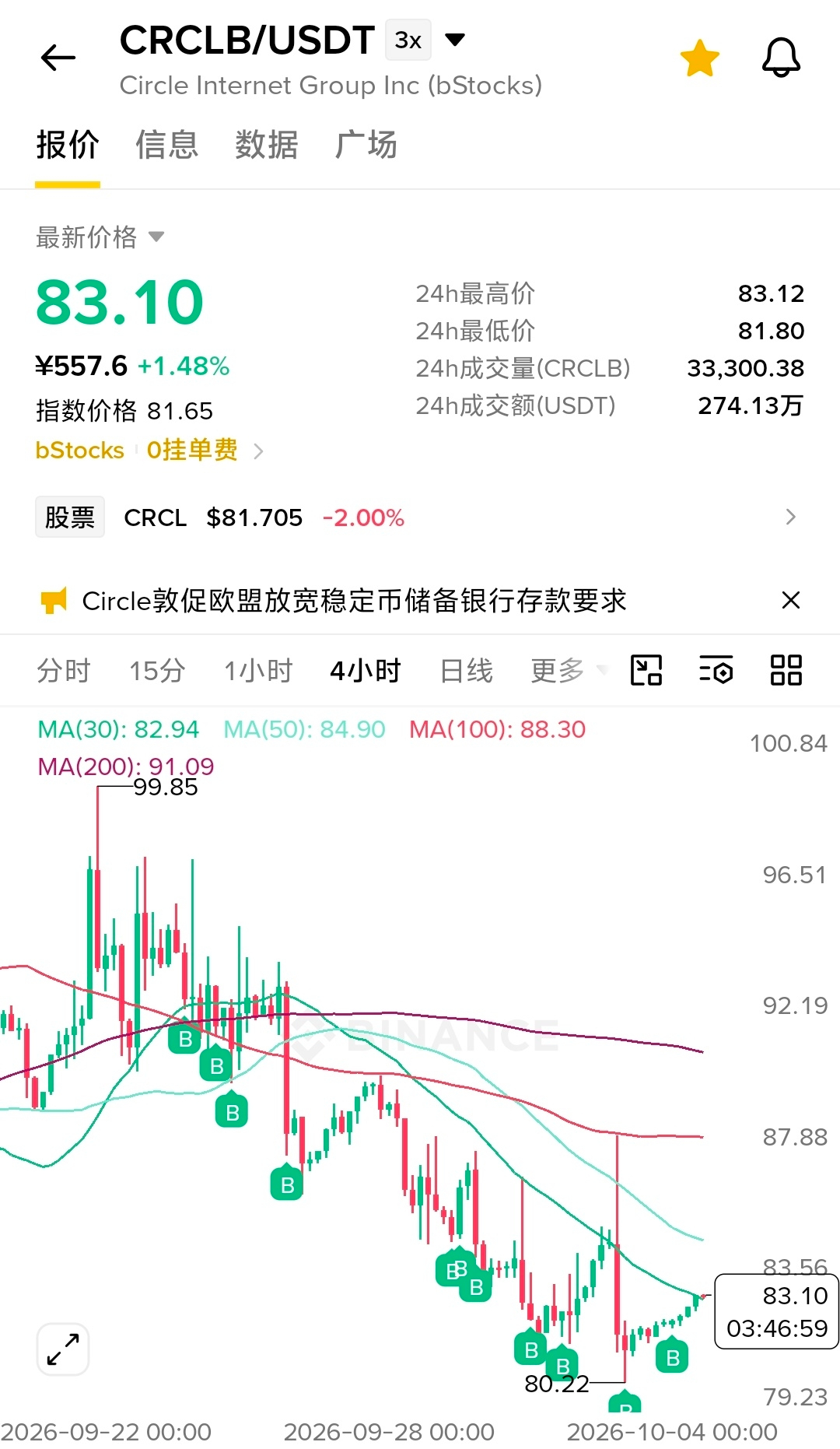
From a technical analysis perspective, $83 is a key support level. If it breaks, it could test $76 next. Resistance sits in the $94–$95 area. The stock has fallen more than 70% from its all-time high and is in a deeply oversold state, with about 12% of float currently sold short—creating potential for a short-squeeze rebound.
What #Circle currently faces is the pain of transitioning from “single-source reserve interest” to “diversified revenue.” In the short term, concentrated negative factors have been released all at once, putting heavy pressure on the share price. Going forward, the key items to watch include: the selection of the new CFO, the Q3 earnings report (expected in November), the final direction of stablecoin regulatory legislation, and the real-world market penetration speed of Open USD.
Captured and studied again
CRCL has continued to fall recently, with sudden management changes that have sparked market concerns
On September 25, the company simultaneously announced the departure of CFO Jeremy Fox-Geen and that co-founder P. Sean Neville stepped down from the board. Although the official statement said the exits were “amicable” and without disagreement over operations, the market responded with a sharp sell-off. The CFO was a key figure in guiding the company through its IPO, and the co-founder’s departure has further intensified investors’ doubts about the company’s future stability.
Core financial metrics came in below expectations, putting pressure on the growth engine
The Q2 2026 results show that while earnings per share met expectations, revenue missed. More importantly, the circulating supply of the core product USDC fell 4.8% quarter-over-quarter to $73.3 billion at quarter-end. The market share also dipped slightly year-over-year; against a backdrop of tightening industry supply, this actually indicates a mild loss of traction.
Wall Street’s major banks have been cutting ratings in large numbers. Competition dynamics and regulatory uncertainty are also weighing on sentiment.
Most importantly, insiders have continued to reduce their holdings and cash out, dealing a blow to market confidence. On September 8, 2026, CEO Jeremy Allaire sold 22,100 shares. Since the IPO, President Heath Tarbert has made 73 sales and 0 buys, cashing out approximately $664M. Continued one-way selling by management is especially evident as a drag on market confidence when the share price is already at a low level.
Circle’s revenue largely comes from interest on USDC reserves; its income statement “tracks the Fed rather than customer growth.” Even though higher interest rates may boost revenue in the short term, a long-term high-rate environment can dampen economic activity and, in turn, constrain the circulation speed and growth of stablecoins.
Recent positive developments include: receiving OCC approval to establish a national trust bank; Binance investing $100M and renewing a five-year commercial agreement; issuing an additional 750 million USDC on the Solana chain over 24 hours; and acquiring Tazapay to expand its Asia-Pacific payments network.
From a technical analysis perspective, $83 is a key support level. If it breaks, it could test $76 next. Resistance sits in the $94–$95 area. The stock has fallen more than 70% from its all-time high and is in a deeply oversold state, with about 12% of float currently sold short—creating potential for a short-squeeze rebound.
What #Circle currently faces is the pain of transitioning from “single-source reserve interest” to “diversified revenue.” In the short term, concentrated negative factors have been released all at once, putting heavy pressure on the share price. Going forward, the key items to watch include: the selection of the new CFO, the Q3 earnings report (expected in November), the final direction of stablecoin regulatory legislation, and the real-world market penetration speed of Open USD.