

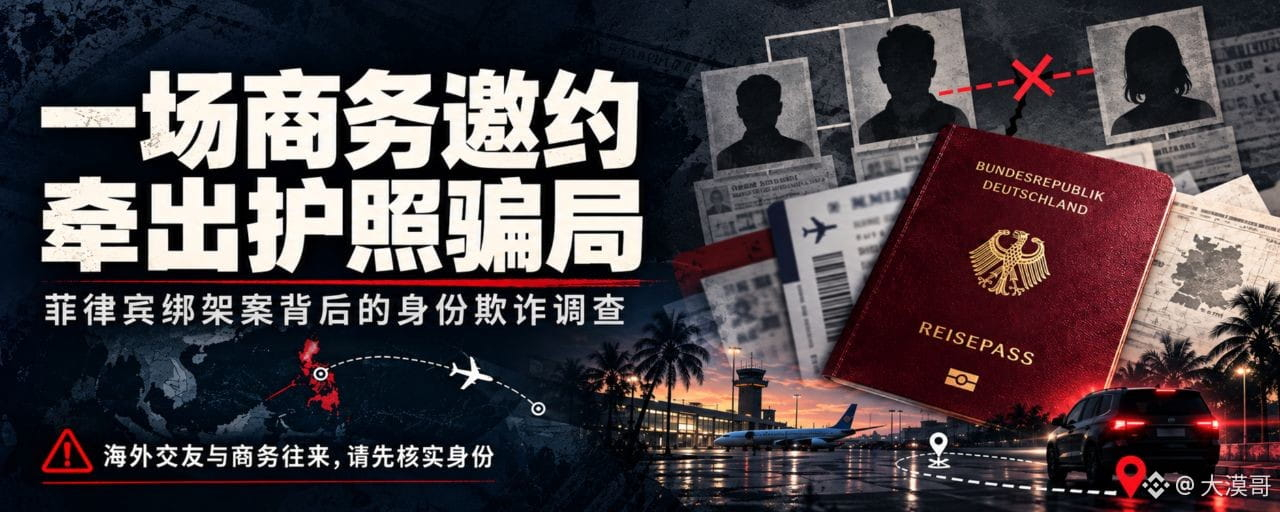


People who travel abroad frequently and meet new friends overseas should be a bit more cautious: just because you click doesn’t mean the person’s identity is reliable. A seemingly tempting business invitation may also hide traps involving fraud and kidnapping. Especially when someone is eager to arrange airport pickup, changes the itinerary at the last minute, or takes you to an unfamiliar private place, be sure to verify first before taking any action.
A kidnapping and murder case in the Philippines unexpectedly led to a batch of cases涉嫌通过虚构犹太血统获取德国国籍 (involving claims of obtaining German citizenship through fabricated Jewish heritage). When you connect these reports, it’s genuinely chilling.
According to Caixin, on June 20, 2024, Xia Kefu, a marketing executive at a Chinese medical device company, and Sun Jing, an American-Chinese person engaged in medical device agency work, were invited by a potential partner “Li Na” to go to Manila, Philippines, for a business inspection. Soon after the two arrived, they were kidnapped, and later killed.
They thought a business opportunity was waiting for them. In reality, they had walked into a deadly trap.
Because some of the victims were U.S. citizens, U.S. law enforcement also joined the investigation. Deutsche Welle, citing an investigation by Der Spiegel, reported that while investigating the murders, the FBI discovered that suspect Liu Hanwen and his family were suspected of obtaining German passports through fraud. Liu Hanwen was arrested in the United States in October 2024 and later deported to China in July 2026.

The investigation then uncovered another layer of identity fraud.
According to Caixin, Liu Hanwen and two other Chinese fugitives, Tian Chunming and Jie Yang, were not related by blood but were presented as the “three brothers” of a Jewish family, through which they obtained German citizenship.
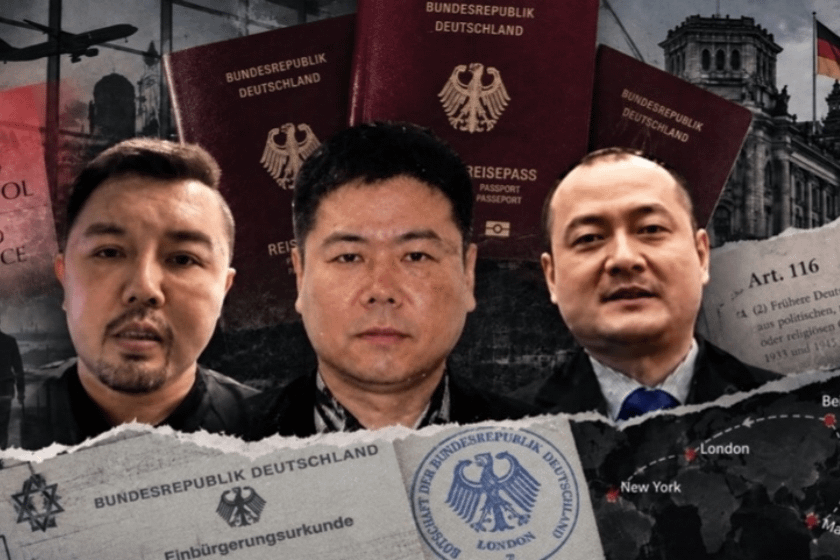
They are suspected of exploiting Germany’s system for restoring citizenship to victims of Nazi persecution and their eligible descendants. The system was intended to redress historical wrongs, but criminals took advantage of it: using forged genealogies and documents about births and family relationships to falsely claim ties to the families of actual victims.
One example disclosed by Deutsche Welle was especially absurd: a real Jewish couple was assigned a “daughter” out of thin air; this “daughter” was then said to have married a Chinese man and had eight children. The couple’s actual descendants knew nothing about it.
A foreign passport that looks genuine does not prove that its holder’s history, relationships, or claims are true.
Caixin reported on September 24, 2026, that the Düsseldorf public prosecutor’s office confirmed the investigation involved 32 people, 28 of them Chinese citizens. Deutsche Welle said about half had already obtained German passports, while the rest had submitted naturalization applications.
It is important to be clear: the case is still under investigation, and not all suspects should be treated as though they have been convicted. The “fake three brothers” case involves fraudulent naturalization, but that does not mean all three men were involved in the Philippine kidnapping and murder case.
But this incident is already enough to remind us that risks in interactions overseas can sometimes begin with a new friend who seems warm and welcoming, a seemingly reliable business partner, or a pickup that has been arranged for you.
There is nothing wrong with traveling abroad often or enjoying meeting people, but trust takes time and requires verification. Don’t accept an entire itinerary arranged by a stranger based only on a passport, business card, social media posts, or an introduction from a mutual acquaintance. Verify the company and the invitation, arrange your own accommodation and transportation, and share your itinerary and contacts with family. Refuse and leave if someone changes vehicles at the last minute, takes you to a remote location, asks you to keep things secret, or demands your documents. If you face a threat, contact local police and the Chinese embassy or consulate first.
May every trip abroad end in a safe return. One extra verification could help you avoid a scam—or even a kidnapping.
Sources: Caixin: Philippine kidnapping case; Caixin: “The Three Jewish Brothers”; Caixin: German investigation into fraudulent naturalization; Deutsche Welle.