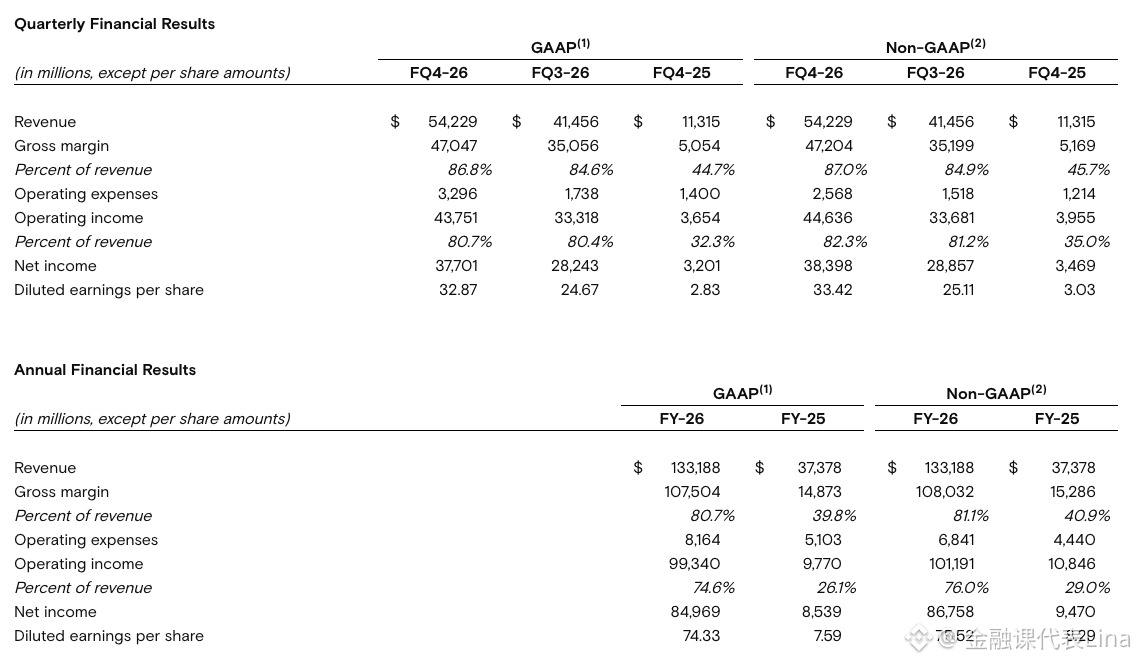
A company earns more money in a single quarter than it did over the entire previous year, yet its share price barely moves—Micron has been like this recently. After the earnings report came out, the stock rose by less than 1% over the next two trading days.
First, let’s break down where the profits come from. Micron sells memory chips—the “memory” inside computers and phones. This business is a bit like selling grain: when conditions are good, supply can’t keep up and prices jump. This quarter, revenue reached $54.2 billion, up nearly fourfold year over year. But most of the increase wasn’t from selling more units—it was from selling each unit at a much higher price. DRAM prices rose by more than ten percentage points on average, while flash memory was even more—up by around 30%.
When ordinary investors buy this kind of stock, they tend to look at the price-to-earnings (P/E) ratio. At about 14x, it may seem inexpensive; and if profits keep growing, next year it could be below 7x. But there’s a trap with P/E ratios for cyclical stocks: when profits are at their highest, the P/E ratio is often at its “cheapest.” Once supply and demand flip, prices fall and profits could drop by a large margin—the “cheap” valuation can instantly become expensive. With the same share price, using profits from different years can make the P/E ratio differ by more than 1x.
So how should you judge it? Don’t just look at how high profits are—look at how long those profits can last. Right now, it’s riding a shortage that’s pushing prices up, while Micron itself is racing to expand production. Next year it plans to spend more than $50 billion to build new factories, and the new capacity won’t come online until 2028. By the time everyone finishes expanding, shortages may turn into oversupply, and the story about prices will be told in the opposite direction.
So the only advice for ordinary people is this: when looking at cyclical stocks, don’t fixate on today’s low P/E ratio—think about whether it’s earning from a “temporary price spread” or from “durable capability.” That distinction determines how much those profits are really worth.
First, let’s break down where the profits come from. Micron sells memory chips—the “memory” inside computers and phones. This business is a bit like selling grain: when conditions are good, supply can’t keep up and prices jump. This quarter, revenue reached $54.2 billion, up nearly fourfold year over year. But most of the increase wasn’t from selling more units—it was from selling each unit at a much higher price. DRAM prices rose by more than ten percentage points on average, while flash memory was even more—up by around 30%.
When ordinary investors buy this kind of stock, they tend to look at the price-to-earnings (P/E) ratio. At about 14x, it may seem inexpensive; and if profits keep growing, next year it could be below 7x. But there’s a trap with P/E ratios for cyclical stocks: when profits are at their highest, the P/E ratio is often at its “cheapest.” Once supply and demand flip, prices fall and profits could drop by a large margin—the “cheap” valuation can instantly become expensive. With the same share price, using profits from different years can make the P/E ratio differ by more than 1x.
So how should you judge it? Don’t just look at how high profits are—look at how long those profits can last. Right now, it’s riding a shortage that’s pushing prices up, while Micron itself is racing to expand production. Next year it plans to spend more than $50 billion to build new factories, and the new capacity won’t come online until 2028. By the time everyone finishes expanding, shortages may turn into oversupply, and the story about prices will be told in the opposite direction.
So the only advice for ordinary people is this: when looking at cyclical stocks, don’t fixate on today’s low P/E ratio—think about whether it’s earning from a “temporary price spread” or from “durable capability.” That distinction determines how much those profits are really worth.