

Previously, when everyone looked at Terafab, there was at least some sense of “is Musk trying to take over everything himself again?” After all, advanced process nodes aren’t like building rockets, and spending money doesn’t automatically mean you can get it done.
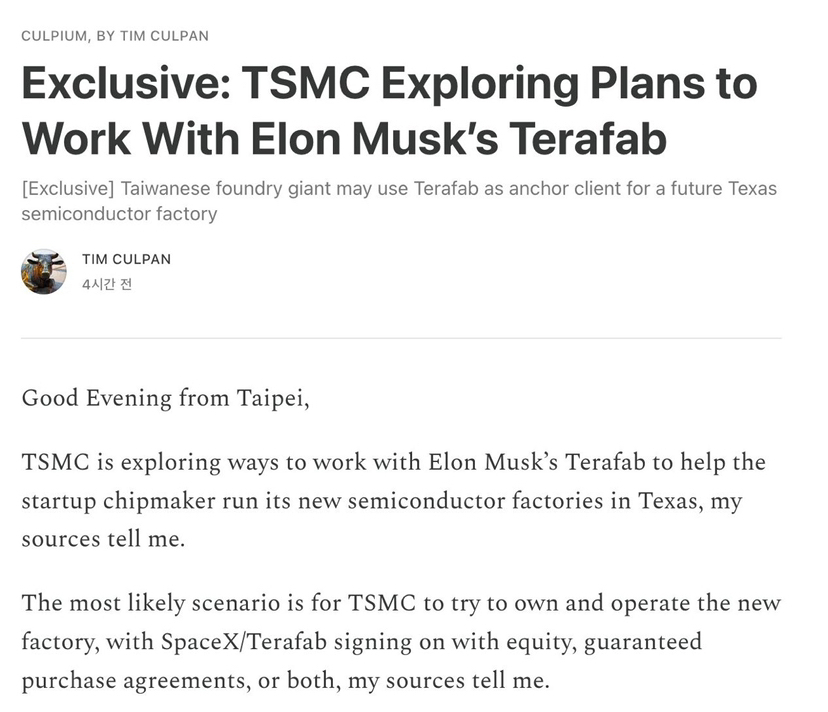
The wind direction has changed a bit now: even TSMC is researching how to get involved.
Culpan’s take is that a more realistic option could be: TSMC builds the factories itself and operates them itself in Texas. SpaceX / Terafab would provide the funding, lock in long-term orders, and even hold shares together.
That is to say, Terafab may not ultimately really be “Musk himself making chips.” More likely, it becomes “Musk puts the demand and the money on the table and invites the best chip makers to do it.”
This gets interesting. Previously many people thought Terafab was too crazy because they assumed he was going to create a TSMC from scratch. But if, in the end, TSMC personally steps in, then the story suddenly isn’t so outrageous.
And don’t forget: going forward, Tesla, xAI, and SpaceX will have the least shortage of all things—chip demand.
For TSMC, if a customer is willing to lock in quantities for many years of the future directly with you, then yes, it’s definitely worth taking seriously.
Now the biggest problem is only one thing:
Is TSMC really just “chatting,” or have they already prepared to place a bet?
The TeraFab factory is a massive AI semiconductor facility jointly planned and constructed under Elon Musk’s Tesla and SpaceX. It’s the super-chip factory in the Tesla/SpaceX plan, used to produce their proprietary AI chips (logic, memory, and packaging). It targets Intel’s 14A process (around 1.4 nm). Main uses: edge-inference silicon chips for Optimus robots and Cybercab/vehicles, and high-power chips for SpaceX’s orbital data centers.
Not for third-party Intel/AMD/Nvidia chips, ordinary automotive parts, or rockets. It’s just vertical integration—far beyond what external foundries could provide.
Giga Texas’ research factory has begun building for small-batch production of AI5 chips by the end of 2026 / early 2027, with mass production achieved in 2027. The main Grimes County site: construction started on December 1, 2026; the first phase is scheduled to be completed by the end of 2028, and ramp-up to large-scale production will gradually increase during 2028–29.
Chips are dedicated for Tesla Optimus/Cybercabs (edge inference) and for SpaceX’s orbital data centers. Vertical integration is only to meet internal needs, which exceed global supply—so there’s no
Musk breaks down the proportions very clearly: “Ground chips are about 100 to 200 gigawatts per year, and in space about one terawatt. Most of the output goes into orbital data centers. Earth is constrained by electricity and land, but orbit isn’t. Starship is responsible for sending mass up, and Terafab is responsible for manufacturing the chips.”
The Terafab chip factory is built in Texas. The building’s floor area exceeds 100 million square feet—about three times the size of New York’s Central Park, equivalent to 1,700 American football fields. He calls it the largest and most valuable building on Earth.
This isn’t an outsourcing fab expanding capacity. This is Tesla, SpaceX, and xAI building their own capacity.
Texas set the start date for construction of the main Grimes County plant to December 1, with the goal of completing it by the end of 2028. Phase one investment is about $16.8 billion.
Why does it have to be built by itself?
The gap isn’t “a little more capacity,” but a difference in orders of magnitude.
Musk’s algorithm is very straightforward: the computing power his companies will need in the future will exceed 1 terawatt per year. He sums up the existing global chip foundries and treats that as only about 2% of this demand. In other words, even if you buy all the output of every chip foundry on Earth, it would only cover one-fiftieth of his plan.
He has said the same thing to Samsung, TSMC, and Micron: “Whatever capacity they can expand, I’ll buy it all.” The problem is that the speed at which those vendors are willing to expand capacity is far behind the demand curve for Tesla, SpaceX, Grok, and Optimus. The supply chain may appreciate it, but if the timing doesn’t match, then you can only build it yourself.
Build it yourself, and use it yourself!
Terafab isn’t a contract wafer foundry taking external orders. Its capacity is reserved for its own companies.
Two product lines, one owner. One is the ground segment: edge inference chips for Optimus, Cybercab, and self-driving. The other is the orbital segment: radiation-hardened, high-power chips designed for space thermal conditions. The long-term plan is 1 million wafer starts per month, with annual output of 100 to 200 billion custom AI and memory chips. Intel joins with process and manufacturing experience, but the volume isn’t sold externally.
If this plant really runs, the advantage isn’t the brand—it’s the capacity that others don’t have.
The endpoint is not in Texas.
The factory cover is on the ground; most of the computing power is sent up to the sky.
Musk breaks down the proportions very clearly: ground chips are about 100 to 200 gigawatts per year, and in space about one terawatt.
Most of the output goes into orbital data centers. Earth is constrained by electricity and land, but orbit isn’t.
Starship is responsible for sending the payload up, while Terafab is responsible for manufacturing the chips.
The three steps are the same thing: first build the largest building on Earth, then produce computing power roughly 50 times the current global supply of AI chips, and finally put most of that computing power into orbit to be used by AI worldwide.
Terafab isn’t a conventional expansion of chip production capacity—it’s a response to an exponentially growing computing-power gap: build it yourself, use it yourself, and don’t rely on anyone else; the endpoint is in orbit.
$SPCX $TSLA