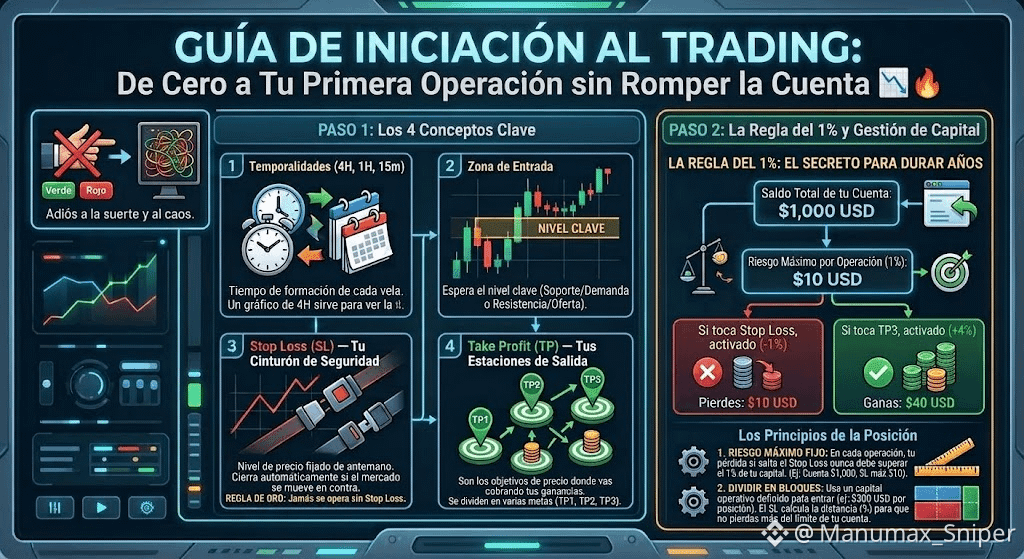
Trading Onboarding Guide: From Zero to Your First Trade Without Breaking Your Account 📉🔥
If you’re taking your first steps on the chart, welcome to the trenches. The most common mistake when starting is thinking that trading is just pressing green and red buttons by luck or filling the screen with a thousand colorful indicators.
Real trading is risk management, patience, and reading the structure of price.
1. The Basic Rules: What is each thing?
To understand any analysis or trading plan, you need to master these 4 key concepts:
Timeframes (Example: 4H, 1H, 15m): The time it takes for each candle to form on your screen. A 4H chart (4 hours) helps you see the overall direction of the trend, while 15m or 1H charts are used to find the exact entry.
Entry Zone: The specific price range where we decide to open the trade. We never enter “where the price is right now”; we wait for it to reach a key level of support (demand) or resistance (supply).
Stop Loss (SL) — Your Seatbelt: A price level set in advance where, if the market moves against you, the trade closes automatically. Golden rule: Never trade without a Stop Loss.
Take Profit (TP) — Your Exit Stations: These are the price targets where you take your profits. They’re divided into multiple goals (TP1, TP2, TP3) so you can secure capital as the price moves in your favor.
2. The 1% Rule and Capital Management
The secret to lasting for years at this isn’t always guessing where price will go, but knowing how much you lose when you’re wrong.
📌 Example 1: The 1% Rule Outline (Clean format without a box)
💰 Total Account Balance: $1,000 USD
│
▼
🛡️ Maximum Risk per Trade (1%): $10 USD
│
├── 🔴 If it hits Stop Loss (-1%): You lose $10 USD
└── 🟢 If it hits TP3 (+4%): You gain $40 USD
Stay tuned for the second part. My next move is also with $LINK and pending.
If you’re taking your first steps on the chart, welcome to the trenches. The most common mistake when starting is thinking that trading is just pressing green and red buttons by luck or filling the screen with a thousand colorful indicators.
Real trading is risk management, patience, and reading the structure of price.
1. The Basic Rules: What is each thing?
To understand any analysis or trading plan, you need to master these 4 key concepts:
Timeframes (Example: 4H, 1H, 15m): The time it takes for each candle to form on your screen. A 4H chart (4 hours) helps you see the overall direction of the trend, while 15m or 1H charts are used to find the exact entry.
Entry Zone: The specific price range where we decide to open the trade. We never enter “where the price is right now”; we wait for it to reach a key level of support (demand) or resistance (supply).
Stop Loss (SL) — Your Seatbelt: A price level set in advance where, if the market moves against you, the trade closes automatically. Golden rule: Never trade without a Stop Loss.
Take Profit (TP) — Your Exit Stations: These are the price targets where you take your profits. They’re divided into multiple goals (TP1, TP2, TP3) so you can secure capital as the price moves in your favor.
2. The 1% Rule and Capital Management
The secret to lasting for years at this isn’t always guessing where price will go, but knowing how much you lose when you’re wrong.
📌 Example 1: The 1% Rule Outline (Clean format without a box)
💰 Total Account Balance: $1,000 USD
│
▼
🛡️ Maximum Risk per Trade (1%): $10 USD
│
├── 🔴 If it hits Stop Loss (-1%): You lose $10 USD
└── 🟢 If it hits TP3 (+4%): You gain $40 USD
Stay tuned for the second part. My next move is also with $LINK and pending.