Two weeks ago, it was still the biggest magnet for inflows among all encrypted (crypto) ETFs. This week, it has become the one draining the most..
📢 消息第一时间
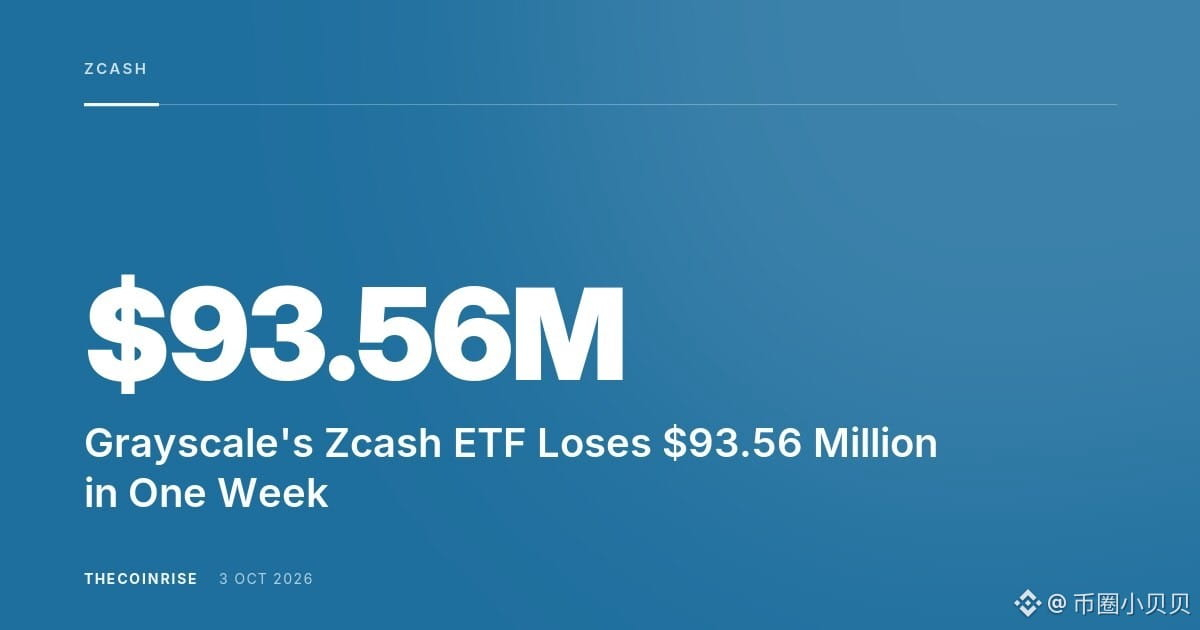
It’s talking about Grayscale’s Zcash ETF, code ZCSH, which only launched in August this year. Data shows that this week it saw net outflows of $93.56 million—its first weekly net outflow since the fund launched. And just two weeks ago, it pulled in $98.20 million, the most among all crypto ETFs that week.
In the span of just two weeks, the same fund went from being #1 in inflows to #1 in outflows.
Most people’s first reaction is that the story of privacy coins is over. But what’s really worth watching isn’t whether ZEC has finished running up—it’s who’s actually setting the price in this reversal.
This round of renewed attention for Zcash is driven by the privacy narrative, plus the relatively scarce supply. The price surged to around $1,300, bringing in demand for “privacy exposure in compliant channels,” something that hasn’t existed much in the past. So money flowed into the ETF rather than buying the coin directly.
The problem lies here. Single-asset ETFs act as a two-way amplifier: when it’s rising, they help turn sentiment into buyable shares; when it’s falling, they also make redemptions translate into coins that the custodian has to sell. As ZEC slid toward $1,300, the flow followed the price momentum and reversed direction—this isn’t a coincidence.
In other words, ETF flows never measure how many people “believe in privacy,” but rather how much money is chasing momentum. And real demand for privacy is split half on-chain and half in cold wallets—none of which shows up in weekly flow tables. So that $93.56 million number is more like the stance of short-term funds, not long-term holders.
So what should you really watch? Not how much it outflows this week, but whether next week’s flows can turn positive. If weekly outflows keep going, as the custodian sells to meet redemptions, the first thing to get hit won’t be the price—it’ll be the newly formed impression that “privacy assets can be stably held by institutions.”
Once that impression breaks, the cost of bringing compliant capital back into the privacy track next time will be much higher than this time.
📢 消息第一时间
It’s talking about Grayscale’s Zcash ETF, code ZCSH, which only launched in August this year. Data shows that this week it saw net outflows of $93.56 million—its first weekly net outflow since the fund launched. And just two weeks ago, it pulled in $98.20 million, the most among all crypto ETFs that week.
In the span of just two weeks, the same fund went from being #1 in inflows to #1 in outflows.
Most people’s first reaction is that the story of privacy coins is over. But what’s really worth watching isn’t whether ZEC has finished running up—it’s who’s actually setting the price in this reversal.
This round of renewed attention for Zcash is driven by the privacy narrative, plus the relatively scarce supply. The price surged to around $1,300, bringing in demand for “privacy exposure in compliant channels,” something that hasn’t existed much in the past. So money flowed into the ETF rather than buying the coin directly.
The problem lies here. Single-asset ETFs act as a two-way amplifier: when it’s rising, they help turn sentiment into buyable shares; when it’s falling, they also make redemptions translate into coins that the custodian has to sell. As ZEC slid toward $1,300, the flow followed the price momentum and reversed direction—this isn’t a coincidence.
In other words, ETF flows never measure how many people “believe in privacy,” but rather how much money is chasing momentum. And real demand for privacy is split half on-chain and half in cold wallets—none of which shows up in weekly flow tables. So that $93.56 million number is more like the stance of short-term funds, not long-term holders.
So what should you really watch? Not how much it outflows this week, but whether next week’s flows can turn positive. If weekly outflows keep going, as the custodian sells to meet redemptions, the first thing to get hit won’t be the price—it’ll be the newly formed impression that “privacy assets can be stably held by institutions.”
Once that impression breaks, the cost of bringing compliant capital back into the privacy track next time will be much higher than this time.