


Eurobras, IMPSA, General Electric Vernova and Siemens.
Venezuela established strategic alliances with four international companies for the recovery of the National Electric System
Venezuela has again proposed the participation of the private sector in electricity generation, transmission, distribution, and commercialization, while it accelerates agreements with international companies to recover the infrastructure of the National Electric System (SEN).
During a review presented by the Minister of Electric Energy, Rolando Alcalá, and the president of the National Electricity Corporation (Corpoelec), Juan Fernández, regarding the SEN recovery plan, they stated that the reform of the Organic Law of the Electric System and Service would, according to their proposal, allow the integration of the public and private sectors into the different activities along the electricity chain.
The opening is taking place over a system that in recent years has been marked by recurring outages, especially outside Caracas. In different states in the interior, cuts have reached several hours a day, and during the most critical periods, users have reported outages of up to 12 hours.
Lack of maintenance, low availability of thermal generation, and failures in the transmission and distribution networks have turned blackouts into one of the main expressions of the deterioration of Venezuela’s infrastructure.
However, the announcement does not mean that the opening is already fully in effect. In June, the National Assembly approved, in a first reading, the draft reform law, which includes the participation of private and mixed companies. The text must complete the legislative process before becoming a new legal framework.
The project seeks to modify the framework under which the sector operates and includes private sector participation at different links in the electricity supply chain. In his remarks, Alcalá presented the reform as an instrument to foster competitiveness, improve efficiency, and attract investment.
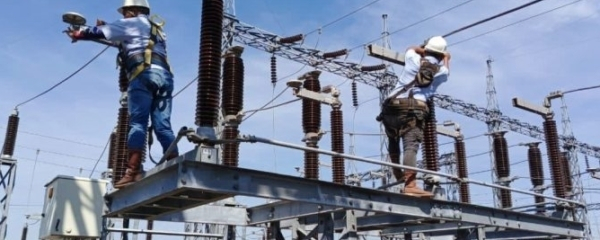
While this new regulatory framework is still being built, the Government is already resorting to international companies to recover part of the existing infrastructure.
Alcalá mentioned strategic agreements with Eurobras, IMPSA, General Electric, and Siemens, related to the recovery of hydroelectric and thermal power generation, as well as to the supply of parts and technology for transmission, generation, and distribution systems.
He detailed that with Eurobras, they are working on reactivating units 17, 18, and 20 of the Simón Bolívar Hydroelectric Power Plant, better known as El Guri. With IMPSA, from Argentina, they are developing projects at the Tocoma and Macagua hydroelectric plants.
He added that GE Vernova and Siemens are working on acquiring original parts and technologies and on refurbishing the electrical and transmission system.
However, the participation of these companies does not necessarily equate to the privatization of the facilities, nor that they are taking over operation of the system. Based on what has been announced so far, a large part of these agreements is related to equipment recovery, technology supply, refurbishment, and infrastructure rehabilitation.
One of the most relevant agreements was formalized at the Miraflores Palace on September 2, when PDVSA and GE Vernova signed a strategic alliance to recover electrical infrastructure linked to the oil industry.
That same day, Venezuela and the U.S. company formalized another agreement to move forward with the recovery of the National Electric System, at a ceremony led by Delcy Rodríguez and the U.S. Secretary of Energy, Chris Wright. The agreement includes recovering existing capacity and adding new generation in the coming years.
Wright then set out a broader horizon for the recovery. He said the immediate goal was to stabilize the grid in a period between six and 12 months, by recovering existing assets, stabilizing the system, and expanding service hours.
The agreement also provides for the addition of 1,000 MW during the first 24 months and another 5,000 MW in the four following years, showing that the comprehensive recovery of the system is not a process that can be solved in a matter of months.
The difference is relevant: while those alliances allow foreign technology and business capacity to be incorporated into the system’s recovery, the legal reform proposes a potentially broader participation by the private sector in the electric business itself, Bloomberg Línea reports.
#Bloomberg #venezuela #ElectricRevolution #Inversiones #PDVSA $BZ $CL