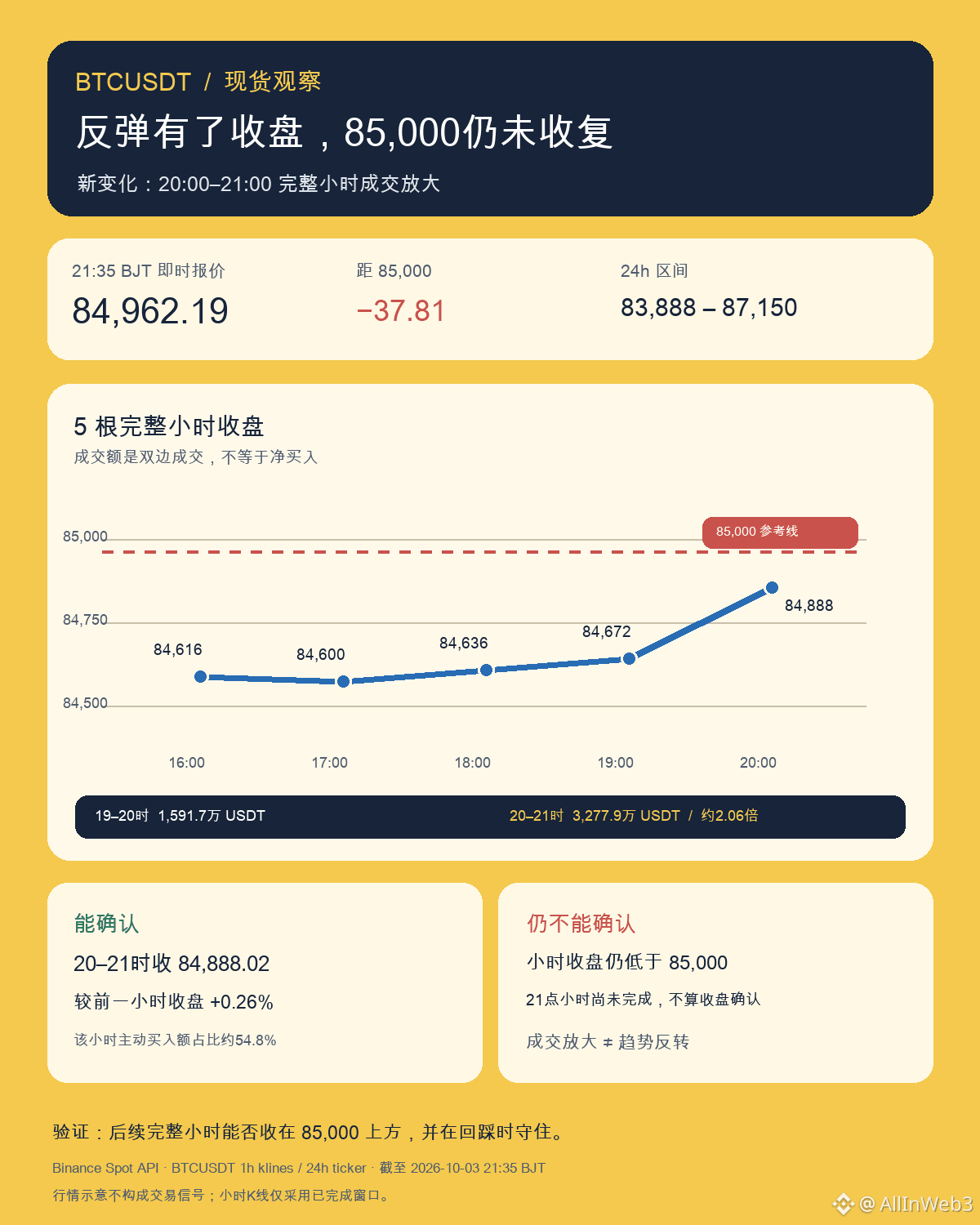
After BTC gave back from $87,220, the previous 16:42 BJT observation was that it stalled at $84,620, below $85,000. Now there is a limited new datapoint: Binance spot BTCUSDT completed the full 20:00–21:00 hour with a close at $84,888.02, up about 0.26% from the 19:00–20:00 close of $84,672.01. The traded notional for that hour was about $32.779 million, which is 2.06x the $15.917 million of the prior hour. The buy-initiated notional accounted for roughly 54.8% of that hour. The hour’s high reached $84,926.47 at 20:00, still $73.53 below $85,000; the gap at the close widened further to $111.98. “Near” does not equal “reclaim.”
This suggests the rebound produced a more actively traded full hour, but the magnitude isn’t large, and the close still did not cross above $85,000. Total turnover comes from two-sided matching; buy-initiated volume reflects the buy-side initiated trade reporting, not net inflow, and cannot by itself prove a trend reversal. With only a single hourly candle, it’s also insufficient to label the bounce as sustained buying.
At 21:35 BJT, the instantaneous price is $84,962.19, about $38 away from $85,000; however, the 21:00 hour is not yet complete, so intraday touches can’t be treated as close-confirmation. The rolling 24-hour range remains $83,888–$87,150, and it’s still about 2.5% below the range high; the 24-hour drop is 2.396%. Compared with the previous entry, the added detail here is the first high-volume rebound hour after the pullback—updating the conditions for observing whether $85,000 can be reclaimed, not rehashing the push up to 87K.
Next, watch whether the full 21:00 hour closes above $85,000, and then whether subsequent pullbacks hold. If the close remains below it, or if it tests the lower edge near $83,888 again, this high-volume rebound will still be only a range-based bounce. The key is validating the conditions, not chasing the target price. Data as of 2026-10-03 21:35 BJT. Source: Binance BTCUSDT spot hourly candles and the 24-hour market report. A rolling 24-hour change is not the same as single-day performance, and this cycle only describes the BTCUSDT spot market—it does not represent the direction of capital flow across the entire market.
This suggests the rebound produced a more actively traded full hour, but the magnitude isn’t large, and the close still did not cross above $85,000. Total turnover comes from two-sided matching; buy-initiated volume reflects the buy-side initiated trade reporting, not net inflow, and cannot by itself prove a trend reversal. With only a single hourly candle, it’s also insufficient to label the bounce as sustained buying.
At 21:35 BJT, the instantaneous price is $84,962.19, about $38 away from $85,000; however, the 21:00 hour is not yet complete, so intraday touches can’t be treated as close-confirmation. The rolling 24-hour range remains $83,888–$87,150, and it’s still about 2.5% below the range high; the 24-hour drop is 2.396%. Compared with the previous entry, the added detail here is the first high-volume rebound hour after the pullback—updating the conditions for observing whether $85,000 can be reclaimed, not rehashing the push up to 87K.
Next, watch whether the full 21:00 hour closes above $85,000, and then whether subsequent pullbacks hold. If the close remains below it, or if it tests the lower edge near $83,888 again, this high-volume rebound will still be only a range-based bounce. The key is validating the conditions, not chasing the target price. Data as of 2026-10-03 21:35 BJT. Source: Binance BTCUSDT spot hourly candles and the 24-hour market report. A rolling 24-hour change is not the same as single-day performance, and this cycle only describes the BTCUSDT spot market—it does not represent the direction of capital flow across the entire market.