$119 worth of SOL—do you still dare buy it?
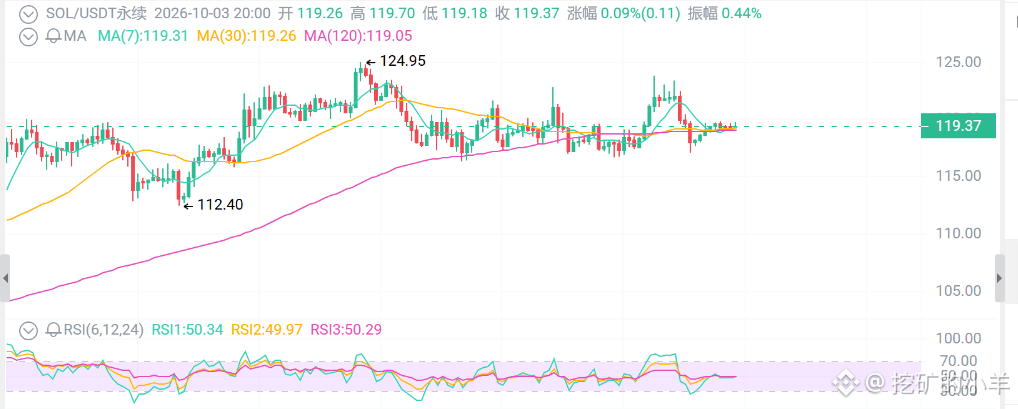
First glance: On October 2, it spiked to 123.8, but failed to hold and slipped back to around 119. The daily price is still above all major moving averages. The 50-day is still above the 200-day. RSI is about 63—strong territory, but no longer expanding. The 116–125 range has become a consolidation platform—digesting, not collapsing. Still, the directional edge is thin, and there will be many fake breakouts.
First thing: This move wasn’t pushed by a technical miracle—it was paid for with real money.
U.S. spot SOL ETFs saw cumulative net inflows of over $1.6B by late September, with assets under management approaching $2B. The week of Sep 21–25 alone brought in $188M, the second-highest week since listing.
But—early October saw a clear slowdown in that incremental demand. That’s why 124+ couldn’t be held.
It’s not that SOL isn’t good—buyers are just catching their breath for now.
Second thing: Fundamentals are improving, but there’s a hard issue you must dock points for.
Alpenglow upgrade is nearing activation: the tolerance threshold is raised from 33% to 40%, voting moves off-chain, enabling a faster finality and cheaper transactions. This is the mid-term narrative, and price has already partially priced it in.
However—
Fee capture at the base layer is still weak. Validators take the bulk of the fees, and token holders’ share has fallen from roughly 68% at the start of the year to about 27%. Staking rate is near 70%, with ~5% annualized returns. The lock-up supports the price, but that doesn’t mean the token itself is directly earning the network’s money.
Third thing: Technicals—119 is just slightly below the pivot.
Daily: The long structure is still there, but momentum is flattening. It rallied from 100 to 125 in mid-September, then consolidated into a 116–125 platform.
4-hour: The October 2 push to 123.8 failed, and price fell back to the middle of the range. MACD is close to flattening; longs look crowded, and in some periods funding rates turned negative.
A daily close falling below 113.7 changes the structure from “platform” to a “deeper pullback.” The next target is 108–110.
Only if price reclaims 124.4 and closes back above it, then we can look for 127/130.
Trading strategy
In the box (range trading):
Don’t chase at 119. If there’s a pullback and rebound to 122.8–124.4 with heavy volume and you see a bearish upper shadow, and the 4-hour chart can’t reclaim it, take a small short. Stop loss above 125.5. Targets: 118.2 / 116.5.
If price falls into 116.5–118.2 and you see selling exhaustion with long lower wicks, buy in batches. Stop loss below 115. Targets: 120.6 / 123.
Breakout trade:
Only if a 4-hour close holds above 124.4 with increased volume, then look for 127–130. Stop loss: close back below 122.
If the daily close falls below 116.5 and can’t reclaim it, the short target shifts lower to 113.7 / 112.
If BTC effectively breaks down below 83100, it will be hard for SOL’s 116 area to hold independently. Reduce leverage. If the ETF sees consecutive days of net outflows, any long breakout trades above 124 lose priority.
First glance: On October 2, it spiked to 123.8, but failed to hold and slipped back to around 119. The daily price is still above all major moving averages. The 50-day is still above the 200-day. RSI is about 63—strong territory, but no longer expanding. The 116–125 range has become a consolidation platform—digesting, not collapsing. Still, the directional edge is thin, and there will be many fake breakouts.
First thing: This move wasn’t pushed by a technical miracle—it was paid for with real money.
U.S. spot SOL ETFs saw cumulative net inflows of over $1.6B by late September, with assets under management approaching $2B. The week of Sep 21–25 alone brought in $188M, the second-highest week since listing.
But—early October saw a clear slowdown in that incremental demand. That’s why 124+ couldn’t be held.
It’s not that SOL isn’t good—buyers are just catching their breath for now.
Second thing: Fundamentals are improving, but there’s a hard issue you must dock points for.
Alpenglow upgrade is nearing activation: the tolerance threshold is raised from 33% to 40%, voting moves off-chain, enabling a faster finality and cheaper transactions. This is the mid-term narrative, and price has already partially priced it in.
However—
Fee capture at the base layer is still weak. Validators take the bulk of the fees, and token holders’ share has fallen from roughly 68% at the start of the year to about 27%. Staking rate is near 70%, with ~5% annualized returns. The lock-up supports the price, but that doesn’t mean the token itself is directly earning the network’s money.
Third thing: Technicals—119 is just slightly below the pivot.
Daily: The long structure is still there, but momentum is flattening. It rallied from 100 to 125 in mid-September, then consolidated into a 116–125 platform.
4-hour: The October 2 push to 123.8 failed, and price fell back to the middle of the range. MACD is close to flattening; longs look crowded, and in some periods funding rates turned negative.
A daily close falling below 113.7 changes the structure from “platform” to a “deeper pullback.” The next target is 108–110.
Only if price reclaims 124.4 and closes back above it, then we can look for 127/130.
Trading strategy
In the box (range trading):
Don’t chase at 119. If there’s a pullback and rebound to 122.8–124.4 with heavy volume and you see a bearish upper shadow, and the 4-hour chart can’t reclaim it, take a small short. Stop loss above 125.5. Targets: 118.2 / 116.5.
If price falls into 116.5–118.2 and you see selling exhaustion with long lower wicks, buy in batches. Stop loss below 115. Targets: 120.6 / 123.
Breakout trade:
Only if a 4-hour close holds above 124.4 with increased volume, then look for 127–130. Stop loss: close back below 122.
If the daily close falls below 116.5 and can’t reclaim it, the short target shifts lower to 113.7 / 112.
If BTC effectively breaks down below 83100, it will be hard for SOL’s 116 area to hold independently. Reduce leverage. If the ETF sees consecutive days of net outflows, any long breakout trades above 124 lose priority.