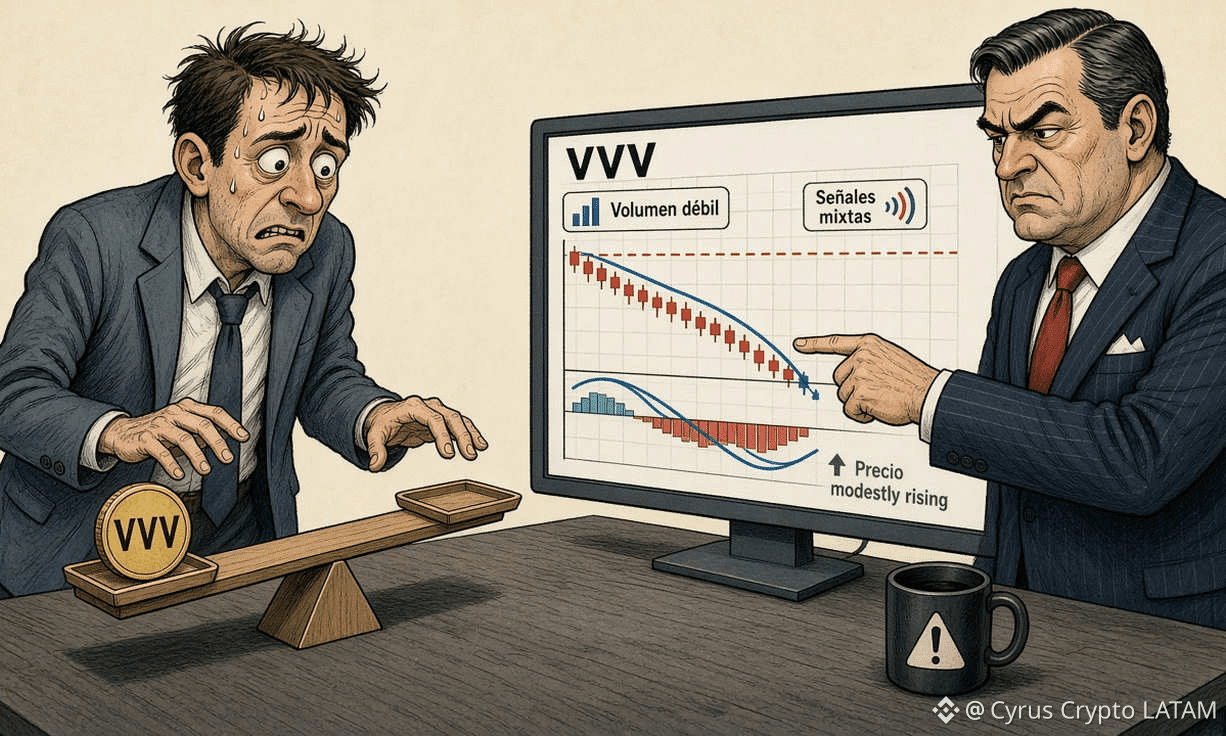
$VVV el 3 October: weak volume slows recovery
VVV trades in USD $27.72, just above the prior close, but volume is below its monthly average and the MACD maintains a bearish bias. The analysis assesses which levels could confirm a recovery and why the available fundamentals and derivatives data are not enough to justify an aggressive directional bet.
The most recent market data shows VVV at USD $27.72, with an indicated change of 0.63% and an open at USD $27.63, versus a prior close of USD $27.58. In the previous session, the range was USD $27.41 to USD $30.20—an amplitude that signals sizable swings, though the data does not allow reconstructing intraday order or asserting that a specific news item drove the move.
The reported capitalization of #VVV is USD $1.34B, but that figure is not sufficient to judge whether the token is cheap or expensive: circulating and total supply are missing, along with holder distribution, future emissions, protocol revenues, and valuation versus usage metrics. The token’s economic function and its value-capture mechanism are also not described.
Recommendation: HOLD, with a wait-and-see bias before opening new positions. The methodology considers five signals: a favorable long-term trend because price is above the 30-, 50-, 90-, and 200-day SMAs; RSI moderately positive at 56.5; an unfavorable short-term structure because it trades below the SMA-7, SMA-10, and SMA-20; a bearish MACD; and daily volume 31.07% below the 30-day average. The score is two favorable signals versus three adverse or insufficient ones.
For the short term, a conditional strategy would be to consider an entry only after reclaiming USD $28.34 and confirming buy-side activity, with a loss limit below USD $27.15 and partial take-profit near USD $28.65 and USD $30.20.
VVV combines a favorable underlying trend with weakness in short-term indicators, volume below its average, and a 19.55% distance from its all-time high.
VVV trades in USD $27.72, just above the prior close, but volume is below its monthly average and the MACD maintains a bearish bias. The analysis assesses which levels could confirm a recovery and why the available fundamentals and derivatives data are not enough to justify an aggressive directional bet.
The most recent market data shows VVV at USD $27.72, with an indicated change of 0.63% and an open at USD $27.63, versus a prior close of USD $27.58. In the previous session, the range was USD $27.41 to USD $30.20—an amplitude that signals sizable swings, though the data does not allow reconstructing intraday order or asserting that a specific news item drove the move.
The reported capitalization of #VVV is USD $1.34B, but that figure is not sufficient to judge whether the token is cheap or expensive: circulating and total supply are missing, along with holder distribution, future emissions, protocol revenues, and valuation versus usage metrics. The token’s economic function and its value-capture mechanism are also not described.
Recommendation: HOLD, with a wait-and-see bias before opening new positions. The methodology considers five signals: a favorable long-term trend because price is above the 30-, 50-, 90-, and 200-day SMAs; RSI moderately positive at 56.5; an unfavorable short-term structure because it trades below the SMA-7, SMA-10, and SMA-20; a bearish MACD; and daily volume 31.07% below the 30-day average. The score is two favorable signals versus three adverse or insufficient ones.
For the short term, a conditional strategy would be to consider an entry only after reclaiming USD $28.34 and confirming buy-side activity, with a loss limit below USD $27.15 and partial take-profit near USD $28.65 and USD $30.20.
VVV combines a favorable underlying trend with weakness in short-term indicators, volume below its average, and a 19.55% distance from its all-time high.