$VELVET squeezes into Binance’s top gainers list at #2. After a short-term pullback, it shows signs of repair, but we still can’t write it as a trend reversal. From my observation, I’m not going to chase longs.
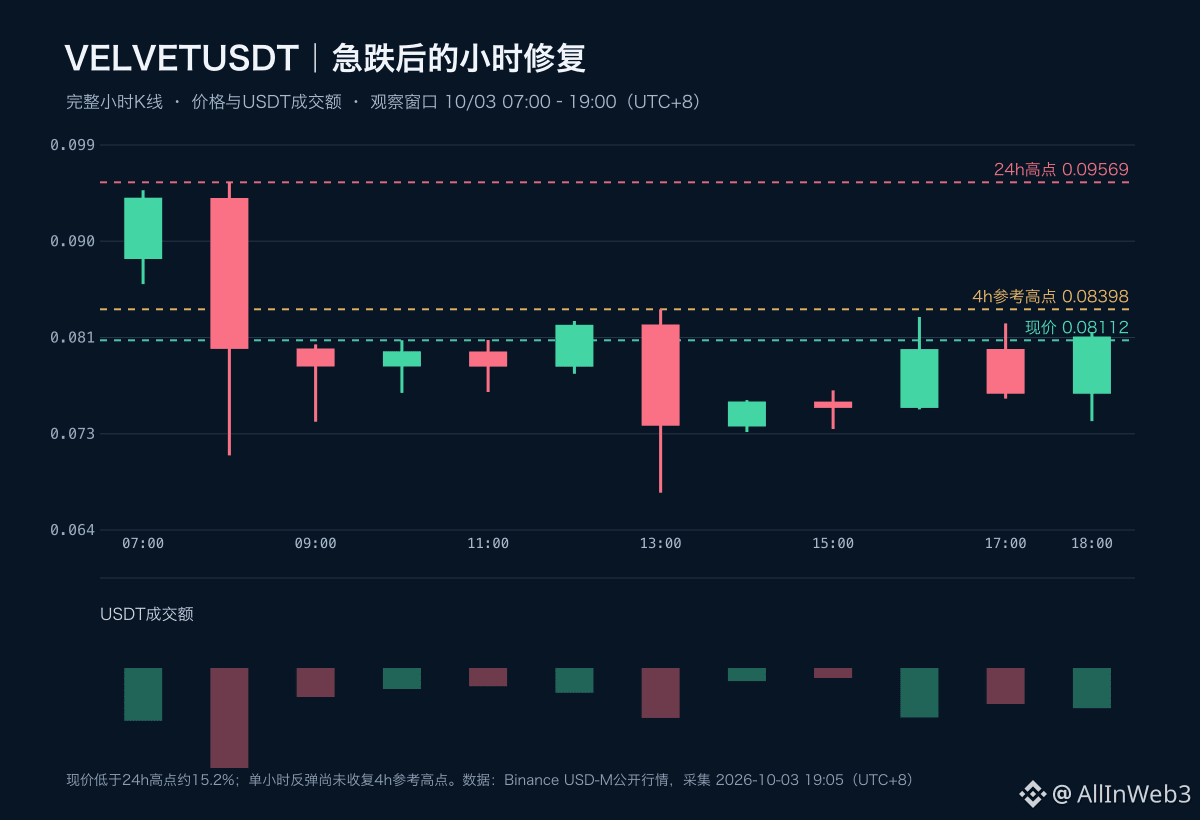
At 19:09 Beijing time on October 3, Binance completed a full scan of 526 USDT perpetual contracts within the specified range. VELVETUSDT’s rolling 24-hour gain is +27.391%, the collection price is 0.08097, ranking #2. At 19:05, the single-coin market price is about 0.08112. Both time points are roughly 15% below the 24-hour high of 0.09569.
The ranking reflects the intensity of the move, not a long signal.
Compared with the previous observation at 17:07 on this account, the incremental update lies in two newly formed complete hourly candles. From 17:00 to 18:00, it opened at 0.08032, surged to 0.08268, then pulled back to close at 0.07620, with trades of about 7.157 million USDT. From 18:00 to 19:00, it dipped to a low of 0.07367, then recovered and closed at 0.08147. Over that single hour, the price rose about 6.93% from the open, and volume was about 8.001 million USDT—roughly 11.8% more than the prior hour. This suggests dip-side bids pulled the price back, but the close still hasn’t broken above the earlier hourly high at 0.08268. A single rebound candle can’t prove that selling pressure has ended.
Positioning and funding-rate boundaries also need to be considered. Binance’s 1-hour position-size sample increased from about 79.14 million coins at 18:00 to about 81.88 million at 19:00—up about 3.47%. OI growth only indicates that open positions have expanded; it doesn’t necessarily mean net long inflows. The most recently settled funding rate is +0.006532%, while the estimated next funding rate is about +0.016903%. The estimated value will change; a positive funding rate means the long side pays the funding cost and cannot be taken as confirmation of an upside move.
Structurally: the most recent four-hour candles from 12:00 to 16:00 closed at 0.07489, with a low at 0.06707. The current 16:00 to 20:00 four-hour candle hasn’t finished yet. The latest update currently visible on the project’s official blog is product integration information dated September 29. I haven’t found a new announcement that can be verified as the direct cause of this round of volatility, and the timing sequence alone can’t establish causality.
Next, we’ll first see whether a full hourly candle can stand above 0.08268. Then we’ll observe whether the reference four-hour high near 0.08398 is reclaimed and whether pullbacks have follow-through. If it falls back below 0.07367, then this repair must be downgraded. For now, it’s more suitable to wait for confirmation rather than chase longs based on the leaderboard. After changes in price, ranking, and unsettled funding rate, the observation points above must be recalculated. The market structure and position snapshot were collected at 19:05 on October 3; the full leaderboard was rechecked at 19:09 before publication. Data comes from Binance’s publicly available USD-M API.
At 19:09 Beijing time on October 3, Binance completed a full scan of 526 USDT perpetual contracts within the specified range. VELVETUSDT’s rolling 24-hour gain is +27.391%, the collection price is 0.08097, ranking #2. At 19:05, the single-coin market price is about 0.08112. Both time points are roughly 15% below the 24-hour high of 0.09569.
The ranking reflects the intensity of the move, not a long signal.
Compared with the previous observation at 17:07 on this account, the incremental update lies in two newly formed complete hourly candles. From 17:00 to 18:00, it opened at 0.08032, surged to 0.08268, then pulled back to close at 0.07620, with trades of about 7.157 million USDT. From 18:00 to 19:00, it dipped to a low of 0.07367, then recovered and closed at 0.08147. Over that single hour, the price rose about 6.93% from the open, and volume was about 8.001 million USDT—roughly 11.8% more than the prior hour. This suggests dip-side bids pulled the price back, but the close still hasn’t broken above the earlier hourly high at 0.08268. A single rebound candle can’t prove that selling pressure has ended.
Positioning and funding-rate boundaries also need to be considered. Binance’s 1-hour position-size sample increased from about 79.14 million coins at 18:00 to about 81.88 million at 19:00—up about 3.47%. OI growth only indicates that open positions have expanded; it doesn’t necessarily mean net long inflows. The most recently settled funding rate is +0.006532%, while the estimated next funding rate is about +0.016903%. The estimated value will change; a positive funding rate means the long side pays the funding cost and cannot be taken as confirmation of an upside move.
Structurally: the most recent four-hour candles from 12:00 to 16:00 closed at 0.07489, with a low at 0.06707. The current 16:00 to 20:00 four-hour candle hasn’t finished yet. The latest update currently visible on the project’s official blog is product integration information dated September 29. I haven’t found a new announcement that can be verified as the direct cause of this round of volatility, and the timing sequence alone can’t establish causality.
Next, we’ll first see whether a full hourly candle can stand above 0.08268. Then we’ll observe whether the reference four-hour high near 0.08398 is reclaimed and whether pullbacks have follow-through. If it falls back below 0.07367, then this repair must be downgraded. For now, it’s more suitable to wait for confirmation rather than chase longs based on the leaderboard. After changes in price, ranking, and unsettled funding rate, the observation points above must be recalculated. The market structure and position snapshot were collected at 19:05 on October 3; the full leaderboard was rechecked at 19:09 before publication. Data comes from Binance’s publicly available USD-M API.