


Key Takeaways
The total stablecoin market capitalization has fallen by $14 billion since May, according to CryptoQuant analyst Darkfost.
Stablecoin supply has begun recovering since September, increasing by approximately $4 billion to around $270 billion.
The rebound suggests liquidity conditions are beginning to improve, but the recovery remains modest compared with the earlier contraction.
Darkfost said stronger stablecoin liquidity growth may be needed to provide enough capital to support Bitcoin toward new highs.
The stablecoin market is showing early signs of recovery after months of contraction, but liquidity entering the crypto market remains relatively weak, according to CryptoQuant analyst Darkfost.
Total stablecoin market capitalization has declined by approximately $14 billion since May, reflecting a significant reduction in crypto-native liquidity.
The trend has improved since September, with stablecoin market capitalization increasing by roughly $4 billion and recovering to around $270 billion.
However, Darkfost cautioned that the rebound remains relatively small and may not yet represent enough new liquidity to support a sustained Bitcoin move toward new highs.
Stablecoin Market Cap Falls $14B Since May
Stablecoin supply is closely watched as an indicator of liquidity available within the crypto ecosystem.
Unlike capital held outside the market, stablecoins can generally be deployed quickly across Bitcoin, Ethereum and other crypto assets.
A rising stablecoin market capitalization can therefore indicate that more dollar-denominated liquidity is available within crypto markets, while sustained contraction can signal capital leaving the ecosystem.
Since May, the total stablecoin market cap has contracted by $14 billion, according to Darkfost.
The decline suggests that liquidity conditions have remained relatively constrained despite periods of strength in Bitcoin and the broader crypto market.
Stablecoin Liquidity Begins Recovering
The picture has started to improve since September.
Stablecoin market capitalization has increased by approximately $4 billion, bringing the total back toward $270 billion.
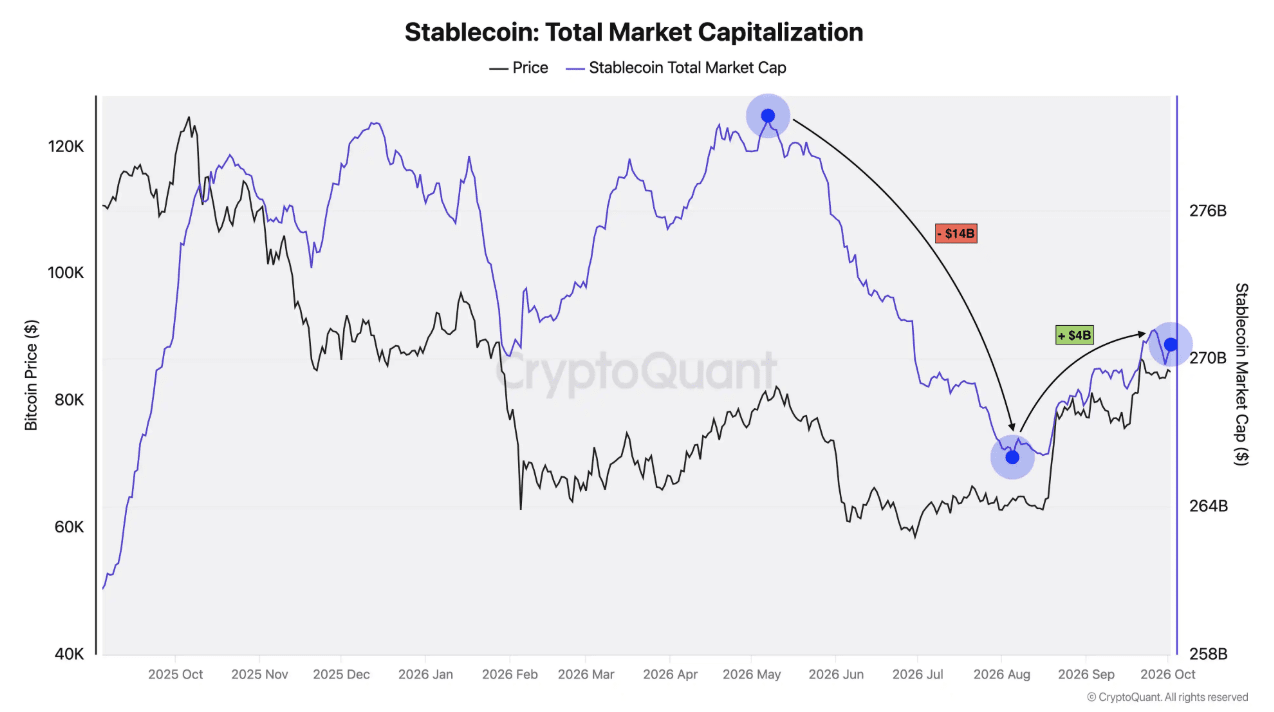
That reversal indicates that some liquidity is returning to the market after the earlier contraction.
However, the $4 billion recovery represents only part of the $14 billion decline recorded since May, leaving overall stablecoin liquidity below its previous level.
Darkfost described the improvement as insufficient to signal a decisive liquidity expansion.
Why Stablecoin Supply Matters for Bitcoin
Stablecoin liquidity can play an important role in supporting crypto market rallies because it represents capital that can potentially rotate into Bitcoin and other digital assets.
A sustained increase in stablecoin issuance and market capitalization can expand the pool of available purchasing power.
Conversely, when stablecoin supply stagnates or contracts, Bitcoin may have less fresh liquidity available to sustain increasingly higher valuations.
The current situation therefore presents a mixed signal.
The contraction in stablecoin market cap appears to be starting to reverse, but the magnitude of the recovery remains limited.
Bitcoin May Need Stronger Liquidity Growth for New Highs
Darkfost said more substantial liquidity inflows may be necessary for Bitcoin to push toward new highs.
The recent $4 billion increase provides an early indication that conditions are improving, but it has yet to offset the broader $14 billion decline since May.
A continued expansion in stablecoin supply could strengthen the liquidity backdrop for Bitcoin, particularly if the additional capital moves onto exchanges and is subsequently deployed into crypto assets.
For now, the data suggests that crypto liquidity is recovering, but not yet at the pace associated with a strong influx of fresh capital.
Whether the stablecoin market can extend its rebound beyond $270 billion could therefore become an important indicator for Bitcoin's next major move.