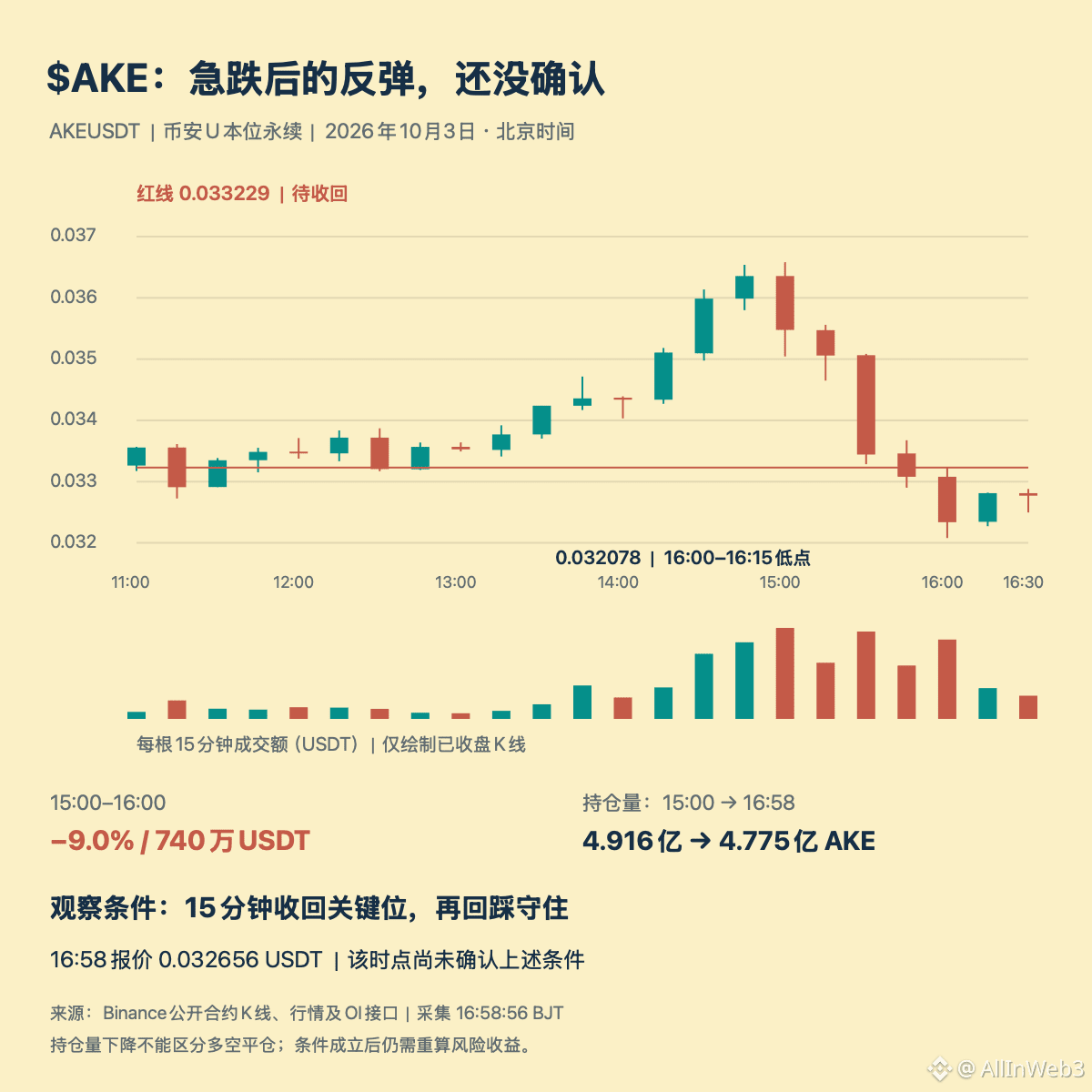
$AKE Can one go long now? My view is to wait first: after a sharp selloff, a rebound has appeared, but it hasn’t yet completed the confirmation that would justify chasing a long.
This discussion is about AKEDO’s AKEUSDT Binance USDT-margined perpetual contract. As of 16:58 Beijing time on October 3rd, the price is 0.032656 USDT, still up 4.19% over the past 24 hours; but “today’s gain is positive” and “it’s currently suitable to open longs” are two different things. At 17:00, the rechecked quote is about 0.032586, which remains below the confirmation level mentioned below.
First, let’s see where the drop happened. From 15:00 to 16:00, the full hourly candle fell from 0.036356 to 0.033079—down roughly 9.0%—with成交值 (trading value) about 7.4 million USDT, higher than the prior one-hour period of about 5 million. Then, from 16:00 to 16:15 it tested down again to 0.032078. This suggests the selloff after the rally has considerable strength, so you can’t just look at the 24-hour gain and treat the pullback as a low-entry opportunity. Also, trading value cannot directly be equated to net outflow.
Next, check whether the rebound has caught up. Two complete 15-minute candles from 16:15 to 16:30 and from 16:30 to 16:45 show trading values of about 790k and 600k USDT respectively—both below the approximately 2.04 million USDT during the 16:00 to 16:15 decline. The price leaving the low point indicates there is some support/absorption; however, rebound trading volume is decreasing, which is still insufficient to prove that active buying has regained control. Unclosed candles aren’t used to confirm a breakout, and there’s no evidence to attribute this rebound to any new positive catalyst.
Positioning also requires restraint in interpretation. Open interest fell from about 4.91600亿 AKE at 15:00 to about 4.77500亿 AKE at 16:58—a reduction of roughly 2.9%. The price pullback accompanied by declining open interest is compatible with some positions being exited; it doesn’t tell us whether longs are cutting losses, shorts are taking profit, or both occurring together—and it certainly can’t be used to conclude “the shakeout is over.”
I will first observe 0.033229: this is the high of the 16:00–16:15 bearish hourly segment candle. If, after that, there are complete 15-minute candles that close above it, and then later a pullback holds it, forming higher lows, along with成交 at comparable-length window, only then is it worth reassessing the long idea. One needle-like poke up isn’t enough; currently these conditions haven’t all happened at the same time.
For the upside, first look at the already-traded 0.033675–0.03387 zone. On the downside, watch 0.032078. If the low is broken and cannot be reclaimed, this rebound-observation logic fails. Even if the confirmation level is recovered, you still need to set the invalidation price based on the actual pullback low; use the first resistance to estimate potential space. After subtracting fees and expected slippage, if it doesn’t reach at least a 2:1 reward-to-risk, then give up—don’t move the target further just to justify opening a trade.
So the current conclusion is: don’t chase longs yet—wait for confirmation and then recalculate. The levels above come from this market snapshot; they are not permanent pending-order instructions. After the quote and structure change, the assessment must be redone.
Source: Binance’s公开合约 K-line, 24-hour market data, and open interest data. The chart imagery uses only candles that had already closed at the time of collection.
This discussion is about AKEDO’s AKEUSDT Binance USDT-margined perpetual contract. As of 16:58 Beijing time on October 3rd, the price is 0.032656 USDT, still up 4.19% over the past 24 hours; but “today’s gain is positive” and “it’s currently suitable to open longs” are two different things. At 17:00, the rechecked quote is about 0.032586, which remains below the confirmation level mentioned below.
First, let’s see where the drop happened. From 15:00 to 16:00, the full hourly candle fell from 0.036356 to 0.033079—down roughly 9.0%—with成交值 (trading value) about 7.4 million USDT, higher than the prior one-hour period of about 5 million. Then, from 16:00 to 16:15 it tested down again to 0.032078. This suggests the selloff after the rally has considerable strength, so you can’t just look at the 24-hour gain and treat the pullback as a low-entry opportunity. Also, trading value cannot directly be equated to net outflow.
Next, check whether the rebound has caught up. Two complete 15-minute candles from 16:15 to 16:30 and from 16:30 to 16:45 show trading values of about 790k and 600k USDT respectively—both below the approximately 2.04 million USDT during the 16:00 to 16:15 decline. The price leaving the low point indicates there is some support/absorption; however, rebound trading volume is decreasing, which is still insufficient to prove that active buying has regained control. Unclosed candles aren’t used to confirm a breakout, and there’s no evidence to attribute this rebound to any new positive catalyst.
Positioning also requires restraint in interpretation. Open interest fell from about 4.91600亿 AKE at 15:00 to about 4.77500亿 AKE at 16:58—a reduction of roughly 2.9%. The price pullback accompanied by declining open interest is compatible with some positions being exited; it doesn’t tell us whether longs are cutting losses, shorts are taking profit, or both occurring together—and it certainly can’t be used to conclude “the shakeout is over.”
I will first observe 0.033229: this is the high of the 16:00–16:15 bearish hourly segment candle. If, after that, there are complete 15-minute candles that close above it, and then later a pullback holds it, forming higher lows, along with成交 at comparable-length window, only then is it worth reassessing the long idea. One needle-like poke up isn’t enough; currently these conditions haven’t all happened at the same time.
For the upside, first look at the already-traded 0.033675–0.03387 zone. On the downside, watch 0.032078. If the low is broken and cannot be reclaimed, this rebound-observation logic fails. Even if the confirmation level is recovered, you still need to set the invalidation price based on the actual pullback low; use the first resistance to estimate potential space. After subtracting fees and expected slippage, if it doesn’t reach at least a 2:1 reward-to-risk, then give up—don’t move the target further just to justify opening a trade.
So the current conclusion is: don’t chase longs yet—wait for confirmation and then recalculate. The levels above come from this market snapshot; they are not permanent pending-order instructions. After the quote and structure change, the assessment must be redone.
Source: Binance’s公开合约 K-line, 24-hour market data, and open interest data. The chart imagery uses only candles that had already closed at the time of collection.