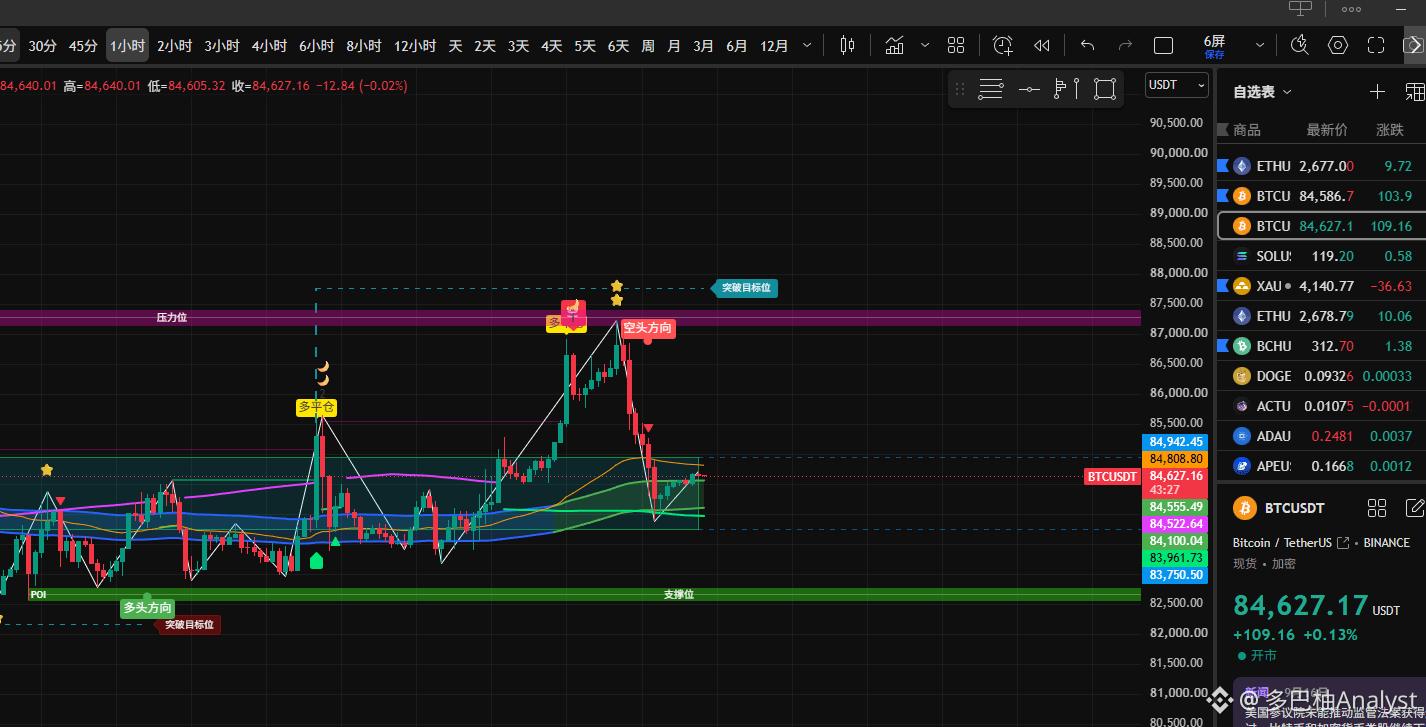
After the weak Non-Farm Payrolls, a BTC spike and pullback is more worth watching
With the Non-Farm data leaning weak, BTC first surged higher, then quickly pulled back.
When many people see this move, their first reaction is: since the data is supposedly more favorable to expectations of looser policy, why didn’t the price keep going up?
But what the market truly trades is never just whether the data is “good” or “bad.” It’s whether, after the good news comes in, there is enough support to absorb selling at higher levels.
This time, the Non-Farm payroll increase was only 29,000, below the market’s prior expectation of about 90,000; the unemployment rate rose to 4.2%, and wages rose only 0.1% month-over-month. From a macro perspective, the data does indeed reduce pressure for further tightening.
However, after BTC surged to around 87,000, it failed to hold. That suggests that the buying pressure driven by the news met real sell-off pressure at higher levels.
We can also see this contradiction on the derivatives side: when the price rebounded previously, open interest and the funding rate rose in tandem, indicating that new leverage had re-entered. The data gave sentiment a reason to move upward—but the speed at which leverage returned also made the high-level area more sensitive to pullbacks.
So now it’s not enough to ask only: “Is the Non-Farm data good for BTC?”
Above at 85,100 is the first test of whether BTC can regain control after the spike-and-pullback. Below at 83,500 is the key to whether the pullback is being absorbed. If 83,500 breaks and cannot be reclaimed, the market will continue to test the area around 82,800.
News provides volatility—the positions where price actually holds are the real answer.
If you have different views, feel free to discuss in the comments.
Follow the homepage.
#BTC #非农数据 #加密市场 $BTC
With the Non-Farm data leaning weak, BTC first surged higher, then quickly pulled back.
When many people see this move, their first reaction is: since the data is supposedly more favorable to expectations of looser policy, why didn’t the price keep going up?
But what the market truly trades is never just whether the data is “good” or “bad.” It’s whether, after the good news comes in, there is enough support to absorb selling at higher levels.
This time, the Non-Farm payroll increase was only 29,000, below the market’s prior expectation of about 90,000; the unemployment rate rose to 4.2%, and wages rose only 0.1% month-over-month. From a macro perspective, the data does indeed reduce pressure for further tightening.
However, after BTC surged to around 87,000, it failed to hold. That suggests that the buying pressure driven by the news met real sell-off pressure at higher levels.
We can also see this contradiction on the derivatives side: when the price rebounded previously, open interest and the funding rate rose in tandem, indicating that new leverage had re-entered. The data gave sentiment a reason to move upward—but the speed at which leverage returned also made the high-level area more sensitive to pullbacks.
So now it’s not enough to ask only: “Is the Non-Farm data good for BTC?”
Above at 85,100 is the first test of whether BTC can regain control after the spike-and-pullback. Below at 83,500 is the key to whether the pullback is being absorbed. If 83,500 breaks and cannot be reclaimed, the market will continue to test the area around 82,800.
News provides volatility—the positions where price actually holds are the real answer.
If you have different views, feel free to discuss in the comments.
Follow the homepage.
#BTC #非农数据 #加密市场 $BTC