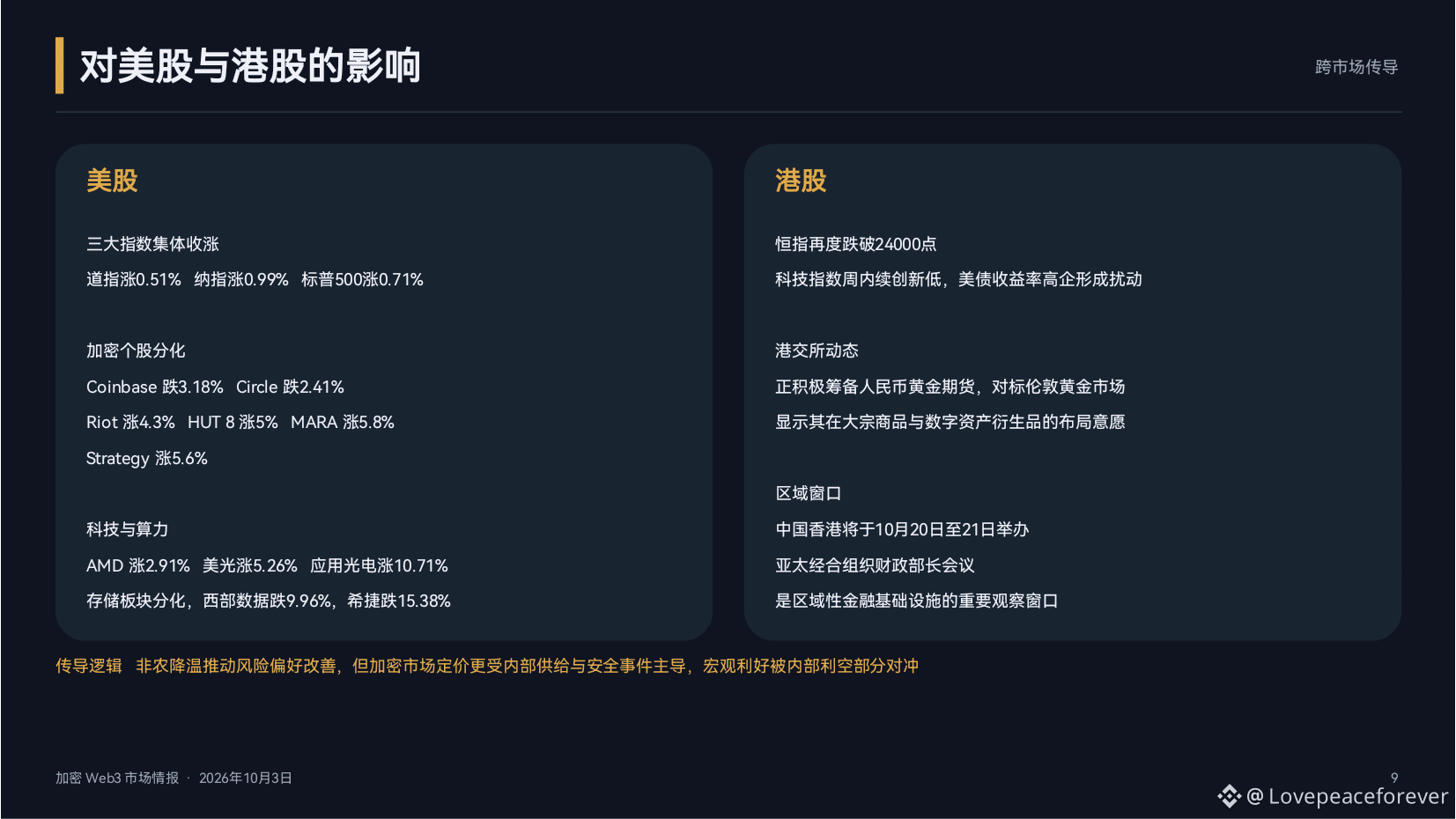
The current market is in a phase where macro conditions are warming while internal forces are still contracting. The U.S. nonfarm payrolls in September came in far below expectations, lowering the probability of a Fed rate hike in October to 17%. Risk appetite improved, providing support for risk assets. However, BTC failed to hold above $87,000 and instead slipped to around $84,000, indicating that the key variables for the crypto market at this time are internal supply and safety-related incidents.
Structurally, funds show a clear contraction-style rotation. The AI identity race (WLD) and the DeFi governance narrative (AAVE) have attracted funds against the trend, while Memes ($PUMP ), AI compute (TAO), and public chains (SUI, LINK) are seeing synchronized outflows. Funds are rotating from higher-beta sectors toward mainstream protocols with clear catalysts, rather than rising across the board.
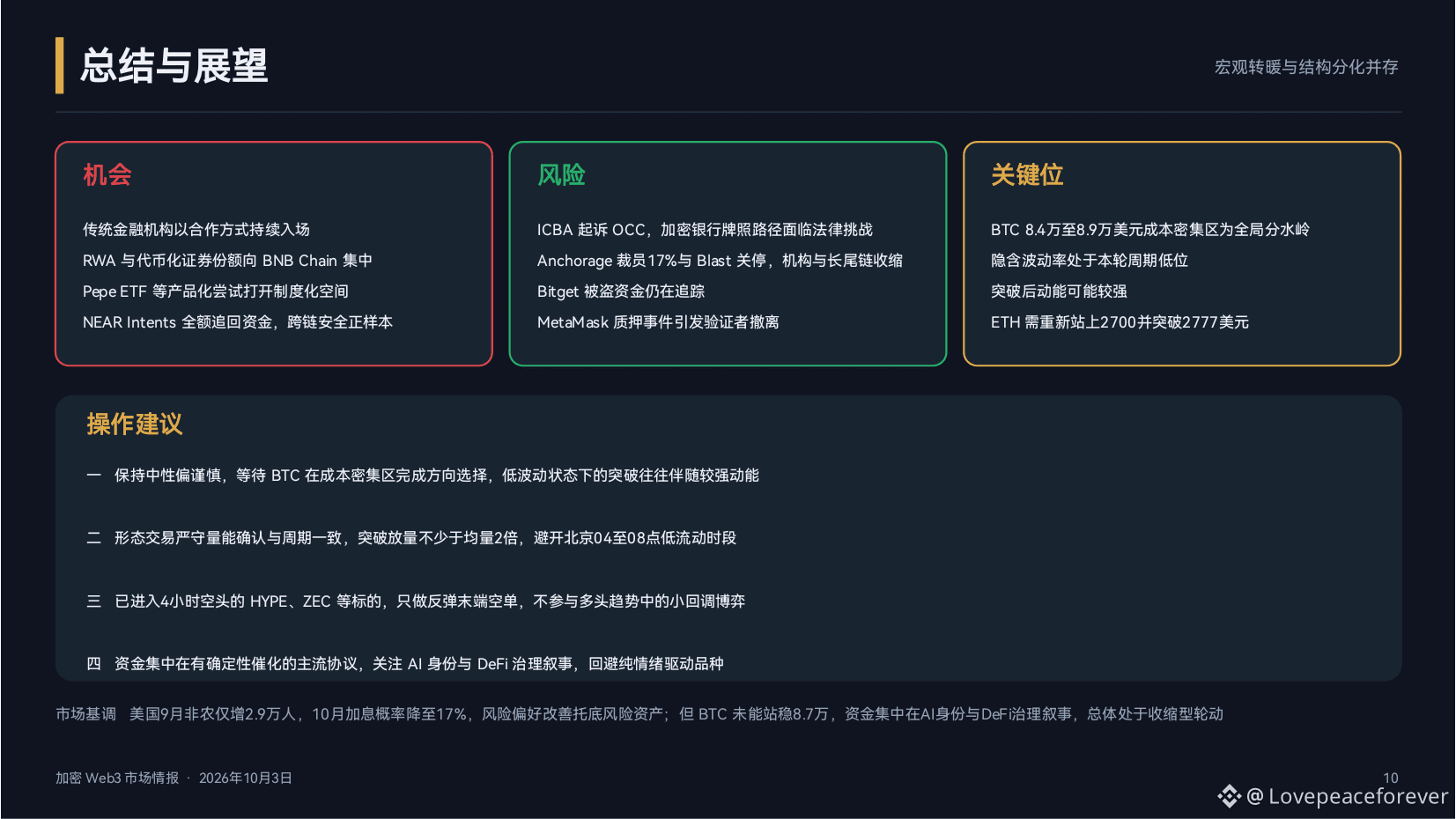
Key risks are concentrated in three areas. First is regulatory turbulence: ICBA’s lawsuit against the OCC creates legal challenges for the path crypto firms use to obtain banking licenses. Second is institutional retrenchment: Anchorage Digital’s 17% layoffs and Blast’s shutdown indicate that bear-market cost pressure is being transmitted to regulated institutions and long-tail chains. Third is lingering aftermath from security incidents: stolen funds from Bitget are still being tracked, and MetaMask’s staking-related incident has triggered validator exits.
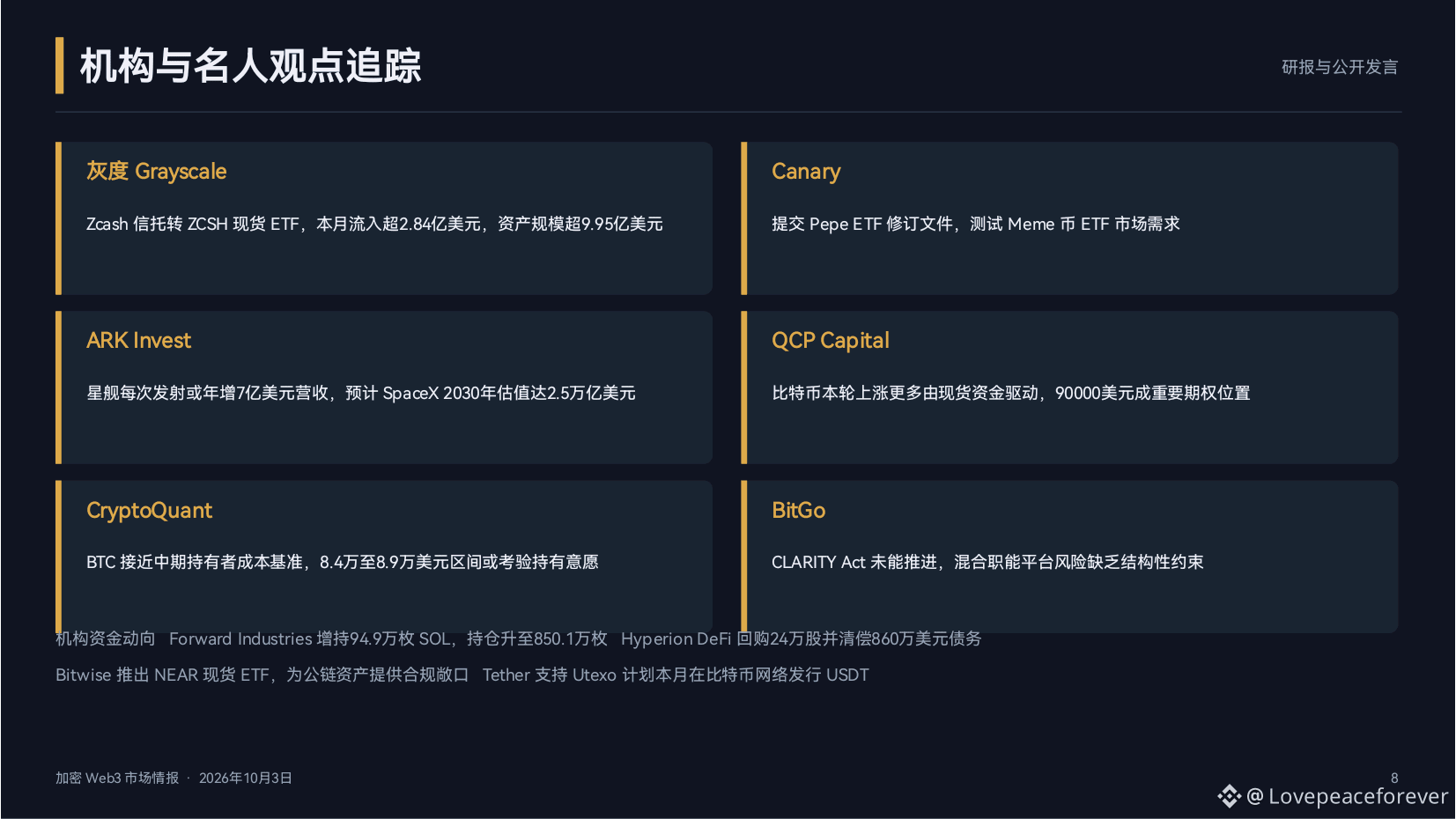
The opportunities are also clear. Traditional financial institutions continue to enter through partnerships (Bank of New York Mellon and Payward). RWA and tokenized security allocations are concentrating on BNB Chain. Productized attempts—such as $PEPE ETFs—are opening up institutionalized space for Meme coins. The full recovery of funds by $NEAR Intents provides a positive example for cross-chain security.
At the execution level, it’s advisable to stay neutral with a cautious bias. BTC’s directional decision within the cost-dense zone of $84,000 to $89,000 is crucial to the broader picture. Low implied volatility suggests that post-breakout momentum could be strong. For pattern-based trading, strictly follow the principle that volume/energy confirmation must align with the time cycle, and avoid low-liquidity periods between 04:00 and 08:00 Beijing time. For assets already in a 4-hour short-side structure—such as HYPE and ZEC—only consider short opportunities at the late stage of a rebound, and do not engage in small pullback gambling within a long trend.
Structurally, funds show a clear contraction-style rotation. The AI identity race (WLD) and the DeFi governance narrative (AAVE) have attracted funds against the trend, while Memes ($PUMP ), AI compute (TAO), and public chains (SUI, LINK) are seeing synchronized outflows. Funds are rotating from higher-beta sectors toward mainstream protocols with clear catalysts, rather than rising across the board.
Key risks are concentrated in three areas. First is regulatory turbulence: ICBA’s lawsuit against the OCC creates legal challenges for the path crypto firms use to obtain banking licenses. Second is institutional retrenchment: Anchorage Digital’s 17% layoffs and Blast’s shutdown indicate that bear-market cost pressure is being transmitted to regulated institutions and long-tail chains. Third is lingering aftermath from security incidents: stolen funds from Bitget are still being tracked, and MetaMask’s staking-related incident has triggered validator exits.
The opportunities are also clear. Traditional financial institutions continue to enter through partnerships (Bank of New York Mellon and Payward). RWA and tokenized security allocations are concentrating on BNB Chain. Productized attempts—such as $PEPE ETFs—are opening up institutionalized space for Meme coins. The full recovery of funds by $NEAR Intents provides a positive example for cross-chain security.
At the execution level, it’s advisable to stay neutral with a cautious bias. BTC’s directional decision within the cost-dense zone of $84,000 to $89,000 is crucial to the broader picture. Low implied volatility suggests that post-breakout momentum could be strong. For pattern-based trading, strictly follow the principle that volume/energy confirmation must align with the time cycle, and avoid low-liquidity periods between 04:00 and 08:00 Beijing time. For assets already in a 4-hour short-side structure—such as HYPE and ZEC—only consider short opportunities at the late stage of a rebound, and do not engage in small pullback gambling within a long trend.