#美国9月非农仅增2.9万人失业率升至4.2%
Most people look at stablecoins and focus on how much the market cap has risen, or whether a new gimmick has emerged.. But researchers at the San Francisco Fed are looking at a different number—the list of buyers of U.S. Treasuries, and the people on it are changing..
📢 进群蹲一手消息
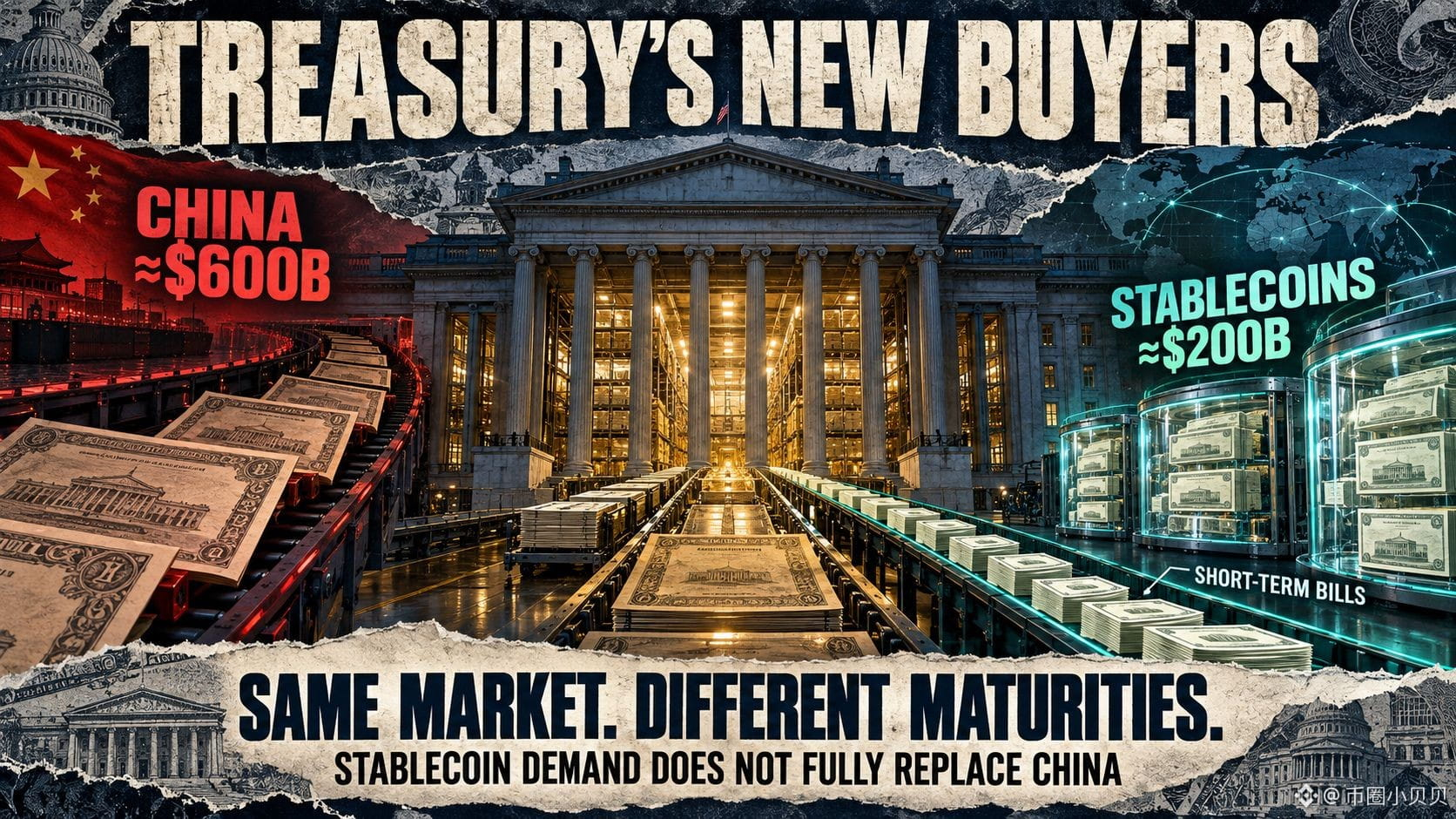
This week, the Federal Reserve Bank of San Francisco issued a research report that brings together something that usually isn’t put in the same box: stablecoin issuers are becoming an increasingly important buyer of U.S. Treasuries.. Over the past five years, Tether and Circle, combined, increased their holdings of U.S. Treasuries plus repurchase agreements by a total of roughly $200 billion—equivalent to more than 40% of the scale of China’s reduction in its holdings of U.S. debt over the same period..
The real change is structural. The share of U.S. Treasuries held by foreign official institutions has fallen—from more than half around 2008 to about 30% at the start of 2026; China’s holdings peaked at the end of 2013 and by mid-2026 have been cut by more than half. As these central bank buyers exit, the main replacement comes from private capital—one that is far more sensitive to interest rates and to fiscal risk than central banks..
Stablecoin business models determine that they can only operate this way. Users can redeem at any time, so issuers must keep large amounts of dollar-denominated assets on hand that can be converted immediately; short-dated Treasuries and repo arrangements fit perfectly.. So starting in 2023, stablecoin issuers have been increasing their holdings of short-term U.S. Treasuries—more than Japan, the largest overseas holder. The San Francisco Fed also cites research from the Bank for International Settlements, saying that this scale is already enough to have a noticeable impact on yields at the short end of the curve..
The significance of this isn’t confined to the crypto world. Who the U.S. relies on to buy its debt, and at what cost it issues that debt, is a real, concrete issue. If the buyer base shifts from central banks that “don’t care too much about the price” to private institutions that “will demand higher yields at any moment,” the elasticity of financing costs changes..
But the reversal is right here as well. Stablecoins can’t fill the gap left by China—most of what China sells is long-dated debt, while what stablecoins mostly buy is short-term Treasury bills. They aren’t in the same market. Someone is taking the short end, but the long end is still hanging in the air. What’s truly worth watching is this: if stablecoins continue to expand, will they be implicitly allowed to absorb even more long-dated U.S. Treasuries.. That’s the next step in how this narrative plays out..
Most people look at stablecoins and focus on how much the market cap has risen, or whether a new gimmick has emerged.. But researchers at the San Francisco Fed are looking at a different number—the list of buyers of U.S. Treasuries, and the people on it are changing..
📢 进群蹲一手消息
This week, the Federal Reserve Bank of San Francisco issued a research report that brings together something that usually isn’t put in the same box: stablecoin issuers are becoming an increasingly important buyer of U.S. Treasuries.. Over the past five years, Tether and Circle, combined, increased their holdings of U.S. Treasuries plus repurchase agreements by a total of roughly $200 billion—equivalent to more than 40% of the scale of China’s reduction in its holdings of U.S. debt over the same period..
The real change is structural. The share of U.S. Treasuries held by foreign official institutions has fallen—from more than half around 2008 to about 30% at the start of 2026; China’s holdings peaked at the end of 2013 and by mid-2026 have been cut by more than half. As these central bank buyers exit, the main replacement comes from private capital—one that is far more sensitive to interest rates and to fiscal risk than central banks..
Stablecoin business models determine that they can only operate this way. Users can redeem at any time, so issuers must keep large amounts of dollar-denominated assets on hand that can be converted immediately; short-dated Treasuries and repo arrangements fit perfectly.. So starting in 2023, stablecoin issuers have been increasing their holdings of short-term U.S. Treasuries—more than Japan, the largest overseas holder. The San Francisco Fed also cites research from the Bank for International Settlements, saying that this scale is already enough to have a noticeable impact on yields at the short end of the curve..
The significance of this isn’t confined to the crypto world. Who the U.S. relies on to buy its debt, and at what cost it issues that debt, is a real, concrete issue. If the buyer base shifts from central banks that “don’t care too much about the price” to private institutions that “will demand higher yields at any moment,” the elasticity of financing costs changes..
But the reversal is right here as well. Stablecoins can’t fill the gap left by China—most of what China sells is long-dated debt, while what stablecoins mostly buy is short-term Treasury bills. They aren’t in the same market. Someone is taking the short end, but the long end is still hanging in the air. What’s truly worth watching is this: if stablecoins continue to expand, will they be implicitly allowed to absorb even more long-dated U.S. Treasuries.. That’s the next step in how this narrative plays out..