

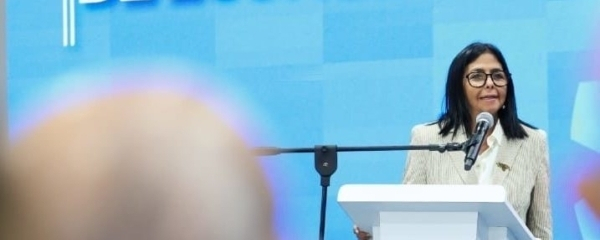

The acting president offered the statements during the National Council on Economics that takes place this Friday, October 2, together with the opening of the Meeting with the IDB Group, an event that brings together government authorities, representatives of the private sector, and the national banking sector with representatives of the international organization.
The acting president of Venezuela, Delcy Rodríguez, said this Friday that the country can already access spare parts and technology to restore the National Electric System (SEN), after denouncing for years a “blockade” that did not allow the purchase of key parts, which, according to this version, caused the country’s energy crisis.
“We are in a process of recovery of the national electric system, under very different conditions, because now we can access spare-part suppliers, technology, that will allow us to recover the electric system, consolidate it,” Rodríguez said during a session of the National Council of Economics, broadcast by the state-run channel Venezolana de Televisión.
Venezuela experiences daily failures in the supply of electricity, especially in regions far from Caracas, which the Government has blamed in the past on the opposition, despite the fact that military personnel oversee facilities in the sector.
The Minister of Electric Energy, Rolando Alcalá, reported on Tuesday about a plan that is under way to add 1,300 megawatts of power to the electric system during the last quarter of the year, in order to stabilize the crisis and reduce the power outages that have intensified in recent weeks.
In the “coming days,” a unit at the Centro plant will begin operating—the main energy-generation complex for Venezuela’s center-west region—which will provide 600 megawatts to this region. In addition, “seven units” with 500 megawatts each will be added for the Zulia state (northwest), the most affected by the failures, Alcalá explained.
The minister said at the time that energy demand has grown in recent weeks driven by the “upswing in economic activity,” the high temperatures caused by the El Niño climate phenomenon, and by the June earthquakes, which, he said, delayed the plans that had been underway to repair the electric system, which has been in crisis for more than a decade.
These arguments have been used by the Government to justify power outages in Venezuela, as well as foreign sanctions that prevented the purchase of spare parts for the system, although the opposition and experts argue that the crisis is the result of corruption and lack of maintenance.
In the past few days, protests have been recorded nearly daily in several regions of Venezuela due to power cuts lasting up to 16 hours.
Meeting with the BID Group
Rodríguez made the remarks during his participation in the National Council of Economics, which takes place this Friday, October 2, together with the opening of the Meeting with the BID Group, an event that brings together government authorities, representatives from the private sector and the national banking sector, along with representatives of the international organization.
The event includes the presence of a BID Invest delegation, led by its CEO, James Scriven, along with executives from the financial and infrastructure sectors, and from the bank’s regional representation.
This institutional space provides follow-up on the reactivation of the BID Group’s office in Caracas, through which a joint work agenda will be established for access to technical assistance, financing, and investment in the country.
During this event, financing mechanisms for the productive sector are addressed, as well as the assessment of projects in strategic areas such as infrastructure, energy, agribusiness, tourism, manufacturing, and the digital economy.
The work agenda also includes the design of financial instruments tailored to small and medium-sized enterprises, optimizing the business environment, and coordinating between Venezuelan banks and multilateral institutions.
#venezuela #DelcyRodriguez #ElectricRevolution #Maracaibo #Inversiones $CL $NMR