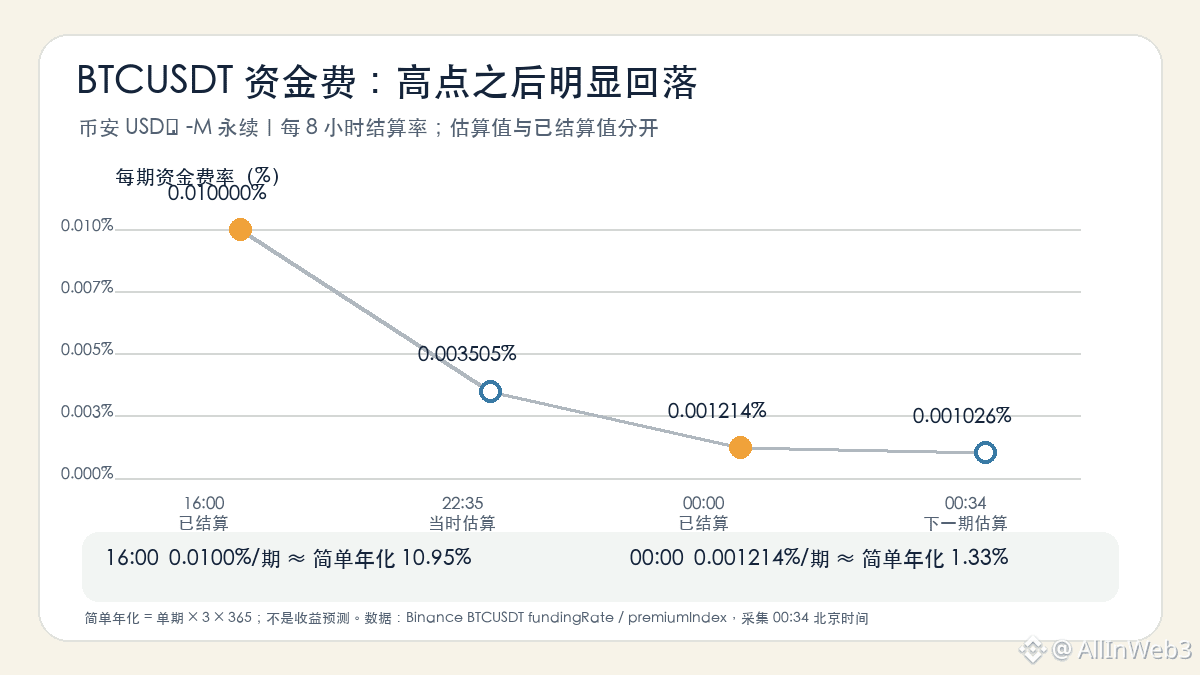
BTC perpetual futures “funding rate rises to 10%”: to make sense of this hot-topic claim, you first need to break the “10%” figure’s time period apart. The previous post was published at 22:42, quoting Binance USDT perpetual contract data: at 16:00, settlement for each 8-hour period was +0.0100%. Using a simple annualization based on 3 times/day and 365 days gives roughly 10.95% per year. The next period estimate at 22:35 had already dropped to +0.003505% per period. This 10.95% is a linear conversion—not the per-period funding rate, nor a realizable return.
The new change occurred after that. Binance BTCUSDT actually settled in Beijing time at 00:00 as +0.001214% per 8 hours. The next period estimate read at 00:34 was +0.001026% per 8 hours; simple annualized, that’s about 1.33% and 1.12%, respectively. For the same contract, settlement from 16:00 to midnight clearly fell, but the estimate value would continue to change; settled history and unsettled estimates cannot be mixed into a single “current funding rate.” When the funding rate is positive, it usually means longs pay shorts; the specifics depend on that contract’s rules and settlement.
Price boundaries were also given: after the previous post, the four complete hourly closes at 20:00, 21:00, 22:00, and 23:00 were 86,768.8, 86,524.3, 85,644.8, and 85,297.4 US dollars, respectively. At 00:34, the BTCUSDT rolling spot price was 85,167.3 US dollars, with a 24-hour change of +0.845%. The hot-list claim “above 86.0k, up 2.99%” is no longer the current state. Downward closes coinciding with a funding-rate drop suggest that during this period the payment pressure from long positions to shorts eased—but it does not prove longs exited or that the price has already bottomed.
“Open interest rising” also has to be checked by definition. At 00:34, the Binance BTCUSDT single-contract open position count was 95,891.074 BTC, but this time the hourly history interface that can be verified did not return a valid sequence. A single data point cannot prove that positions have been continuously increasing, nor can it replace cross-exchange total volumes. Next steps should wait for the 02:00 funding-rate settlement, complete-hour closes, and an OI series using the same definition—then evaluate whether the change persists. If the estimated funding rate rises again while closes continue to fall, only then is the crowded-risk scenario worth re-assessing. The above is an observation of perpetual mechanisms and data conventions, and it does not constitute investment advice.
The new change occurred after that. Binance BTCUSDT actually settled in Beijing time at 00:00 as +0.001214% per 8 hours. The next period estimate read at 00:34 was +0.001026% per 8 hours; simple annualized, that’s about 1.33% and 1.12%, respectively. For the same contract, settlement from 16:00 to midnight clearly fell, but the estimate value would continue to change; settled history and unsettled estimates cannot be mixed into a single “current funding rate.” When the funding rate is positive, it usually means longs pay shorts; the specifics depend on that contract’s rules and settlement.
Price boundaries were also given: after the previous post, the four complete hourly closes at 20:00, 21:00, 22:00, and 23:00 were 86,768.8, 86,524.3, 85,644.8, and 85,297.4 US dollars, respectively. At 00:34, the BTCUSDT rolling spot price was 85,167.3 US dollars, with a 24-hour change of +0.845%. The hot-list claim “above 86.0k, up 2.99%” is no longer the current state. Downward closes coinciding with a funding-rate drop suggest that during this period the payment pressure from long positions to shorts eased—but it does not prove longs exited or that the price has already bottomed.
“Open interest rising” also has to be checked by definition. At 00:34, the Binance BTCUSDT single-contract open position count was 95,891.074 BTC, but this time the hourly history interface that can be verified did not return a valid sequence. A single data point cannot prove that positions have been continuously increasing, nor can it replace cross-exchange total volumes. Next steps should wait for the 02:00 funding-rate settlement, complete-hour closes, and an OI series using the same definition—then evaluate whether the change persists. If the estimated funding rate rises again while closes continue to fall, only then is the crowded-risk scenario worth re-assessing. The above is an observation of perpetual mechanisms and data conventions, and it does not constitute investment advice.