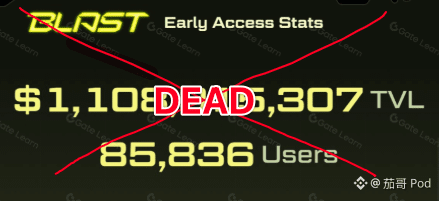

This city is going dark: Blast announces it will stop operating, and you only have a 24-day window to escape—withdraw your assets now!
On October 2, the Layer 2 network Blast announced it will cease operations.
There was no hack, no vulnerability—the cause of death is an unbalanced equation: the ongoing costs required to keep the network running have already exceeded the revenue generated by L2. The team admits: there is no credible path that would allow it to remain economically sustainable.
There is no survivor’s plan—only an evacuation notice.
Blast recommends that all users withdraw their on-chain assets and their balances in the Blast PWA back to the Ethereum mainnet. The withdrawal waiting period will be shortened to 24 hours. But the evacuation will not begin immediately: the team will first handle the exit of the Lido assets held by Blast, which is expected to take about a week. During this week, the withdrawal function will be temporarily unavailable. You press the button, and all you get on the other side is four words: temporarily unavailable.
On October 26, it is the last day of the regular withdrawal channel. Before then, you can complete withdrawals through Blast’s regular interface. After that, your assets can still be retrieved—but the interface is gone, and customer support is gone too. You’ll need to interact directly with the Blast Bridge contract on Ethereum L1 and complete the final step against cold, unfeeling code. Instructions for how to operate will be published before the deadline.
Lights go out one by one, and the code won’t disappear. Your assets won’t disappear either—but they will remain forever in a network that has already died, waiting for a response that will never come.
On October 2, the Layer 2 network Blast announced it will cease operations.
There was no hack, no vulnerability—the cause of death is an unbalanced equation: the ongoing costs required to keep the network running have already exceeded the revenue generated by L2. The team admits: there is no credible path that would allow it to remain economically sustainable.
There is no survivor’s plan—only an evacuation notice.
Blast recommends that all users withdraw their on-chain assets and their balances in the Blast PWA back to the Ethereum mainnet. The withdrawal waiting period will be shortened to 24 hours. But the evacuation will not begin immediately: the team will first handle the exit of the Lido assets held by Blast, which is expected to take about a week. During this week, the withdrawal function will be temporarily unavailable. You press the button, and all you get on the other side is four words: temporarily unavailable.
On October 26, it is the last day of the regular withdrawal channel. Before then, you can complete withdrawals through Blast’s regular interface. After that, your assets can still be retrieved—but the interface is gone, and customer support is gone too. You’ll need to interact directly with the Blast Bridge contract on Ethereum L1 and complete the final step against cold, unfeeling code. Instructions for how to operate will be published before the deadline.
Lights go out one by one, and the code won’t disappear. Your assets won’t disappear either—but they will remain forever in a network that has already died, waiting for a response that will never come.