BTC single funding rate 0.01%, why does the annualized figure become 10.95%?
When you see “funding rate 10%,” first confirm whether it refers to a single settlement interval or an annualized metric. The difference is huge.
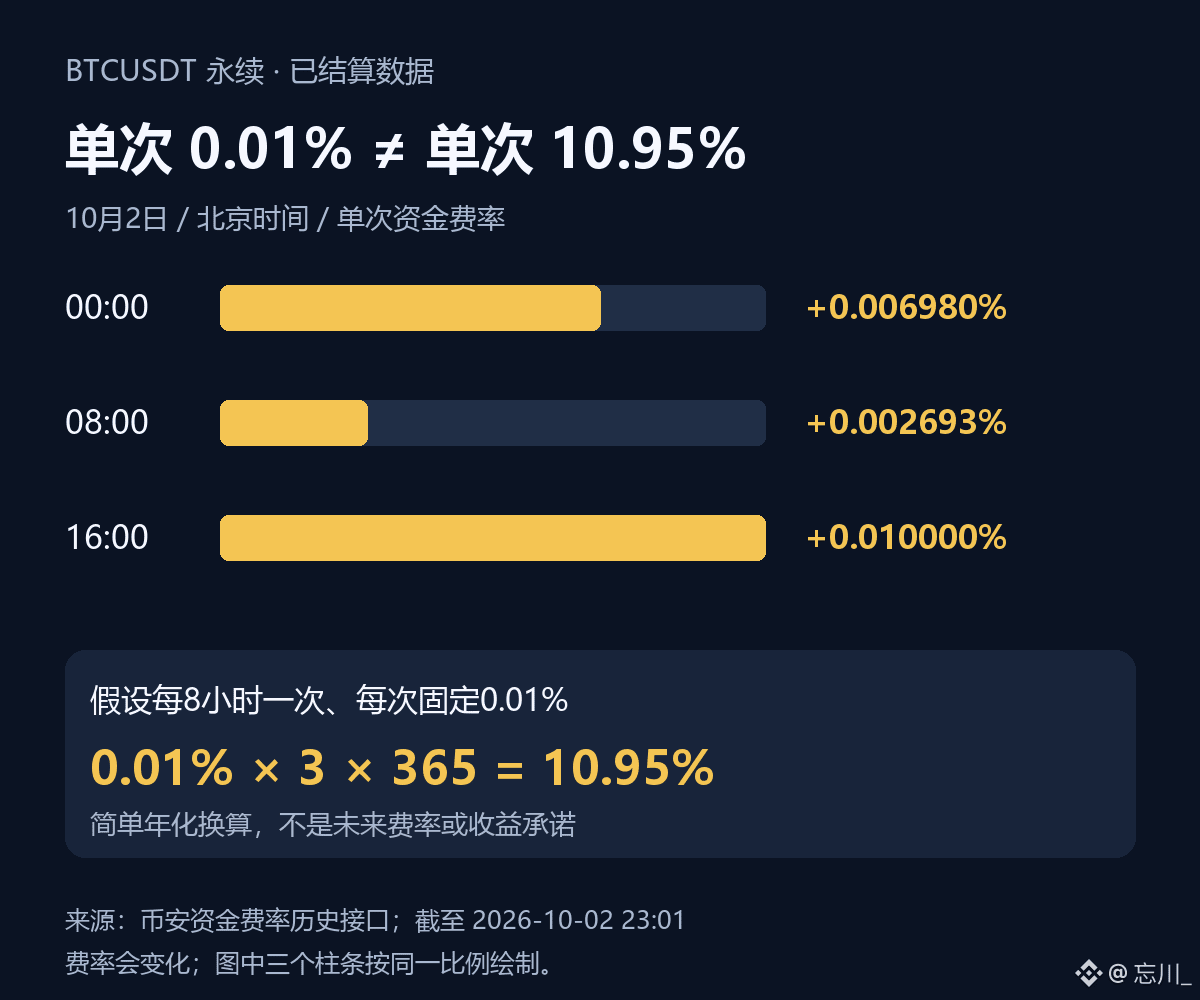
I checked the actual settlement records for Binance’s BTCUSDT perpetual contract. On October 2 (Beijing time):
00:00: +0.006980%
08:00: +0.002693%
16:00: +0.010000%
For the most recent one, assume you hold a position with a notional value of 10,000 USDT at the time of settlement. Based on 0.01%, the funding fee would be about 1 USDT. With a positive rate, the long side pays the short side.
If we assume settlement happens once every 8 hours, and each time the rate stays at 0.01%, then simple annualization is:
0.01% × 3 × 365 = 10.95%。
This is a conversion under the fixed-fee-rate assumption—not the next actual funding rate, and not a promise of annual returns. The three records above already show that the rate changes.
Funding fees are calculated based on the position’s notional value, not just the margin alone. To judge your holding costs, first look at the current settlement rate, the settlement interval, and the position’s notional value—don’t treat the annualized number as the proportion for a single fee deduction.
$BTC #资金费率 #Trading Knowledge
Data as of 23:01 on October 2 (Beijing time). Source: Binance BTCUSDT funding rate history API. Calculation rules: Binance 《Introduction to Contract Funding Rates》. The figures in the image are already settled data, not future projections.
When you see “funding rate 10%,” first confirm whether it refers to a single settlement interval or an annualized metric. The difference is huge.
I checked the actual settlement records for Binance’s BTCUSDT perpetual contract. On October 2 (Beijing time):
00:00: +0.006980%
08:00: +0.002693%
16:00: +0.010000%
For the most recent one, assume you hold a position with a notional value of 10,000 USDT at the time of settlement. Based on 0.01%, the funding fee would be about 1 USDT. With a positive rate, the long side pays the short side.
If we assume settlement happens once every 8 hours, and each time the rate stays at 0.01%, then simple annualization is:
0.01% × 3 × 365 = 10.95%。
This is a conversion under the fixed-fee-rate assumption—not the next actual funding rate, and not a promise of annual returns. The three records above already show that the rate changes.
Funding fees are calculated based on the position’s notional value, not just the margin alone. To judge your holding costs, first look at the current settlement rate, the settlement interval, and the position’s notional value—don’t treat the annualized number as the proportion for a single fee deduction.
$BTC #资金费率 #Trading Knowledge
Data as of 23:01 on October 2 (Beijing time). Source: Binance BTCUSDT funding rate history API. Calculation rules: Binance 《Introduction to Contract Funding Rates》. The figures in the image are already settled data, not future projections.