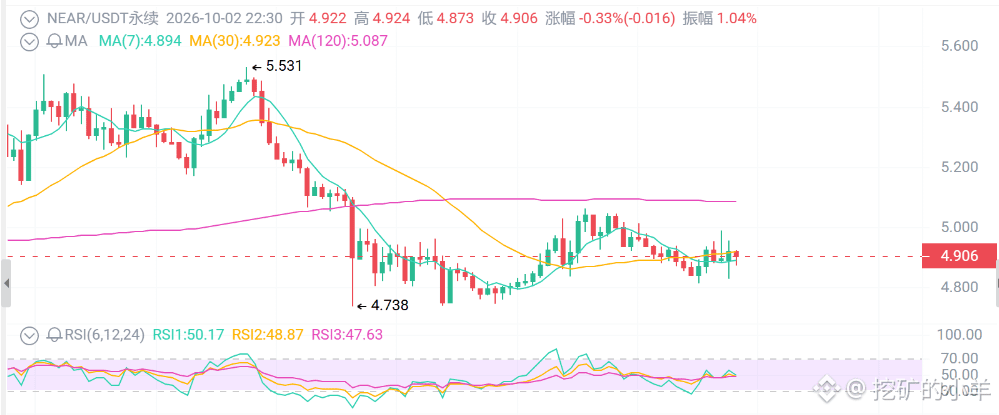
$4.9 NEAR—are you going to cut your losses?
First, the surface:
Over the past 30 days it’s risen 150%–170%. In September it went from 1.9 to 5.5, yet when the ETF opened, the price actually fell.
On October 1st, a single candle dumped from 5.34 to 4.74. Then the hackers stole another $3.8 million.
But today, around 4.9 it’s holding steady—4.74 to 4.9 is a consolidation and defense zone. The daily chart is overbought and rolling over, but the 20-day moving average is still around 4.1. The medium-term structure hasn’t broken.
First thing: ETF listing, and the price drops—classic script, played again.
Bitwise’s NRR: it opened on Sept 29 on NYSE Arca with a 0.75% fee and holdings used for lending/pledging. Net inflows on day one were $35.5 million; over the first three days it totaled $52.8 million—about 0.8% of market cap.
Sounds decent? But the price fell.
Why? Because the jump from 1.9 to 5.5 in September already priced in the ETF expectations. When the good news landed, profit-takers ran first.
Second thing: Intents got hacked for $3.8 million—the chain itself is fine, but the narrative took a hit.
On Oct 1, a vulnerability was exploited in NEAR Intents’ Omni deposit/withdrawal and contract interactions. On BSC, about $3.8 million USDT was siphoned off. The team patched within an hour and promised full reimbursement. A co-founder was explicit: it only affected USDT on BSC; the underlying NEAR chain and NEAR tokens themselves were not hit.
Intents’ cumulative traded volume is about $32 billion, and protocol fees are only on the order of $32 million. The story is real and running, but cash flow relative to a $6.4 billion market cap is still thin.
Third thing: an inflation proposal is moving forward—bearish for the net-new-coin narrative, and friendlier to holders.
A big player has proposed reducing annual inflation from 2.5% to 1.6% and taking it through the House of Stake. It hasn’t been implemented yet, but the signal is clear: the ecosystem is starting to shift from “issuing new coins to fund the network” to “protecting the value of holders’ coins.”
NEAR is a sharded L1. Active addresses have stayed near the front long-term. Staking yields are about 4.5%. Circulating supply is 1.308 billion, and market cap is close to fully diluted.
Trading strategy
Aggressive:
Lightly try longs around 4.90, stop-loss at 4.70. First target 5.06, second target 5.30.
At 5.06, cut half first. Don’t get greedy—this level isn’t a place to go all-in.
Conservative:
Consider longs only when price is between 4.55 and 4.74, stop-loss at 4.38.
A better entry is 4.20–4.40. If it doesn’t give you that, just hold a small position—don’t chase.
Breakout:
Only consider chasing if price holds above 5.30 on strong volume and a pullback doesn’t break 5.05. Targets: 5.55 and 6.00.
If it’s a false breakout, give up immediately—don’t fight it.
Bears:
If it struggles to push higher between 5.05 and 5.20, you can take a light short/hedge on the pullback. Stop-loss at 5.38, target 4.74.
First, the surface:
Over the past 30 days it’s risen 150%–170%. In September it went from 1.9 to 5.5, yet when the ETF opened, the price actually fell.
On October 1st, a single candle dumped from 5.34 to 4.74. Then the hackers stole another $3.8 million.
But today, around 4.9 it’s holding steady—4.74 to 4.9 is a consolidation and defense zone. The daily chart is overbought and rolling over, but the 20-day moving average is still around 4.1. The medium-term structure hasn’t broken.
First thing: ETF listing, and the price drops—classic script, played again.
Bitwise’s NRR: it opened on Sept 29 on NYSE Arca with a 0.75% fee and holdings used for lending/pledging. Net inflows on day one were $35.5 million; over the first three days it totaled $52.8 million—about 0.8% of market cap.
Sounds decent? But the price fell.
Why? Because the jump from 1.9 to 5.5 in September already priced in the ETF expectations. When the good news landed, profit-takers ran first.
Second thing: Intents got hacked for $3.8 million—the chain itself is fine, but the narrative took a hit.
On Oct 1, a vulnerability was exploited in NEAR Intents’ Omni deposit/withdrawal and contract interactions. On BSC, about $3.8 million USDT was siphoned off. The team patched within an hour and promised full reimbursement. A co-founder was explicit: it only affected USDT on BSC; the underlying NEAR chain and NEAR tokens themselves were not hit.
Intents’ cumulative traded volume is about $32 billion, and protocol fees are only on the order of $32 million. The story is real and running, but cash flow relative to a $6.4 billion market cap is still thin.
Third thing: an inflation proposal is moving forward—bearish for the net-new-coin narrative, and friendlier to holders.
A big player has proposed reducing annual inflation from 2.5% to 1.6% and taking it through the House of Stake. It hasn’t been implemented yet, but the signal is clear: the ecosystem is starting to shift from “issuing new coins to fund the network” to “protecting the value of holders’ coins.”
NEAR is a sharded L1. Active addresses have stayed near the front long-term. Staking yields are about 4.5%. Circulating supply is 1.308 billion, and market cap is close to fully diluted.
Trading strategy
Aggressive:
Lightly try longs around 4.90, stop-loss at 4.70. First target 5.06, second target 5.30.
At 5.06, cut half first. Don’t get greedy—this level isn’t a place to go all-in.
Conservative:
Consider longs only when price is between 4.55 and 4.74, stop-loss at 4.38.
A better entry is 4.20–4.40. If it doesn’t give you that, just hold a small position—don’t chase.
Breakout:
Only consider chasing if price holds above 5.30 on strong volume and a pullback doesn’t break 5.05. Targets: 5.55 and 6.00.
If it’s a false breakout, give up immediately—don’t fight it.
Bears:
If it struggles to push higher between 5.05 and 5.20, you can take a light short/hedge on the pullback. Stop-loss at 5.38, target 4.74.