Circle pushes MiCA revisions: USDC reserve rules may see key changes
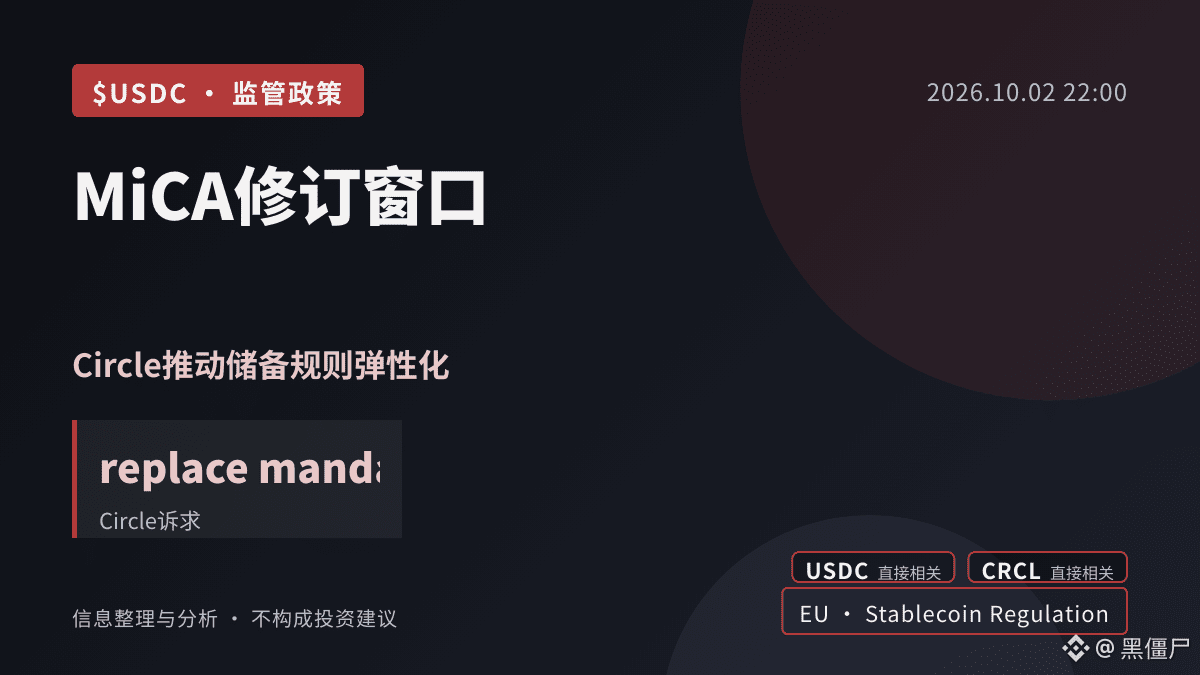
Circle is urging the EU to adjust its stablecoin reserve rules during the MiCA review, according to Cointelegraph. Its core request is to replace mandatory minimum bank deposit requirements with more flexible liquidity requirements, while preserving room for cross-border flows. This move directly points to the compliance costs and liquidity arrangements of $USDC , and it also relates to business expectations for $CRCL as the issuer.
For the stablecoin market, MiCA’s reserve rules are not merely technical provisions, but a key variable that determines whether issuers can maintain low costs and high liquidity within the EU. If the EU accepts a more flexible framework, operational space for USDC in areas such as bank partnerships, fund allocation, and cross-border settlement may expand, and compliance pressure could ease temporarily.
That said, EU regulators have consistently emphasized a prudent baseline. Whether the bank deposit requirements will be completely replaced remains uncertain. If the revision timeline is slow or the final outcome still retains a relatively high deposit ratio, the short-term price impact on USDC may be limited, manifesting more as changes in compliance expectations and institutional willingness to participate.
Next, we need to watch the public statements from the European Commission and the European Central Bank regarding the MiCA revisions, as well as whether Circle further discloses details of its reserve structure. If you’re following $USDC , in the near term it’s more worth monitoring whether regulatory signals confirm the direction, rather than betting on it in advance.
$USDC $CRCL #USDC #MiCA #Stablecoin
The above is an information summary and personal analysis and does not constitute investment advice.
Once additional policy details become clearer, I will continue to update.
Circle is urging the EU to adjust its stablecoin reserve rules during the MiCA review, according to Cointelegraph. Its core request is to replace mandatory minimum bank deposit requirements with more flexible liquidity requirements, while preserving room for cross-border flows. This move directly points to the compliance costs and liquidity arrangements of $USDC , and it also relates to business expectations for $CRCL as the issuer.
For the stablecoin market, MiCA’s reserve rules are not merely technical provisions, but a key variable that determines whether issuers can maintain low costs and high liquidity within the EU. If the EU accepts a more flexible framework, operational space for USDC in areas such as bank partnerships, fund allocation, and cross-border settlement may expand, and compliance pressure could ease temporarily.
That said, EU regulators have consistently emphasized a prudent baseline. Whether the bank deposit requirements will be completely replaced remains uncertain. If the revision timeline is slow or the final outcome still retains a relatively high deposit ratio, the short-term price impact on USDC may be limited, manifesting more as changes in compliance expectations and institutional willingness to participate.
Next, we need to watch the public statements from the European Commission and the European Central Bank regarding the MiCA revisions, as well as whether Circle further discloses details of its reserve structure. If you’re following $USDC , in the near term it’s more worth monitoring whether regulatory signals confirm the direction, rather than betting on it in advance.
$USDC $CRCL #USDC #MiCA #Stablecoin
The above is an information summary and personal analysis and does not constitute investment advice.
Once additional policy details become clearer, I will continue to update.