MAGMA’s 3rd-biggest surge—changing the leaderboard is more interesting
When I look at trending coins, I’ll switch the ranking order right away. I don’t just look at who’s pumping hardest—I also check how active the trading is.
📌 Over the past 24 hours, MAGMA’s spot equivalent turnover is about 86.3455 million USDT, ranking 40th, accounting for 0.18% of the effective USDT perpetual sample. The surge ranking clearly runs ahead of the turnover scale—this makes me want to take another look to see whether the hype can last.
For MAGMA, a high surge rank means the price is moving a lot, while a high turnover rank means trading volume is large. The two don’t have to match in the first place. Turnover share is also affected by the whole market: if other contracts suddenly become active, even if their trades don’t drop, their share will fall. So when you revisit, you need to verify both your own trade amount and the market-wide denominator at the same time.
I’ll split future changes into two types: if the price stays strong and trading remains lively, it’s worth continuing to study for persistence; if trading is hot but the close can’t hold high levels, you should watch for whipsawing. Also, this day’s turnover amount isn’t the same as order-book depth—so you can’t conclude from it that there’s no slippage. Without open position data and an order book, don’t guess who is buying first.
The way we measure turnover also affects interpretation: here it’s compared by USDT turnover, not by token quantity. Price movement itself changes the amount—so you can’t assume participation increases just because the amount grows. If you want to judge whether attention is sustained, you still need to observe continuously; a single day’s ranking can only serve as a starting point.
→ The reason is actually simple: in any single trade, there are both a buyer and a seller. Someone takes the buy, someone sells. You can’t directly label it “institutional net buying.” I’ll keep watching whether, when the price is rising, the turnover share can hold together; if only the surge ranking stays conspicuous, then it’s time to reassess.
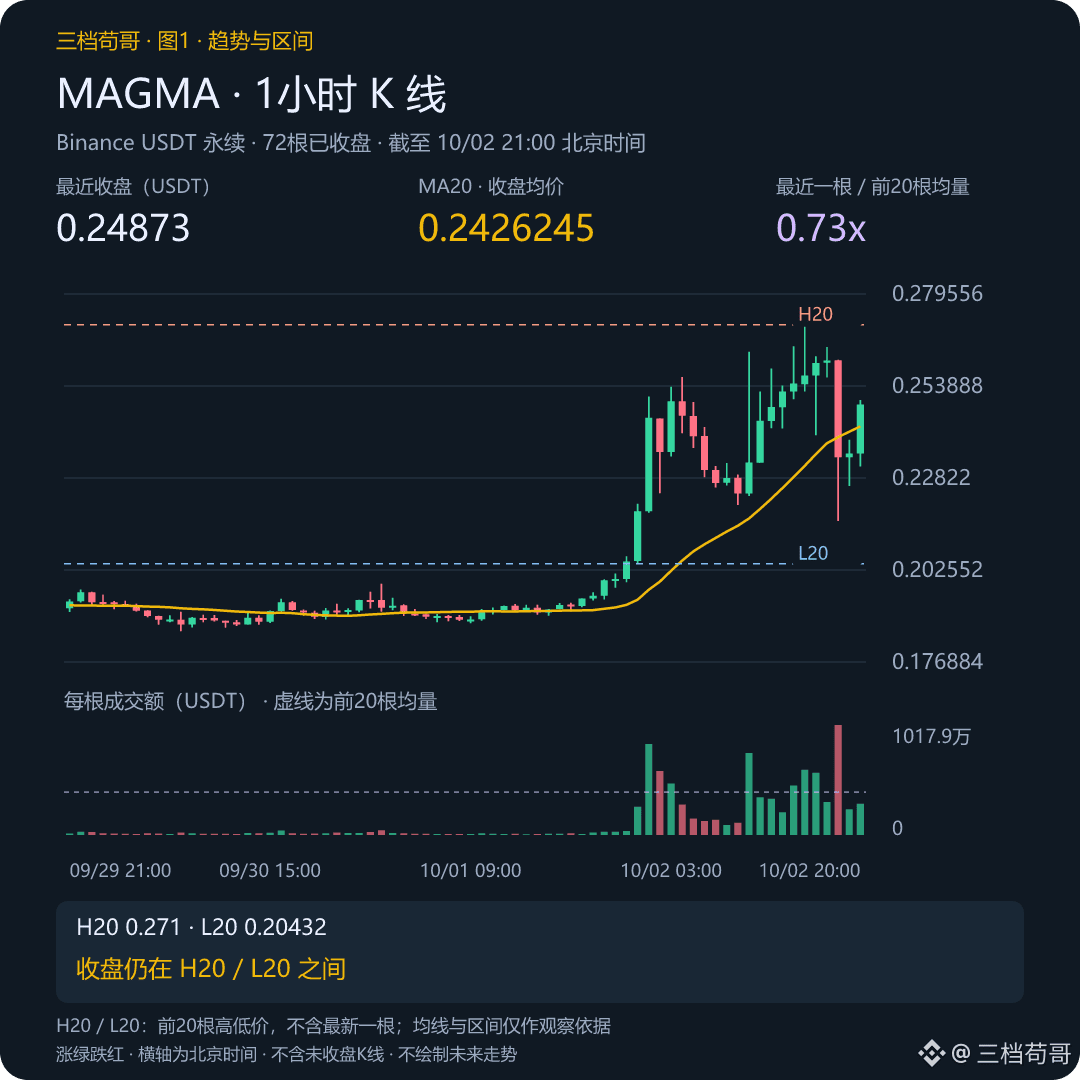
📊 Figure 1|MAGMA 1-hour K-line (Beijing 21:00): the close is still in the 0.20432–0.271 range, and above the MA20. Turnover is 0.73 times the average volume of the previous 20 candles → the direction still needs confirmation by a close breaking above.
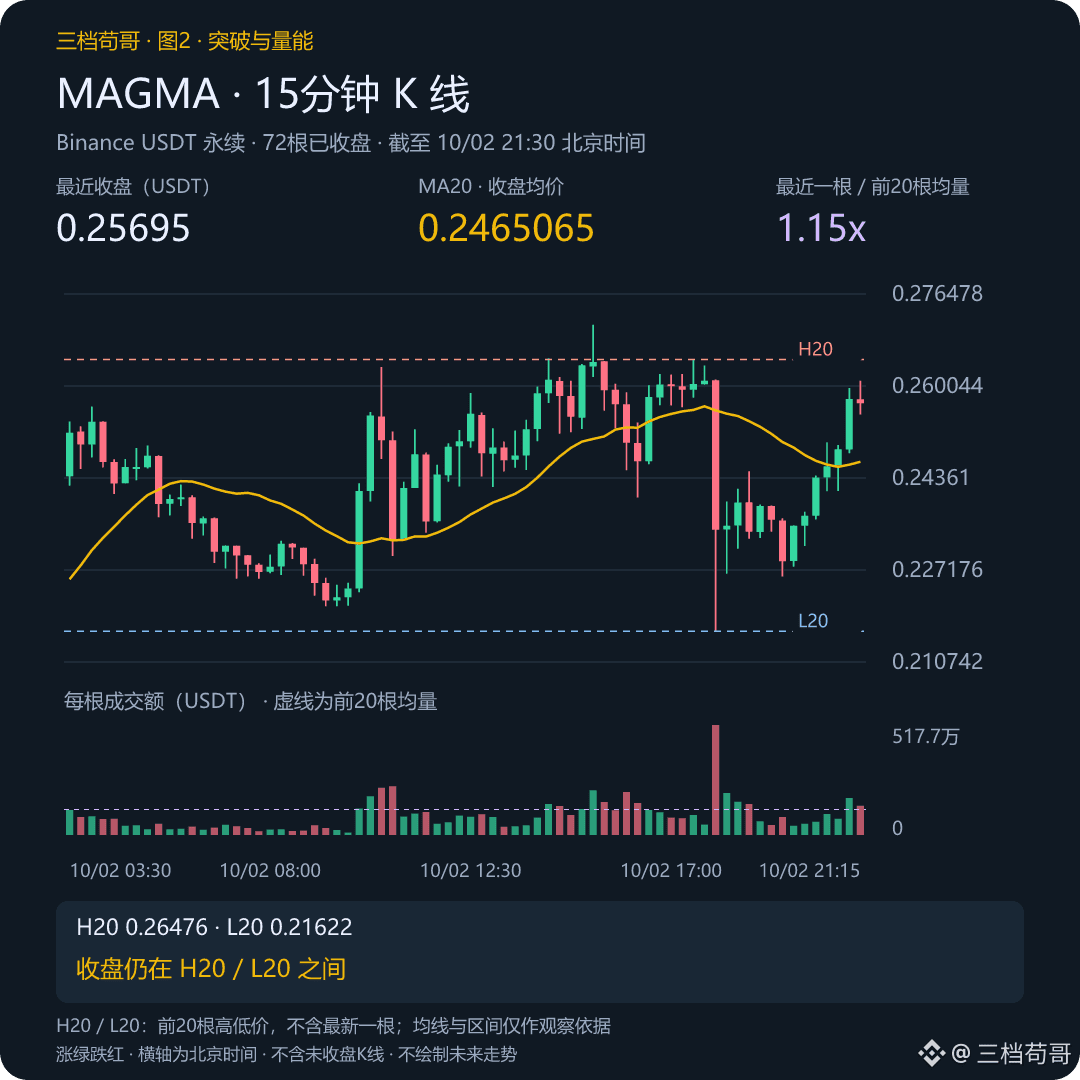
🔎 Figure 2|MAGMA 15-minute K-line (Beijing 21:30): the close is still in the 0.21622–0.26476 range, and above the MA20. Turnover is 1.15 times the average volume of the previous 20 candles → the direction still needs confirmation by a close breaking above.
💬 For MAGMA to carry the momentum forward, which confirmation do you think it currently lacks most?
I’ll keep the conditions above and use the MAGMA market action below to verify.
Source: Binance USDT Perpetual|Rolling 24 hours|2026/10/2 21:30:15 Beijing time.
For discussion only, not investment advice.
$BTC $ETH $MAGMA
When I look at trending coins, I’ll switch the ranking order right away. I don’t just look at who’s pumping hardest—I also check how active the trading is.
📌 Over the past 24 hours, MAGMA’s spot equivalent turnover is about 86.3455 million USDT, ranking 40th, accounting for 0.18% of the effective USDT perpetual sample. The surge ranking clearly runs ahead of the turnover scale—this makes me want to take another look to see whether the hype can last.
For MAGMA, a high surge rank means the price is moving a lot, while a high turnover rank means trading volume is large. The two don’t have to match in the first place. Turnover share is also affected by the whole market: if other contracts suddenly become active, even if their trades don’t drop, their share will fall. So when you revisit, you need to verify both your own trade amount and the market-wide denominator at the same time.
I’ll split future changes into two types: if the price stays strong and trading remains lively, it’s worth continuing to study for persistence; if trading is hot but the close can’t hold high levels, you should watch for whipsawing. Also, this day’s turnover amount isn’t the same as order-book depth—so you can’t conclude from it that there’s no slippage. Without open position data and an order book, don’t guess who is buying first.
The way we measure turnover also affects interpretation: here it’s compared by USDT turnover, not by token quantity. Price movement itself changes the amount—so you can’t assume participation increases just because the amount grows. If you want to judge whether attention is sustained, you still need to observe continuously; a single day’s ranking can only serve as a starting point.
→ The reason is actually simple: in any single trade, there are both a buyer and a seller. Someone takes the buy, someone sells. You can’t directly label it “institutional net buying.” I’ll keep watching whether, when the price is rising, the turnover share can hold together; if only the surge ranking stays conspicuous, then it’s time to reassess.
📊 Figure 1|MAGMA 1-hour K-line (Beijing 21:00): the close is still in the 0.20432–0.271 range, and above the MA20. Turnover is 0.73 times the average volume of the previous 20 candles → the direction still needs confirmation by a close breaking above.
🔎 Figure 2|MAGMA 15-minute K-line (Beijing 21:30): the close is still in the 0.21622–0.26476 range, and above the MA20. Turnover is 1.15 times the average volume of the previous 20 candles → the direction still needs confirmation by a close breaking above.
💬 For MAGMA to carry the momentum forward, which confirmation do you think it currently lacks most?
I’ll keep the conditions above and use the MAGMA market action below to verify.
Source: Binance USDT Perpetual|Rolling 24 hours|2026/10/2 21:30:15 Beijing time.
For discussion only, not investment advice.
$BTC $ETH $MAGMA