BTC just needs that final step—I’d rather see whether it can actually hold its ground
The price is already close to the high. The most tempting thought at this point is, “If I don’t follow now, it’ll be too late,” but what I want to see is whether it can push through and still keep its position.
BTC is currently around 86,755 USDT, with a 24-hour high of 87,250 USDT. Another roughly 0.57% higher would put it right there. It’s very close—which only means this test is nearly here, not that it has already passed.
Why am I watching this specific level first? Because BTC’s percentage change only tells me whether it’s higher or lower than the window’s starting point. The distance between the high and the current price is what completes the other half: after pushing up, how much does it manage to hold onto. These two questions have to be looked at together. A coin can still be showing a decent gain, yet be drifting farther and farther away from its just-reached peak; or the gain might not look that impressive, but the price may steadily stay near the upper edge of its range. My focus will shift based on the combination of these two factors, not just the ranking on a leaderboard.
But there’s also an easy misunderstanding here: a snapshot of the market can’t tell whether it climbed gradually or suddenly surged up and then dropped back down. So I won’t use only whether it’s higher or lower to invent a narrative like “the consolidation is over” or “the main players are accumulating.” To judge whether the uptrend has staying power, we’ll need to see continuous price movements afterward. These numbers are better for helping us find a starting point to observe—so the next time we check the chart, we have something comparable—not for writing the ending to the next move in advance.
If price moves forward, I’ll consider different scenarios separately. If it breaks above the old high and then, when it pulls back, it doesn’t quickly lose that level, my earlier bullish assessment has more support. If it only breaks above for a moment and then returns to the old range, then I’ll pull back my expectations for the breakout. Another less exciting path is chopping sideways around the high: at that point, you can’t automatically declare a top just because it hasn’t risen yet, and you also shouldn’t treat sideways movement as an automatic “setup” for the next leg higher.
I’ll also watch BTC and ETH within the same time window. When the whole market lifts together, the threshold for an individual coin to strengthen may not be that high. If the broader market weakens and it can still hold its own position, that’s more worth studying one more layer. Of course, this set of data alone isn’t enough to prove it has already held up through a particular pullback. What I mean is to make clear what we need to verify next: whatever the price shows, I’ll update accordingly—I won’t look for excuses to force the later changes to fit my earlier view.
Since the price is still on the upper side of its range, I’ll continue watching it. If it breaks above the previous high and then, during a pullback, it can still hold, that’s more convincing than just a brief push. If it pushes up and then retreats immediately, expectations need to be lowered by one level.
Treat the previous high first as a level to be validated, not as a victory already secured.
There’s a BTC market entry below—after this, you can keep comparing to see how the price moves.
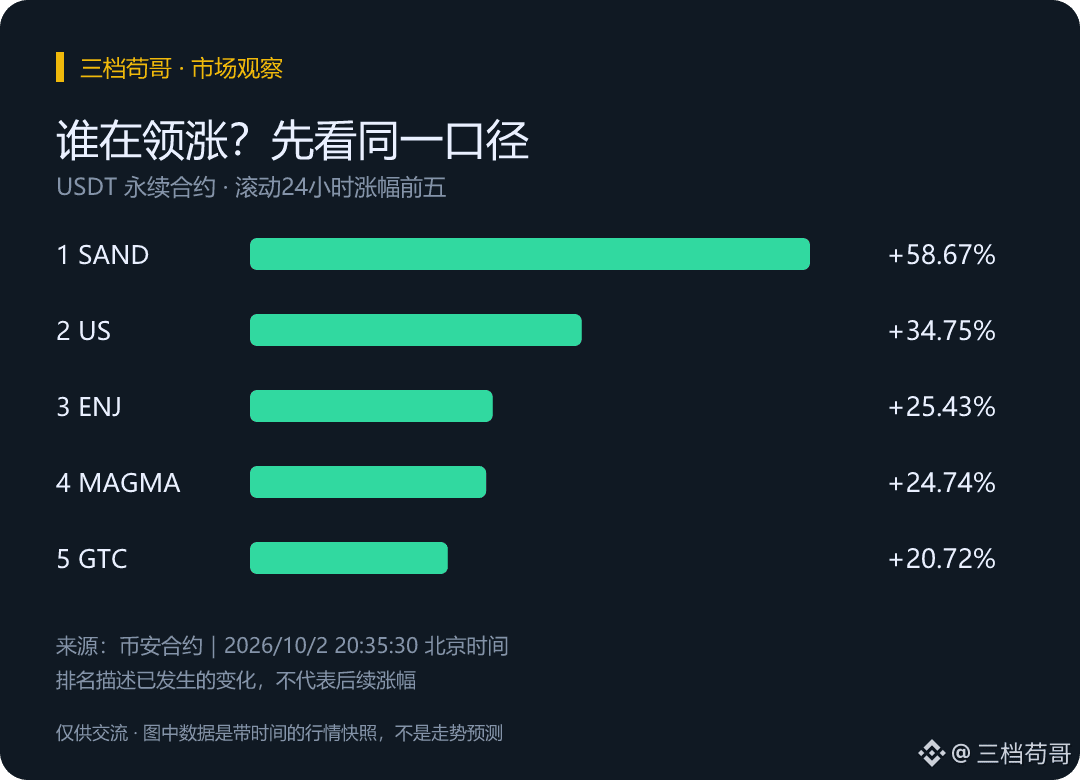
Source: Binance USDT Perpetual | Rolling 24 hours | 2026/10/2 20:35:30 Beijing time.
For discussion only and does not constitute investment advice.
$BTC $ETH $ENJ
The price is already close to the high. The most tempting thought at this point is, “If I don’t follow now, it’ll be too late,” but what I want to see is whether it can push through and still keep its position.
BTC is currently around 86,755 USDT, with a 24-hour high of 87,250 USDT. Another roughly 0.57% higher would put it right there. It’s very close—which only means this test is nearly here, not that it has already passed.
Why am I watching this specific level first? Because BTC’s percentage change only tells me whether it’s higher or lower than the window’s starting point. The distance between the high and the current price is what completes the other half: after pushing up, how much does it manage to hold onto. These two questions have to be looked at together. A coin can still be showing a decent gain, yet be drifting farther and farther away from its just-reached peak; or the gain might not look that impressive, but the price may steadily stay near the upper edge of its range. My focus will shift based on the combination of these two factors, not just the ranking on a leaderboard.
But there’s also an easy misunderstanding here: a snapshot of the market can’t tell whether it climbed gradually or suddenly surged up and then dropped back down. So I won’t use only whether it’s higher or lower to invent a narrative like “the consolidation is over” or “the main players are accumulating.” To judge whether the uptrend has staying power, we’ll need to see continuous price movements afterward. These numbers are better for helping us find a starting point to observe—so the next time we check the chart, we have something comparable—not for writing the ending to the next move in advance.
If price moves forward, I’ll consider different scenarios separately. If it breaks above the old high and then, when it pulls back, it doesn’t quickly lose that level, my earlier bullish assessment has more support. If it only breaks above for a moment and then returns to the old range, then I’ll pull back my expectations for the breakout. Another less exciting path is chopping sideways around the high: at that point, you can’t automatically declare a top just because it hasn’t risen yet, and you also shouldn’t treat sideways movement as an automatic “setup” for the next leg higher.
I’ll also watch BTC and ETH within the same time window. When the whole market lifts together, the threshold for an individual coin to strengthen may not be that high. If the broader market weakens and it can still hold its own position, that’s more worth studying one more layer. Of course, this set of data alone isn’t enough to prove it has already held up through a particular pullback. What I mean is to make clear what we need to verify next: whatever the price shows, I’ll update accordingly—I won’t look for excuses to force the later changes to fit my earlier view.
Since the price is still on the upper side of its range, I’ll continue watching it. If it breaks above the previous high and then, during a pullback, it can still hold, that’s more convincing than just a brief push. If it pushes up and then retreats immediately, expectations need to be lowered by one level.
Treat the previous high first as a level to be validated, not as a victory already secured.
There’s a BTC market entry below—after this, you can keep comparing to see how the price moves.
Source: Binance USDT Perpetual | Rolling 24 hours | 2026/10/2 20:35:30 Beijing time.
For discussion only and does not constitute investment advice.
$BTC $ETH $ENJ