

Post


CJ_GraceWang1688
·
--
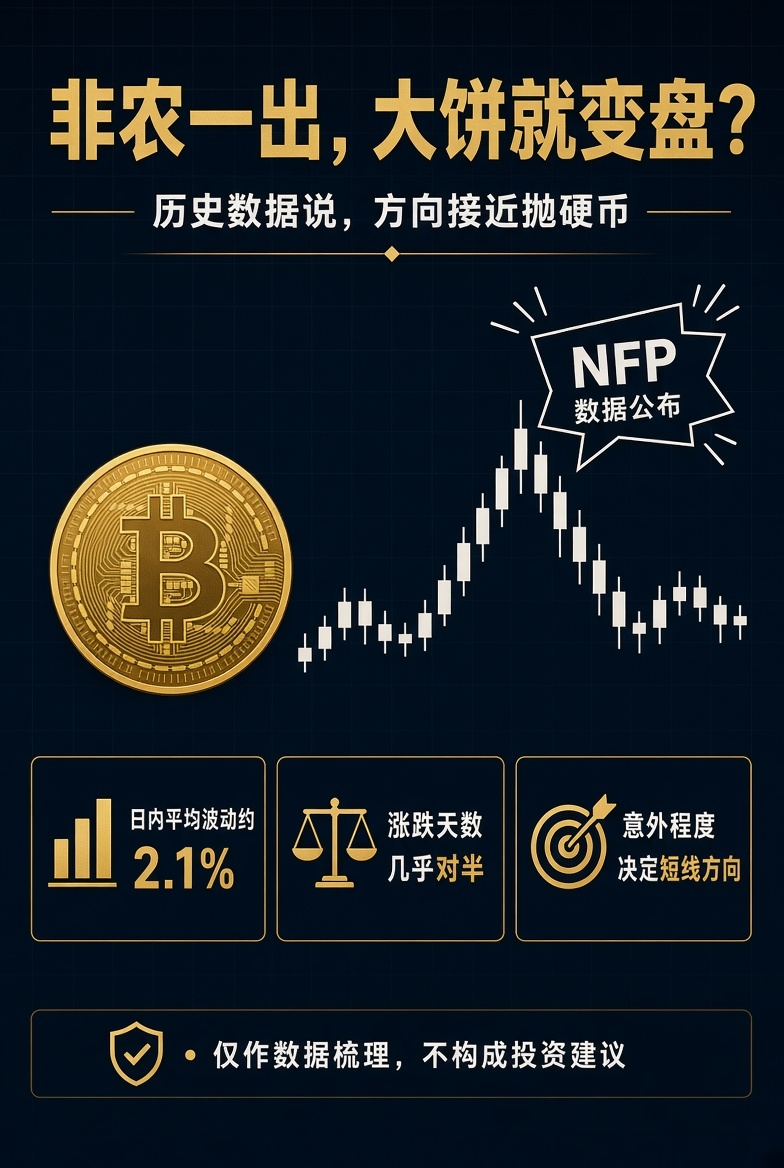
When Non-Farm Payrolls hits, does the big BTC really flip the market? The data may not be that obedient.
U.S. Non-Farm Payrolls are released once a month—12 times a year—usually on the first Friday of the month. Many people treat it like a “market switch” for Bitcoin, but history isn’t that straightforward.
CoinDesk analyzed about 79 Non-Farm release days since 2020: the intraday average volatility on BTC days is about 2.1%, roughly the same as a typical trading day; the number of up and down days is almost evenly split—39 up and 40 down. The direction is close to a coin toss.
What actually tends to amplify volatility is how surprising the data is relative to expectations—not the numbers themselves:
· Much stronger than expected: the U.S. dollar and Treasury yields rise, rate-cut expectations cool, and price action leans downward in the short term
· Roughly in line with expectations: after a quick spike, it often returns to the original trend
· Much weaker than expected: tighter-policy expectations ease, price action leans upward in the short term; if it’s weak enough to trigger recession fears, it may even rise first and then fall
The short-term window is more sensitive. In the first 30 minutes after release, the median price move is about 2x the usual. Extreme moves have happened too: during the 2022 bear market, one Non-Farm day saw BTC rise about 11.4%, and the next one fell about 7.8%.
Non-Farm is more like a trigger, not a direction playbook. The size depends on the magnitude of the surprise, the rate expectations at the time, and how crowded the contract leverage is. Volatility is typically highest within minutes to half an hour after the release, and then reverse spikes often follow.
The above is for data compilation only and does not constitute investment advice.
#比特币 #NonFarm #BTC #比特币升至8.5万美元附近
U.S. Non-Farm Payrolls are released once a month—12 times a year—usually on the first Friday of the month. Many people treat it like a “market switch” for Bitcoin, but history isn’t that straightforward.
CoinDesk analyzed about 79 Non-Farm release days since 2020: the intraday average volatility on BTC days is about 2.1%, roughly the same as a typical trading day; the number of up and down days is almost evenly split—39 up and 40 down. The direction is close to a coin toss.
What actually tends to amplify volatility is how surprising the data is relative to expectations—not the numbers themselves:
· Much stronger than expected: the U.S. dollar and Treasury yields rise, rate-cut expectations cool, and price action leans downward in the short term
· Roughly in line with expectations: after a quick spike, it often returns to the original trend
· Much weaker than expected: tighter-policy expectations ease, price action leans upward in the short term; if it’s weak enough to trigger recession fears, it may even rise first and then fall
The short-term window is more sensitive. In the first 30 minutes after release, the median price move is about 2x the usual. Extreme moves have happened too: during the 2022 bear market, one Non-Farm day saw BTC rise about 11.4%, and the next one fell about 7.8%.
Non-Farm is more like a trigger, not a direction playbook. The size depends on the magnitude of the surprise, the rate expectations at the time, and how crowded the contract leverage is. Volatility is typically highest within minutes to half an hour after the release, and then reverse spikes often follow.
The above is for data compilation only and does not constitute investment advice.
#比特币 #NonFarm #BTC #比特币升至8.5万美元附近
Disclaimer: Includes third-party opinions. No advice. Binance AI may be used without guarantee. See T&Cs.