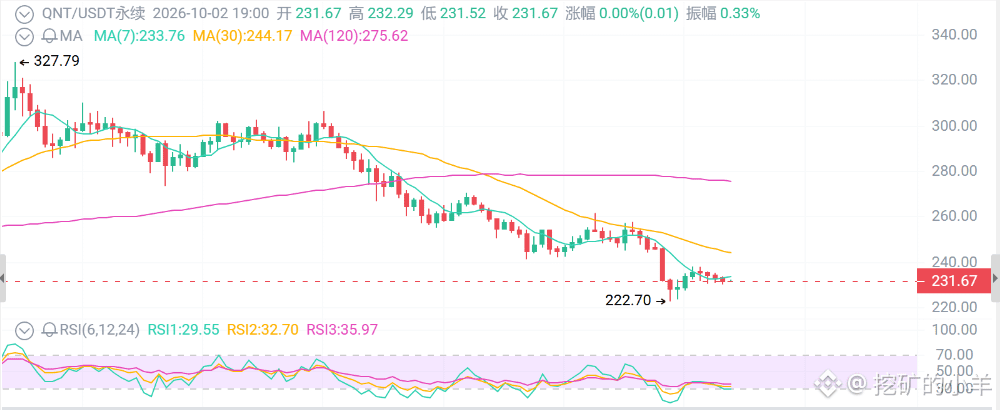
$230 for $QNT —do you want to buy the dip, or catch the falling knife?
First, look at the surface: On September 24, TCH selected Quant as the interoperability layer for its tokenized deposit network. It connects to RTP and CHIPS, real trades were conducted by UK banks, and there were demonstrations at Sibos. According to the script, this should be a launch signal. So what happened?
On the 27th it surged to 350–373. On the 28th it got smashed to 195–205. On the 30th it rebounded to 315–326. On October 1 it tried again at 300 and failed. Today it’s back to 230. In 24 hours it’s down 18–24%, and within an hour longs were liquidated.
First thing: the banks are buying software, not your coin.
The TCH story is real. The Clearing House chose Quant for the interoperability layer, with a target timeline of the first half of 2027, and real trades are already happening with UK banks.
But the announcement doesn’t say they must lock QNT, and it doesn’t say they must burn QNT.
You buy tokens; banks buy company software. Banks run tokenized deposits using Overledger, and the consumption rate of your QNT sits in between—there’s a ledger that isn’t specified.
Second thing: leverage is increasing, and chips are moving out—so whose side are you on?
A whale that had been asleep for three years previously moved its holdings to Binance, Coinbase, and Kraken.
Today, long liquidations are clearly more than shorts. This is higher-position leverage being swept—not new money coming in.
Retail traders ask at 230, “Can we buy the dip?” Meanwhile, the whale has already sold above 300.
QNT’s hard cap is about 14.61 million, and it’s nearly fully circulating—so it has huge elasticity. The characteristics of this market are: it rallies fast, dumps even faster, and the wicks are brutal.
Third thing: the overall market isn’t bad—QNT is the only one falling, which points to a problem with it itself.
Today BTC surged from around 83k to near 86k, with the daily chart leaning strong. The market hasn’t broken down; QNT alone is down by about 20%.
The Fed rate is still 3.75%–4%, and liquidity hasn’t suddenly improved. The market is stable, giving room for QNT to oscillate within its range; but if BTC loses 82.6k again, 230 will break first.
When the market rises, you don’t rise; when the market falls, you fall even more.
Trading strategy
Aggressive:
Around 230, try a small long position at most, with a stop-loss at 218. First target 245, second target 260. Take half off at 245.
Then wait for 205–215 to consider opening longs again, with a stop-loss at 192. A better entry is 195–200. If it doesn’t come, stay out and watch the range.
Breakout:
Only consider chasing if price stands above 260 on increased volume and the pullback holds without breaking 245. Targets: 280 and 300. A false breakout means abandon the idea.
Bears:
If you can’t push through between 245–250 and price struggles on the highs, you can lightly position for a pullback with a stop-loss at 262 and a target at 223.
Don’t get stuck short around 205—it’s easy to get squeezed.
First, look at the surface: On September 24, TCH selected Quant as the interoperability layer for its tokenized deposit network. It connects to RTP and CHIPS, real trades were conducted by UK banks, and there were demonstrations at Sibos. According to the script, this should be a launch signal. So what happened?
On the 27th it surged to 350–373. On the 28th it got smashed to 195–205. On the 30th it rebounded to 315–326. On October 1 it tried again at 300 and failed. Today it’s back to 230. In 24 hours it’s down 18–24%, and within an hour longs were liquidated.
First thing: the banks are buying software, not your coin.
The TCH story is real. The Clearing House chose Quant for the interoperability layer, with a target timeline of the first half of 2027, and real trades are already happening with UK banks.
But the announcement doesn’t say they must lock QNT, and it doesn’t say they must burn QNT.
You buy tokens; banks buy company software. Banks run tokenized deposits using Overledger, and the consumption rate of your QNT sits in between—there’s a ledger that isn’t specified.
Second thing: leverage is increasing, and chips are moving out—so whose side are you on?
A whale that had been asleep for three years previously moved its holdings to Binance, Coinbase, and Kraken.
Today, long liquidations are clearly more than shorts. This is higher-position leverage being swept—not new money coming in.
Retail traders ask at 230, “Can we buy the dip?” Meanwhile, the whale has already sold above 300.
QNT’s hard cap is about 14.61 million, and it’s nearly fully circulating—so it has huge elasticity. The characteristics of this market are: it rallies fast, dumps even faster, and the wicks are brutal.
Third thing: the overall market isn’t bad—QNT is the only one falling, which points to a problem with it itself.
Today BTC surged from around 83k to near 86k, with the daily chart leaning strong. The market hasn’t broken down; QNT alone is down by about 20%.
The Fed rate is still 3.75%–4%, and liquidity hasn’t suddenly improved. The market is stable, giving room for QNT to oscillate within its range; but if BTC loses 82.6k again, 230 will break first.
When the market rises, you don’t rise; when the market falls, you fall even more.
Trading strategy
Aggressive:
Around 230, try a small long position at most, with a stop-loss at 218. First target 245, second target 260. Take half off at 245.
Then wait for 205–215 to consider opening longs again, with a stop-loss at 192. A better entry is 195–200. If it doesn’t come, stay out and watch the range.
Breakout:
Only consider chasing if price stands above 260 on increased volume and the pullback holds without breaking 245. Targets: 280 and 300. A false breakout means abandon the idea.
Bears:
If you can’t push through between 245–250 and price struggles on the highs, you can lightly position for a pullback with a stop-loss at 262 and a target at 223.
Don’t get stuck short around 205—it’s easy to get squeezed.