[CJ Arbitrage Advanced 11/14]
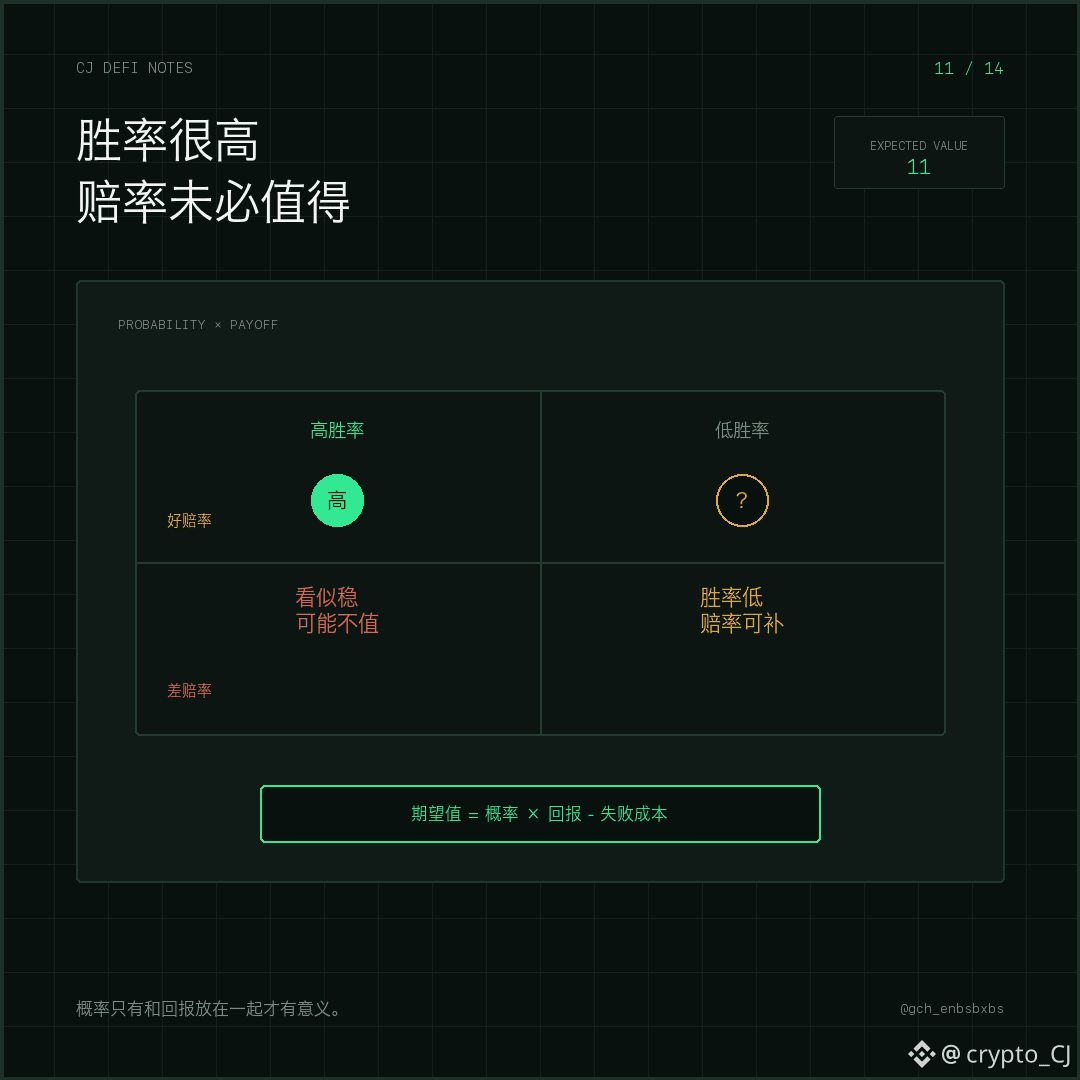
One trade wins nine out of ten times, and it still could be a losing strategy. Predicting the market’s “tail-end sweep” makes it easy to overlook this.
A common approach is to buy the side that looks almost certain at a price of 0.90 to 0.95 as the event is about to end. Most of the time you can only earn 0.05 to 0.10. But if the one low-probability event happens, you may lose nearly your entire principal. The continuous positive feedback from a high win rate can gradually make you increase your position size, until one tail outcome wipes out many small profits from earlier rounds.
CJ used AI to backtest this kind of 5-minute and 15-minute events and reminded people not to judge solely by win rate. At minimum, you need to calculate the true odds, out-of-sample performance, fees, execution slippage, and extreme scenarios. Long-horizon prediction has another cost: even if the direction is ultimately correct, your funds may be locked up for a long time, and the annualized capital efficiency may not be high.
Combining prediction markets with new products like Perp may create new hedging paths. But whether the product exists, whether liquidity is sufficient, and whether the rules change—all of it must be re-verified. First ask how much you could lose in the worst case; then ask how many times you can do it in a year. If you only focus on “winning often,” it’s easy to hide tail risks.
Next article: When opportunities exist for only a few seconds, which step should a trader automate first?
#预测市场 # Quantitative Backtesting
One trade wins nine out of ten times, and it still could be a losing strategy. Predicting the market’s “tail-end sweep” makes it easy to overlook this.
A common approach is to buy the side that looks almost certain at a price of 0.90 to 0.95 as the event is about to end. Most of the time you can only earn 0.05 to 0.10. But if the one low-probability event happens, you may lose nearly your entire principal. The continuous positive feedback from a high win rate can gradually make you increase your position size, until one tail outcome wipes out many small profits from earlier rounds.
CJ used AI to backtest this kind of 5-minute and 15-minute events and reminded people not to judge solely by win rate. At minimum, you need to calculate the true odds, out-of-sample performance, fees, execution slippage, and extreme scenarios. Long-horizon prediction has another cost: even if the direction is ultimately correct, your funds may be locked up for a long time, and the annualized capital efficiency may not be high.
Combining prediction markets with new products like Perp may create new hedging paths. But whether the product exists, whether liquidity is sufficient, and whether the rules change—all of it must be re-verified. First ask how much you could lose in the worst case; then ask how many times you can do it in a year. If you only focus on “winning often,” it’s easy to hide tail risks.
Next article: When opportunities exist for only a few seconds, which step should a trader automate first?
#预测市场 # Quantitative Backtesting