ZEC worth $1,380—do you still dare to take it?
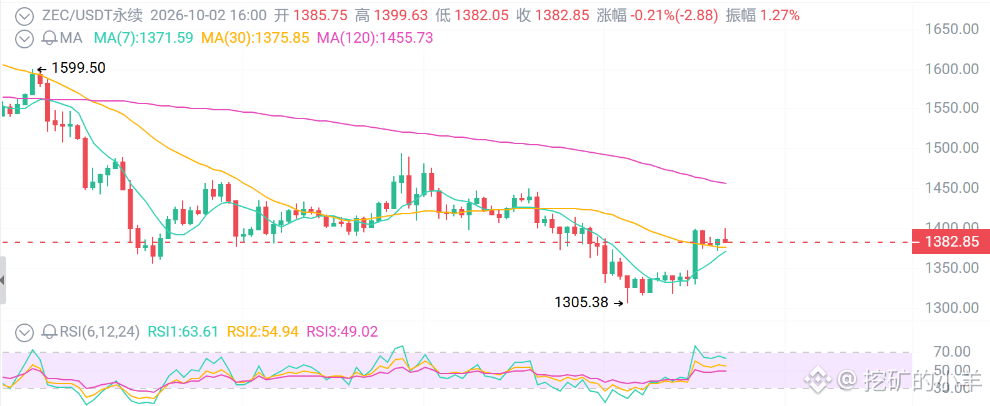
First, take a look at the surface: from 14:30 on October 1 to early hours of October 2, it was dumped straight from 1430 to 1312. Long liquidations totaled $4.3 million, and then it rebounded to the 1,380 you’re seeing now. In 7 days it dropped 10%, but over 30 days it’s still up 65%. With a market cap of $23 billion, it ranks tenth. This is the deep pullback repair after the 1697 peak—not a fresh major breakout.
First thing: when the overall market is up, you don’t rise; when the overall market falls, you fall even harder—that’s more terrifying.
Over these two days, BTC rallied from 83,000 to 86,000, and today’s high was 86,900. What about ZEC? Still hovering below 1,400.
At the same time, the ZCSH ETF split was implemented on September 30, with a size of about $900 million and holdings representing roughly 3.5% of the total. Europe’s ETPs also got on board. Sounds bullish? But the incremental capital has already turned dull—this isn’t new fuel for the short term.
Good news being “priced in” without a rise is the biggest bearish signal.
Second thing: NU7 is in the countdown, but today through October 6 is a наблюсation window, not a settlement/realization date.
The code target is to complete by September 30. The testnet is set for October 6, the go/no-go is on October 20, and the mainnet target is November 5. Block production every 25 seconds, preserve the halving, and disable Sprout’s v4 trading.
What if there’s a problem with the testnet?
Price will first dump expectations. This year, ZEC has had circuit vulnerabilities and an emergency upgrade for Ironwood—engineering risk is real. If the November upgrade goes smoothly, the experience will feel faster; if it’s delayed, the narrative will cool down first.
Third thing: three rejections from 1670–1697—this isn’t a coincidence.
In mid-September, it pulled from 1,100 to 1,335, then pushed again toward 1,697. After rejecting 1670–1697 three times in a row, it fell back to 1,360, and on October 2 it swept again down to 1,305.
If three attempts aren’t allowed through, it means there’s a huge volume of trapped capital waiting overhead to get out. Every time price charges up, someone is distributing.
On the daily chart, it fell from overbought and the short moving averages have started to press down. If it can’t reclaim 1,440 on volume, don’t talk about 1,500. If the daily closes below 1,305, treat the short term as a deep adjustment; the next targets are 1,290 and 1,180.
Trading strategies
Aggressive type:
Lightly go long near 1,380, with a stop loss at 1,295. First target 1,440, second target 1,500. When it hits 1,440, cut half.
Conservative type:
Wait for 1,305–1,320, then consider going long, with a stop loss at 1,268. A better entry is 1,180–1,220. If it doesn’t come, just hold a small position—don’t rush.
Breakout type:
Only consider chasing if it trades with volume and holds above 1,440, and the pullback doesn’t break 1,400. Targets 1,500 and 1,540. If it’s a false breakout, give up—don’t hesitate.
Bear side:
If the 1,440 area can’t push higher, you can take a light short on the pullback, stop loss at 1,485, target 1,310. Don’t short and get stuck near 1,305—places that were just swept are prone to rebound.
First, take a look at the surface: from 14:30 on October 1 to early hours of October 2, it was dumped straight from 1430 to 1312. Long liquidations totaled $4.3 million, and then it rebounded to the 1,380 you’re seeing now. In 7 days it dropped 10%, but over 30 days it’s still up 65%. With a market cap of $23 billion, it ranks tenth. This is the deep pullback repair after the 1697 peak—not a fresh major breakout.
First thing: when the overall market is up, you don’t rise; when the overall market falls, you fall even harder—that’s more terrifying.
Over these two days, BTC rallied from 83,000 to 86,000, and today’s high was 86,900. What about ZEC? Still hovering below 1,400.
At the same time, the ZCSH ETF split was implemented on September 30, with a size of about $900 million and holdings representing roughly 3.5% of the total. Europe’s ETPs also got on board. Sounds bullish? But the incremental capital has already turned dull—this isn’t new fuel for the short term.
Good news being “priced in” without a rise is the biggest bearish signal.
Second thing: NU7 is in the countdown, but today through October 6 is a наблюсation window, not a settlement/realization date.
The code target is to complete by September 30. The testnet is set for October 6, the go/no-go is on October 20, and the mainnet target is November 5. Block production every 25 seconds, preserve the halving, and disable Sprout’s v4 trading.
What if there’s a problem with the testnet?
Price will first dump expectations. This year, ZEC has had circuit vulnerabilities and an emergency upgrade for Ironwood—engineering risk is real. If the November upgrade goes smoothly, the experience will feel faster; if it’s delayed, the narrative will cool down first.
Third thing: three rejections from 1670–1697—this isn’t a coincidence.
In mid-September, it pulled from 1,100 to 1,335, then pushed again toward 1,697. After rejecting 1670–1697 three times in a row, it fell back to 1,360, and on October 2 it swept again down to 1,305.
If three attempts aren’t allowed through, it means there’s a huge volume of trapped capital waiting overhead to get out. Every time price charges up, someone is distributing.
On the daily chart, it fell from overbought and the short moving averages have started to press down. If it can’t reclaim 1,440 on volume, don’t talk about 1,500. If the daily closes below 1,305, treat the short term as a deep adjustment; the next targets are 1,290 and 1,180.
Trading strategies
Aggressive type:
Lightly go long near 1,380, with a stop loss at 1,295. First target 1,440, second target 1,500. When it hits 1,440, cut half.
Conservative type:
Wait for 1,305–1,320, then consider going long, with a stop loss at 1,268. A better entry is 1,180–1,220. If it doesn’t come, just hold a small position—don’t rush.
Breakout type:
Only consider chasing if it trades with volume and holds above 1,440, and the pullback doesn’t break 1,400. Targets 1,500 and 1,540. If it’s a false breakout, give up—don’t hesitate.
Bear side:
If the 1,440 area can’t push higher, you can take a light short on the pullback, stop loss at 1,485, target 1,310. Don’t short and get stuck near 1,305—places that were just swept are prone to rebound.