Pay for zero-knowledge proofs—does that mean AI can’t see what you say?
According to an October 1 update from the Ethereum Foundation, the zkAPI developed in collaboration with the Open Anonymity project is now running on the Ethereum mainnet. It uses zero-knowledge proofs to authorize API usage, reducing the link between payment records and requests.
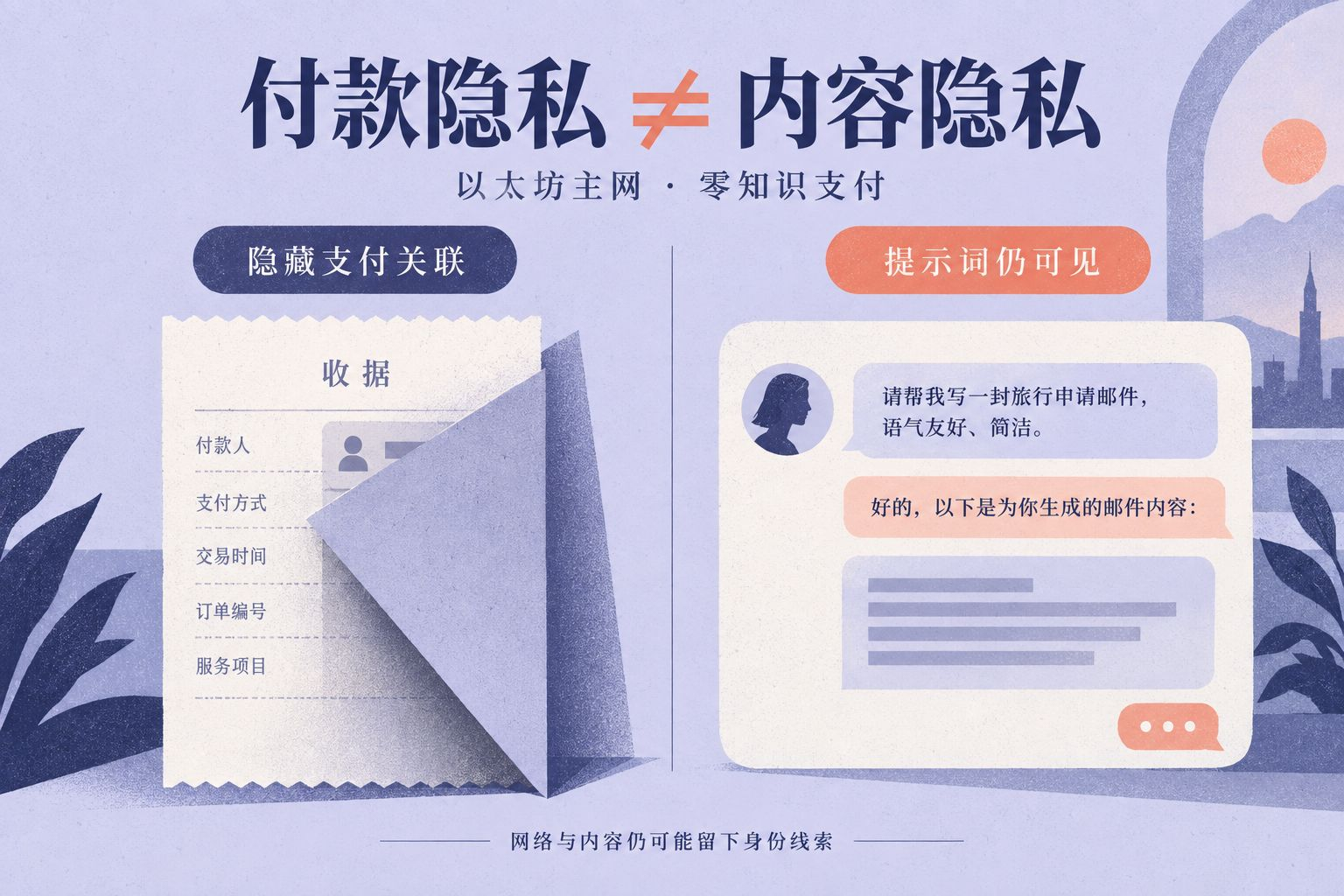
But the official guidance also sets boundaries: model service providers can still see the prompts; IP addresses, request times, and personal information that appears repeatedly could all become linking clues. There is also a more easily deployed proxy mode in which the relay will come into contact with the request traffic.
My take: when evaluating privacy tools like this, you should ask separately “who pays,” “who can read the content,” and “who can link sessions.” Solving the first problem doesn’t automatically make the other two disappear. Writing payment privacy as “completely anonymous AI” can obscure the parts that truly need scrutiny.
Source: Ethereum Foundation official blog, October 1. $ETH #privacy technology
According to an October 1 update from the Ethereum Foundation, the zkAPI developed in collaboration with the Open Anonymity project is now running on the Ethereum mainnet. It uses zero-knowledge proofs to authorize API usage, reducing the link between payment records and requests.
But the official guidance also sets boundaries: model service providers can still see the prompts; IP addresses, request times, and personal information that appears repeatedly could all become linking clues. There is also a more easily deployed proxy mode in which the relay will come into contact with the request traffic.
My take: when evaluating privacy tools like this, you should ask separately “who pays,” “who can read the content,” and “who can link sessions.” Solving the first problem doesn’t automatically make the other two disappear. Writing payment privacy as “completely anonymous AI” can obscure the parts that truly need scrutiny.
Source: Ethereum Foundation official blog, October 1. $ETH #privacy technology