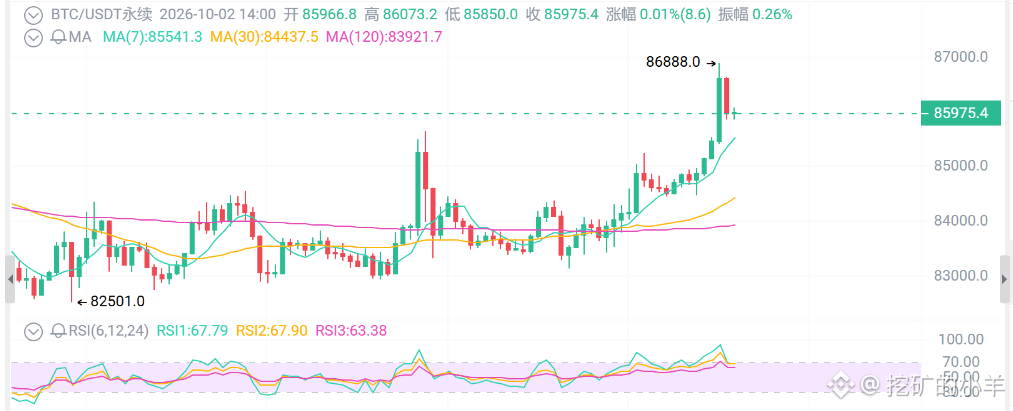
$86,000 BTC—are you going to chase it or not?
First, look at the surface: August’s PCE came in cooler; core PCE at 3.0% was below expectations. In a few hours, BTC surged from 83,000 to 85,600. Then what? The 10-year Treasury yield is still around 5.28%, while the 30-year yield is approaching the highest level since 2002. Most of that rally’s gains were given back the same day.
On September 30, ETF net outflows totaled $149 million, ending nine consecutive trading days and $3.1 billion of straight inflows. The “Uptober” narrative is being shouted loudly, and some institutions have revised their targets upward—from 82,000 to 113,000.
First thing: If PCE is good, why did it only harden for a few hours?
Core PCE at 3.0% was below expectations. In the script, that should warm up rate-cut expectations and lift risk assets. The probability of an additional rate hike in October dropped from 70% to 38%.
But look at yields—10-year at 5.28% and the 30-year near the 2002 highs. When inflation data cools off, the bond market doesn’t cool down.
Real yields are weighing on gold, and BTC is no exception. 86,000 wasn’t pushed up by demand—it held around 82,600 first, and then saw a technical rebound.
Second thing: The nine-day ETF inflow streak broke—turning point or just slope?
On September 30, net outflows were $149 million, ending nine consecutive days of net inflows. Sounds scary?
Look at the full month: September still had net inflows of about $2.65 billion, and the cumulative total for 2026 remains positive. The “gap” is a slope issue, not the disappearance of demand.
If ETFs see net outflows for three straight days, 86,000 likely won’t hold.
Third thing: “Uptober” is loud, but volume didn’t follow.
In Q3, BTC rose 43%—it rebounded from the July low of 58,000 to 87,000. Institutions are calling for 113,000, and sentiment is fully pumped.
But look at volume—it’s far lower than the massive volume day on September 21. This is a repair move, not a restart of the main upswing.
86,000 is stuck at the doorstep of supply from the prior high. Without breaking above 87,500 with volume, don’t talk about 90,000.
Trading strategies
Aggressive:
Near 86,000, try long with at most a light position; stop-loss at 84,400. Take off half at 86,900 first, and exit all at 87,300. Don’t add leverage in the supply zone and bet on 90,000.
Conservative:
Wait for 84,500–85,000 to open longs; stop-loss at 82,800. A better entry is 83,100–83,500. If you don’t get that price, keep a small position—don’t rush.
Breakout:
Only consider chasing if it holds above 87,500 on strong volume and the subsequent pullback doesn’t break 86,000. Target: 90,000. If it’s a false breakout, abandon the idea—don’t get stuck fighting.
Bears:
If the rally peters out between 86,900–87,500, you can take a light short on the fade. Stop-loss at 88,200; target 84,500. Don’t sit there shorting near 82,600—that’s asking for trouble.
First, look at the surface: August’s PCE came in cooler; core PCE at 3.0% was below expectations. In a few hours, BTC surged from 83,000 to 85,600. Then what? The 10-year Treasury yield is still around 5.28%, while the 30-year yield is approaching the highest level since 2002. Most of that rally’s gains were given back the same day.
On September 30, ETF net outflows totaled $149 million, ending nine consecutive trading days and $3.1 billion of straight inflows. The “Uptober” narrative is being shouted loudly, and some institutions have revised their targets upward—from 82,000 to 113,000.
First thing: If PCE is good, why did it only harden for a few hours?
Core PCE at 3.0% was below expectations. In the script, that should warm up rate-cut expectations and lift risk assets. The probability of an additional rate hike in October dropped from 70% to 38%.
But look at yields—10-year at 5.28% and the 30-year near the 2002 highs. When inflation data cools off, the bond market doesn’t cool down.
Real yields are weighing on gold, and BTC is no exception. 86,000 wasn’t pushed up by demand—it held around 82,600 first, and then saw a technical rebound.
Second thing: The nine-day ETF inflow streak broke—turning point or just slope?
On September 30, net outflows were $149 million, ending nine consecutive days of net inflows. Sounds scary?
Look at the full month: September still had net inflows of about $2.65 billion, and the cumulative total for 2026 remains positive. The “gap” is a slope issue, not the disappearance of demand.
If ETFs see net outflows for three straight days, 86,000 likely won’t hold.
Third thing: “Uptober” is loud, but volume didn’t follow.
In Q3, BTC rose 43%—it rebounded from the July low of 58,000 to 87,000. Institutions are calling for 113,000, and sentiment is fully pumped.
But look at volume—it’s far lower than the massive volume day on September 21. This is a repair move, not a restart of the main upswing.
86,000 is stuck at the doorstep of supply from the prior high. Without breaking above 87,500 with volume, don’t talk about 90,000.
Trading strategies
Aggressive:
Near 86,000, try long with at most a light position; stop-loss at 84,400. Take off half at 86,900 first, and exit all at 87,300. Don’t add leverage in the supply zone and bet on 90,000.
Conservative:
Wait for 84,500–85,000 to open longs; stop-loss at 82,800. A better entry is 83,100–83,500. If you don’t get that price, keep a small position—don’t rush.
Breakout:
Only consider chasing if it holds above 87,500 on strong volume and the subsequent pullback doesn’t break 86,000. Target: 90,000. If it’s a false breakout, abandon the idea—don’t get stuck fighting.
Bears:
If the rally peters out between 86,900–87,500, you can take a light short on the fade. Stop-loss at 88,200; target 84,500. Don’t sit there shorting near 82,600—that’s asking for trouble.