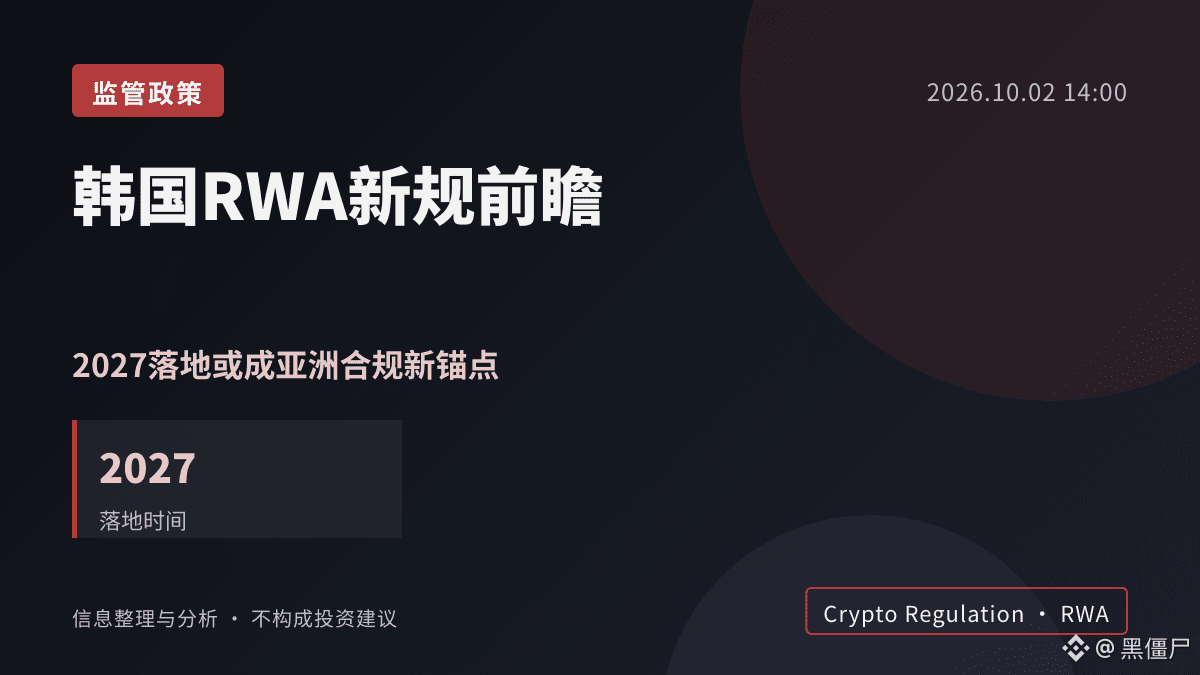
South Korea to propose rules for tokenized securities; implementation in 2027 may reshape Asia’s RWA compliance roadmap
According to Cointelegraph, South Korea’s financial regulators have put forward a draft set of detailed rules for tokenized securities, covering capital requirements and over-the-counter (OTC) arrangements, with plans to formally roll them out in 2027. This development provides a new regulatory anchor for the Asia RWA track, and its impact may extend beyond a single market.
As a major financial hub in Asia, South Korea’s regulatory framework has long had a demonstration effect on regional markets. If these provisions advance as proposed, they will establish clear standards for issuing, trading, and clearing tokenized securities, reducing compliance uncertainty for institutions. For RWA projects, clear capital requirements and OTC mechanisms may improve the feasibility of putting assets on-chain—especially for tokenization use cases involving traditional assets such as real estate and bonds.
In terms of market reaction, ahead of the rules taking effect, discussions about compliance costs and implementation details may emerge. Some projects may need to adjust their existing architectures to meet the new requirements. The timing of institutional capital entering the market may depend on the final terms’ flexibility and the maturity of supporting infrastructure. As it is still in the proposal stage, changes remain possible.
On risks, the final rules may tighten capital thresholds and trading restrictions, increasing the compliance burden on smaller and mid-sized projects. Meanwhile, if OTC arrangements lack sufficient transparency, they could undermine expectations for secondary-market liquidity. In addition, the strength of South Korea’s regulatory enforcement and the efficiency of cross-department coordination remain key points to watch.
Next, it will be important to monitor the revision directions following the public consultation process, as well as the progress in adapting to the rules by South Korea’s domestic RWA projects and exchanges. If the regulatory framework becomes clearer, other Asian markets may accelerate follow-up with similar arrangements, creating regional compliance coordination effects.
#RWA #CryptoRegulation
The above is information compiled and personal analysis only and does not constitute investment advice. After further policy details are clarified, I will continue to provide updates.
According to Cointelegraph, South Korea’s financial regulators have put forward a draft set of detailed rules for tokenized securities, covering capital requirements and over-the-counter (OTC) arrangements, with plans to formally roll them out in 2027. This development provides a new regulatory anchor for the Asia RWA track, and its impact may extend beyond a single market.
As a major financial hub in Asia, South Korea’s regulatory framework has long had a demonstration effect on regional markets. If these provisions advance as proposed, they will establish clear standards for issuing, trading, and clearing tokenized securities, reducing compliance uncertainty for institutions. For RWA projects, clear capital requirements and OTC mechanisms may improve the feasibility of putting assets on-chain—especially for tokenization use cases involving traditional assets such as real estate and bonds.
In terms of market reaction, ahead of the rules taking effect, discussions about compliance costs and implementation details may emerge. Some projects may need to adjust their existing architectures to meet the new requirements. The timing of institutional capital entering the market may depend on the final terms’ flexibility and the maturity of supporting infrastructure. As it is still in the proposal stage, changes remain possible.
On risks, the final rules may tighten capital thresholds and trading restrictions, increasing the compliance burden on smaller and mid-sized projects. Meanwhile, if OTC arrangements lack sufficient transparency, they could undermine expectations for secondary-market liquidity. In addition, the strength of South Korea’s regulatory enforcement and the efficiency of cross-department coordination remain key points to watch.
Next, it will be important to monitor the revision directions following the public consultation process, as well as the progress in adapting to the rules by South Korea’s domestic RWA projects and exchanges. If the regulatory framework becomes clearer, other Asian markets may accelerate follow-up with similar arrangements, creating regional compliance coordination effects.
#RWA #CryptoRegulation
The above is information compiled and personal analysis only and does not constitute investment advice. After further policy details are clarified, I will continue to provide updates.