Is the springtime of old-timers stocks here? Accenture’s ACN surge nearly 16%—what exactly happened?
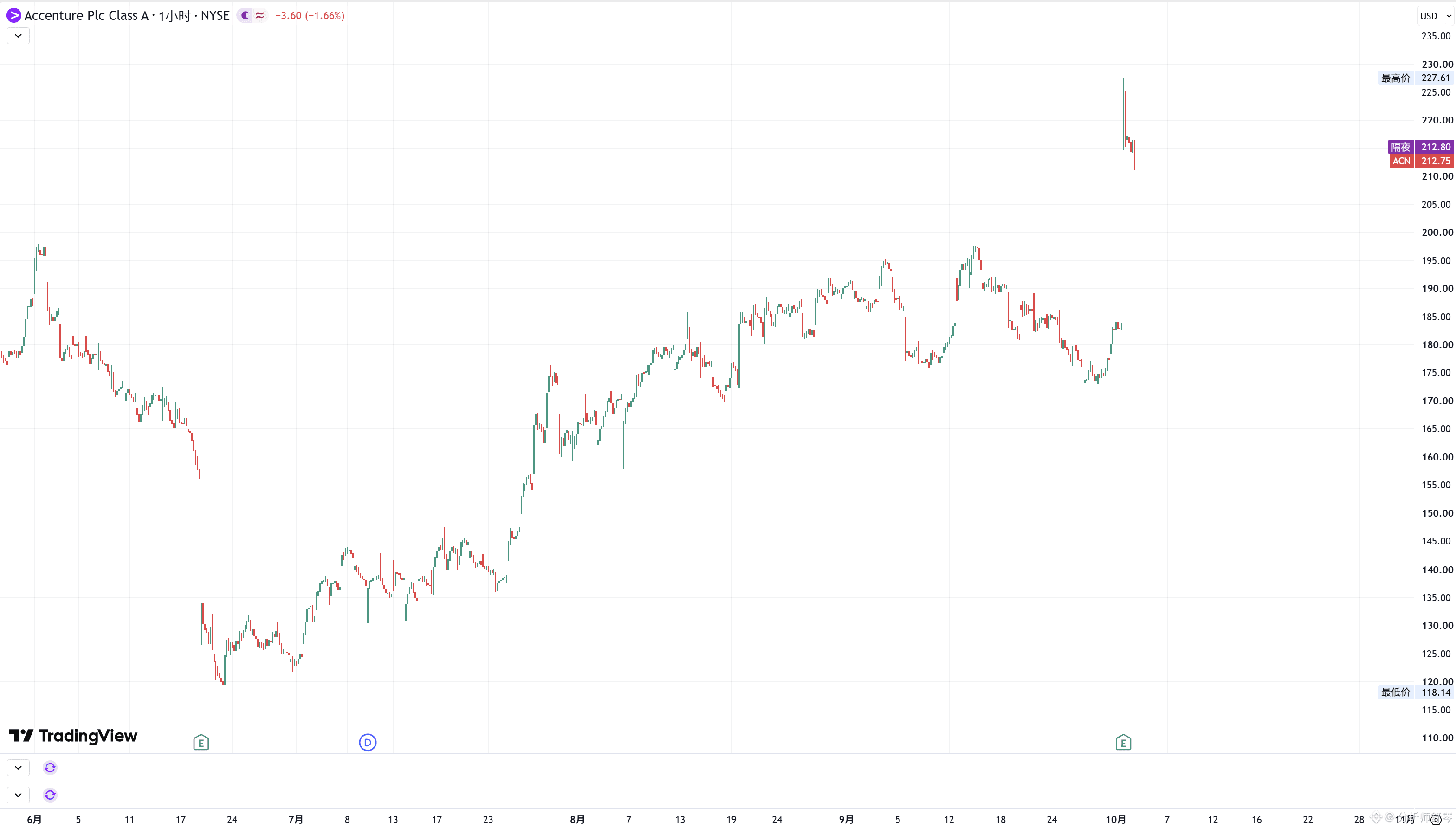
1. During intraday trading on October 1, Accenture shares surged as much as 22%, the largest intraday jump since the company listed, and closed up about 15.8%. At the open, peers with strong gains led the way: Cognizant rose more than 10%, and IBM climbed nearly 5%—but unfortunately, those gains didn’t hold. So what happened?
2. The answer: the earnings report blew things wide open! Accenture’s fiscal fourth-quarter revenue was $18.7 billion, beating expectations of $18.05 billion. New orders came in at $22.2 billion, with a bookings-to-revenue ratio of 1.2. For the full year, it landed 141 deals worth $100 million-plus—an all-time high. It also added more than 400 AI customers.
3. Xiao Qin’s takeaway is that when businesses roll out AI, they need to build data foundations, assemble technology stacks, and overhaul processes—none of that can be done without external help. What AI cuts is low-end, repetitive work; what it creates is demand for higher-level implementation services. Of course, most importantly, AI safety is now front-page news—Anthropic partnering with Accenture to conduct evaluations is the key point.
4. But there’s one detail: ACN orders year over year rose only 4%, and full-year revenue grew only 5%. So it’s steady, not exactly high growth. Xiao Qin suspects this earnings report shows “things aren’t that dire,” but doesn’t yet prove “it’s time to take off.” How many of these big deals are one-off projects is something outsiders can’t tell.
5. Personally, Xiao Qin thinks these consulting firms are pretty similar to earlier software stocks: they’re down sharply because of panic over AI taking away jobs, slicing them in half. Saying “spring is here” may be too early. But given how much they’ve fallen, a rebound in the short to medium term is still possible. Going forward, it’ll come down to whether they can win more orders from more AI companies.
I feel like the AI era has spawned a whole bunch of new companies, and some old ones inevitably get nibbled at. If there isn’t a real business transformation, valuations may contract a bit—or at least not rise as fast in the long run. That’s probably something we should consider. What do you think~
1. During intraday trading on October 1, Accenture shares surged as much as 22%, the largest intraday jump since the company listed, and closed up about 15.8%. At the open, peers with strong gains led the way: Cognizant rose more than 10%, and IBM climbed nearly 5%—but unfortunately, those gains didn’t hold. So what happened?
2. The answer: the earnings report blew things wide open! Accenture’s fiscal fourth-quarter revenue was $18.7 billion, beating expectations of $18.05 billion. New orders came in at $22.2 billion, with a bookings-to-revenue ratio of 1.2. For the full year, it landed 141 deals worth $100 million-plus—an all-time high. It also added more than 400 AI customers.
3. Xiao Qin’s takeaway is that when businesses roll out AI, they need to build data foundations, assemble technology stacks, and overhaul processes—none of that can be done without external help. What AI cuts is low-end, repetitive work; what it creates is demand for higher-level implementation services. Of course, most importantly, AI safety is now front-page news—Anthropic partnering with Accenture to conduct evaluations is the key point.
4. But there’s one detail: ACN orders year over year rose only 4%, and full-year revenue grew only 5%. So it’s steady, not exactly high growth. Xiao Qin suspects this earnings report shows “things aren’t that dire,” but doesn’t yet prove “it’s time to take off.” How many of these big deals are one-off projects is something outsiders can’t tell.
5. Personally, Xiao Qin thinks these consulting firms are pretty similar to earlier software stocks: they’re down sharply because of panic over AI taking away jobs, slicing them in half. Saying “spring is here” may be too early. But given how much they’ve fallen, a rebound in the short to medium term is still possible. Going forward, it’ll come down to whether they can win more orders from more AI companies.
I feel like the AI era has spawned a whole bunch of new companies, and some old ones inevitably get nibbled at. If there isn’t a real business transformation, valuations may contract a bit—or at least not rise as fast in the long run. That’s probably something we should consider. What do you think~