

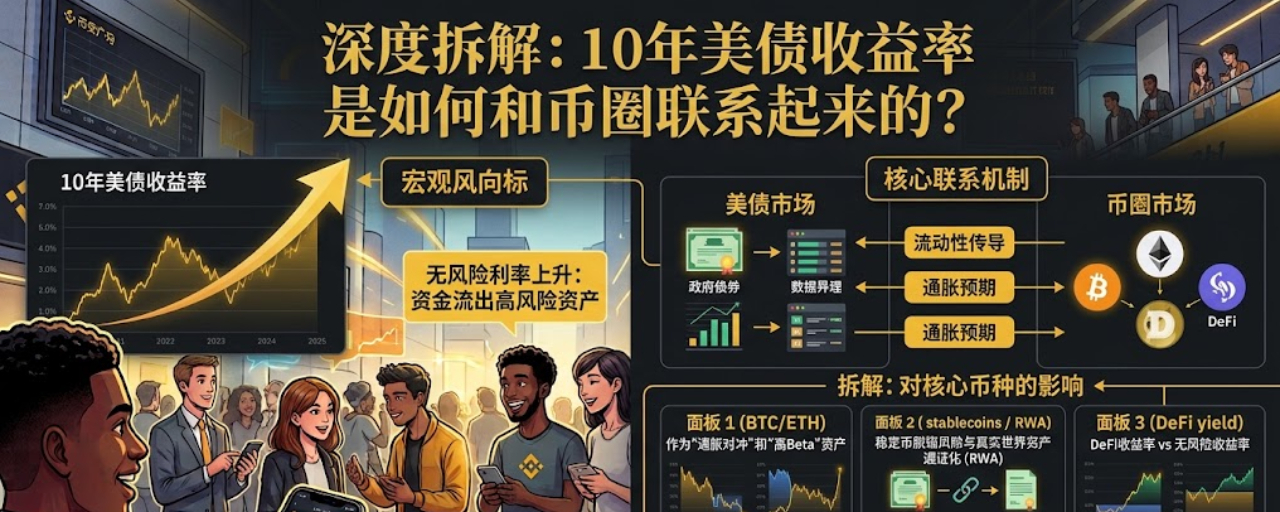

The US 10-year Treasury yield has already moved close to 5.3%.
On the surface, this news is about bonds, but what really matters is:
The US dollar, global liquidity, BTC, and the development of RWA next.
First, look at the data. #美国10年期美债收益率逼近5.3%
As of October 1, the US 10-year Treasury yield once climbed to 5.31%–5.34%, the highest level since 2002.
In September, the one-month rise was about 87 basis points, one of the most intense quarterly increases since 1994.
The 30-year Treasury yield has also exceeded 5.6%, similarly approaching the highest levels since 2002.
This is no longer ordinary volatility.
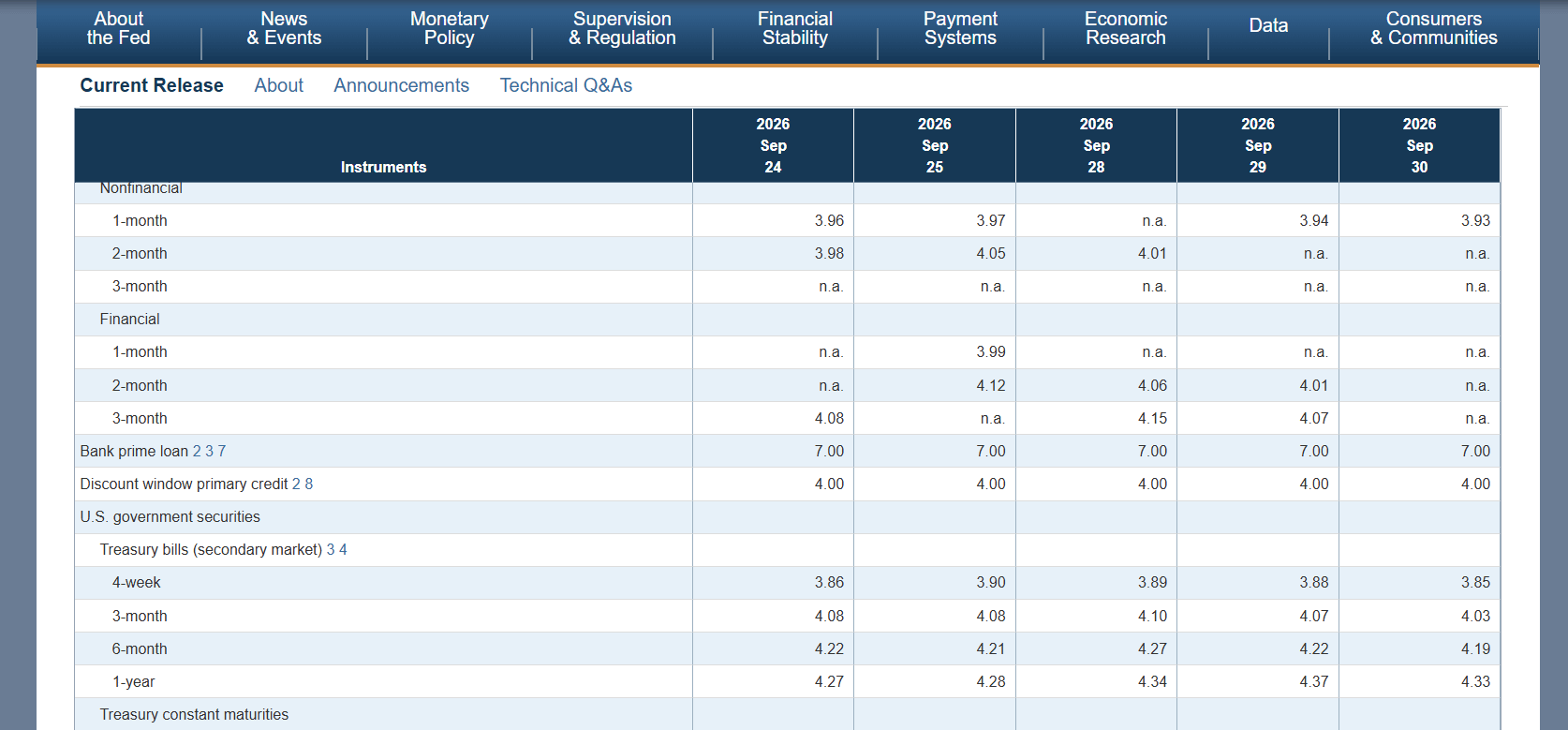
1. Why is the 10-year U.S. Treasury yield so important? #美财政部允许各州提前提交稳定币认证
You can interpret the 10-year U.S. Treasury as a pricing anchor for the global financial markets.
Its impact is felt across the cost of borrowing for the U.S. government, corporate financing costs, mortgages, stock valuations, the U.S. dollar, and even BTC and altcoins.
In simple terms:
The higher the 10-year Treasury yield, the higher the benchmark return for global capital.
Previously, capital might have thought:
Holding low-yield Treasury returns isn’t as good as buying stocks, BTC, and altcoins.
But if the 10-year Treasury yield gets close to 5.3%, capital will recalculate:
Why should I take on volatility of crypto assets—dozens of percent—to exchange for an uncertain return?
That’s where the pressure on risk assets comes from.
II. The most troublesome part this time isn’t just the Fed
When many people see Treasury yields rising, their first reaction is: #
Is the Fed going to raise rates?
But this time it can’t be understood only in that way.
In recent weeks, U.S. core PCE year-over-year growth is about 3%, with no clear surprise beyond expectations.
By normal logic, if inflation doesn’t keep worsening, long-term bond yields should face downward pressure.
But the 10-year U.S. Treasury yield still surged to around 5.3%.
This shows the market is worried not only about short-term rates, but more long-term issues.
1. U.S. fiscal deficits and the scale of debt issuance
The U.S. government needs to issue a large amount of Treasuries.
As bond supply increases, the market demands higher yields before it’s willing to keep taking the risk.
In short:
There’s too much debt, so buyers demand higher interest.
IV. Inflation may not be so easily able to return to 2%
Even if short-term inflation data hasn’t clearly worsened, oil prices, wages, and fiscal spending could still keep long-term inflation expectations elevated.
If the market doesn’t believe inflation will return smoothly to 2%, it won’t be willing to hold U.S. Treasuries long-term at lower yields.
3. The U.S. economy hasn’t shown a clear recession
This connects with the earlier U.S. initial jobless claims figure of 197,000.
The job market hasn’t deteriorated noticeably, and the economy isn’t bad enough that the Fed needs to quickly step in to support the markets.
So what the market is facing now is a rather troublesome combination:
Inflation hasn’t fully disappeared
Employment is still relatively strong
The U.S. fiscal deficit is large
Treasury supply continues to increase
With these factors combining, they will push long-term U.S. Treasury yields higher.
III. And this is related to $BTC

What’s the actual connection?
You can’t just write it as:
If U.S. Treasury yields rise, BTC has to fall.
The real transmission chain is:
10-year U.S. Treasury yields rise
↓
The risk-free return on dollar assets increases
↓
The opportunity cost of holding cash and U.S. Treasuries declines
↓
Capital’s requirements for risk assets increase
↓
Equity and crypto valuations face pressure
↓
Highly leveraged and highly valued assets get affected first
So the first thing to feel the pressure is often not BTC.
Instead:
Small-cap altcoins
Overvalued tokens
Pure narrative projects
Highly leveraged positions
BTC’s ability to withstand pressure is typically stronger than these assets.
But if U.S. Treasury yields and the U.S. dollar both strengthen, BTC also will be hard to keep rising easily.
IV. Why is this time’s BTC reaction worth watching?
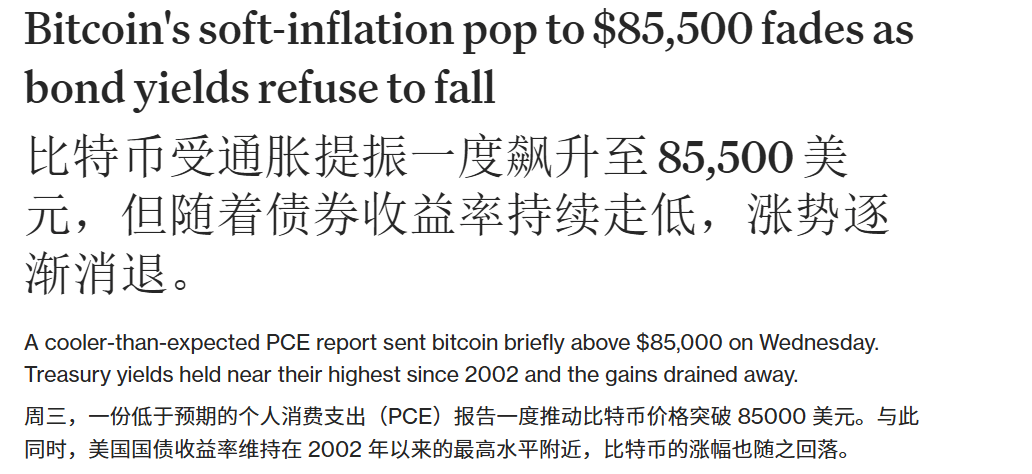
On September 30, after U.S. core PCE came in below market expectations, BTC briefly surged to around $85,500.
By normal logic:
Inflation cools
↓
Pressure on the Fed eases
↓
BTC continues to rise
But in reality:
After BTC surged above $85,000, the gains were quickly swallowed up.
The reason is that the 10-year Treasury yield hasn’t fallen in sync and is still around 5.3%.
CoinDesk also mentioned that BTC’s rise driven by PCE later gradually faded as Treasury yields stayed high.
This suggests that what’s suppressing BTC might not be only short-term inflation anymore.
Instead:
Long-term cost of capital is too high.
V. The dollar is also helping tighten liquidity
There’s another variable you can’t ignore now:
The U.S. Dollar Index is also strengthening.
Recently, the U.S. dollar has risen to around a 17-month high.
So the market ends up with:
U.S. Treasury yields rise
Add to that:
The dollar strengthens
When these two factors combine, it means global dollar liquidity is tightening.
Cryptocurrencies are essentially global, U.S.-dollar-denominated assets.
The stronger the dollar, the higher the cost for investors from other countries to buy BTC, ETH, and SOL.
So what BTC truly needs isn’t just Fed rate cuts.
More importantly:
Dollar liquidity becomes loose again.
VI. If U.S. Treasury yields rise, will BTC definitely fall?
You also can’t judge it that simply.
Because the reasons behind yield rising and yield falling could be completely different.
Scenario one: the economy is strong, inflation is high, and long-term bond yields rise
This is troublesome for BTC and risk assets.
Because the economy is still doing okay, the Fed has no reason to loosen quickly.
Meanwhile, inflation hasn’t fully disappeared, so long-term yields remain elevated.
This is the situation the market is most worried about right now.
Scenario two: economic recession, long-term bond yields fall
This situation also doesn’t necessarily mean an immediate positive for BTC.
Because although interest rates are falling, an economic downturn can reduce risk appetite, and capital may first pull out from risk assets.
So:
A decline in yields doesn’t mean BTC will definitely rise.
The real comfortable environment is:
Inflation cools
Plus:
The economy isn’t collapsing
Plus:
Long-term yields fall back
and:
The dollar weakens
Only when these conditions show up together is the most comfortable environment for risk assets.
VII. Why can this news still be connected to RWA?
This is where it gets most interesting.
The higher the Treasury yields, the more attractive U.S. Treasuries themselves become.
Traditional capital thinks:
If U.S. Treasuries can offer nearly 5.3% returns, why go chasing higher-risk assets?
But on-chain investors may ask another question:
Can tokenized U.S. Treasury bond yields be done directly, and then used on-chain?
That’s Tokenized Treasury—U.S. Treasury tokenization.
So the high U.S. Treasury yields have two sides for the crypto market.
First side: suppress BTC and altcoins
Because the risk-free return increases, capital is unwilling to take on too much risk.
The second side: increase the attractiveness of on-chain U.S. Treasuries
Because the yield of U.S. Treasuries themselves has risen, the products of Tokenized Treasury become more attractive.
That’s why:
When Treasury yields rise, they may suppress risk assets, but at the same time they also drive RWA development.
VIII. Tokenized securities in South Korea and U.S. Treasury bills can be strung into a single line
Yesterday’s news out of South Korea was about:
Stocks, bonds, and funds begin entering a tokenized securities framework.
Today’s news out of the U.S. is saying:
U.S. Treasury yields have risen to the highest level since 2002.
Look at these two pieces of news together:
Returns on traditional assets improve
↓
Traditional assets are more worth holding
↓
Traditional assets begin to be tokenized
↓
U.S. Treasuries, stocks, and funds could all move into on-chain financial systems
↓
Stablecoins become dollars on-chain
This isn’t just about “moving real estate onto the chain.”
The next phase of RWA might be:
U.S. Treasuries
Stocks
Bonds
Funds
Money market funds
All of them become financial assets that can be held, transferred, and settled on-chain.
IX. Which coins can connect to this news?
$ONDO
This is the most direct line.
ONDO itself is already doing Tokenized Treasuries and on-chain real-world assets.
Also, recently South Korea has been pushing the tokenization of stocks, bonds, and fund products; Ondo has also just been studying the tokenization of South Korean stocks and overseas distribution with Kakao Pay Securities.
So now you can string these lines together:
U.S. Treasury yields rise
↓
The on-chain yield on U.S. Treasuries becomes more attractive
↓
South Korea begins pushing the tokenization of traditional securities
↓
ONDO lays out both U.S. Treasuries and tokenized South Korean stocks
That’s what ONDO is most worth watching right now.
But note:
The growth of the RWA industry doesn’t necessarily mean the ONDO token will definitely rise.
You also need to keep watching its real TVL, the size of Tokenized Stocks, inflows of capital, and exactly how much protocol value the ONDO token can capture.
$ETH
ETH is more like underlying infrastructure.
Many RWA projects still revolve around the Ethereum ecosystem.
If more and more traditional assets move onto the chain, the Ethereum ecosystem may continue to take on part of the functions of issuance, trading, and settlement.
SOL
SOL is positioned in the high-performance public chain and financial applications route.
If more securities trading, tokenized assets, and on-chain financial activity require high throughput, SOL may also become a competitor.
But its risk profile is clearly higher than BTC and ETH.
LINK
LINK is data, cross-chain, and institutional finance infrastructure.
Once RWA truly runs, it needs:
Asset price data
Corporate action data
Cross-chain transmission
Collateral management
Data interoperability between institutions
So LINK is more like a shovelful infrastructure project.