


Main post topics:
From VietQR in Vietnam to PayPay in Japan, Binance Pay is integrating with national QR payment infrastructures along Asia’s major travel corridors.
The number of active tourist users on Binance Pay grew 20% between July and August 2026, a sign that ongoing crypto payments for local currency are resonating with travelers.
Tourists visiting Japan can now pay directly with crypto at millions of locations with PayPay support across the country, without needing to exchange JPY in advance.
Paying by QR code is already second nature in much of Asia—whether it’s getting a coffee in Hanoi or buying food in Tokyo.
Binance Pay lets tourist users spend crypto directly from their Binance balance, and over the past year it has been connecting to this everyday habit—directly integrating with national QR systems so that travelers can pay with crypto in the same way local residents already pay with QR codes, cash, or cards.
This reach now extends to Japan through a new integration with PayPay, one of the country’s most widely used payment platforms. Next, we share the story of how this network came together, what it means to pay like a local—and where Binance Pay is going next.
Connecting to national QR infrastructure across Asia-Pacific
From VietQR in Vietnam to PayPay in Japan, Binance Pay is integrating with national QR payment infrastructures across the main travel corridors of Asia. Each integration works the same way: no new app to download, no separate wallet to add funds—just a scan via Binance Pay at merchants that travelers already visit.
How the network works
Many countries already run their own national QR standard, or one supported by banks—the system a local uses every day to pay for coffee, the supermarket, or a taxi ride. Instead of building a separate payments network from scratch, Binance Pay connects directly to these existing standards. Merchants keep the QR code they already display. Travelers only need the Binance app and a crypto balance. There’s no need for a local bank account, new hardware, or a separate wallet.
A traveler told us how it works in practice during a visit to Vietnam: as a foreign tourist, they don’t need to exchange currency or carry cash. Just scan with Binance Pay and pay using stablecoins like USDT or USDC, or other tokens like BTC, BNB, or ETH. Transactions are settled with real-time exchange rates. On the merchant side, the shop owner receives the local currency directly—making the experience seamless on both ends.
The number of active tourist users on Binance Pay grew 20% between July and August 2026, a sign that ongoing crypto-to-local currency payments are resonating with travelers. Ask any of them why, and the reasons tend to be the same: small practical conveniences that, together, make the trip much easier.
One app, multiple countries. The same Binance Pay experience, whether in Hanoi or Tokyo.
No need to exchange currency. Pay with crypto, and the merchant receives local fiat currency.
No gas fees. Real-time conversion at spot exchange rates.
Japan’s PayPay network joins Binance Pay for tourists
This same seamless experience is now coming to Japan—one of Asia’s most visited destinations, with millions of PayPay-supported locations across the country.
With this integration, tourists can scan a PayPay merchant’s QR code or show their own payment code for the merchant to scan and pay directly with crypto from their Binance account balance. There’s no need to exchange JPY in advance.
The benefits remain the same as across the rest of the network: a convenient, familiar payment experience; real-time conversion at the point of payment; and wide coverage across more than one million PayPay locations, including convenience stores, restaurants, and much more.
Imagine landing in Tokyo after a long flight. A quick stop at a convenience store to buy water and snacks, and the PayPay QR code is right there at the checkout. Open Binance Pay, scan, and you’re done—no hassle, no cash on hand, and no conversion worries.
Note: This PayPay QR payment feature is visible and available exclusively to tourists visiting Japan who have completed Binance identity verification. It is not available for Japan residents.
How to pay at PayPay merchants
The PayPay QR feature is already built right into the Binance app, so there’s nothing extra to download or set up.
When you arrive at the checkout, the payment takes just a few taps—just as fast and convenient as you’d expect when you tap a card or open a local wallet app. See exactly how it works:
Open the Binance app and tap the [Pay] icon.
Tap the [PayPay] icon.
Present your PayPay payment code: display your code in the Binance app and let the merchant scan it.
Confirm and complete the payment. Your crypto is automatically converted to JPY at the time of payment.
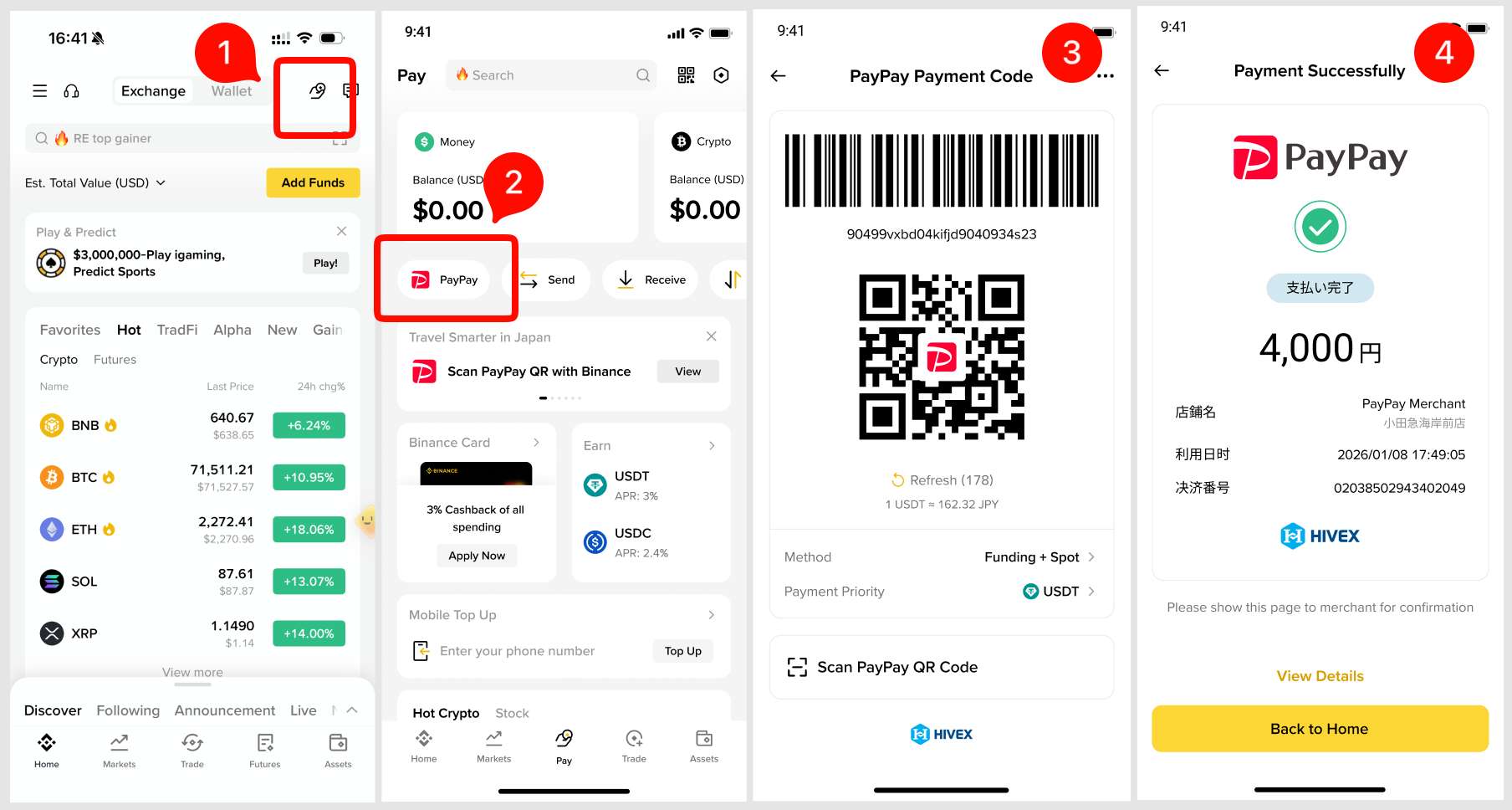
At some local stores that accept PayPay, you can also scan the merchant’s PayPay QR code, and then enter the payment amount to complete the transaction. To learn more with step-by-step instructions, check out our detailed guide: How to pay with Binance Pay at a PayPay store in Japan as a visitor.
What’s next for QR payments
Japan is the latest stop, not the last.
The next phase of Binance Pay focuses on expanding coverage across the APAC region while also exploring other regions where QR payments are already part of everyday life, with strong tourist traffic. The same conditions that made Vietnam and Japan such natural choices.
The idea is simple: go where QR is already how people pay, so that crypto fits into a habit that travelers and merchants already know. A year ago, this network didn’t exist. Today, it covers some of Asia’s busiest travel corridors.
Paying abroad should feel as familiar as paying at home, using the phone you already carry. That’s what Binance Pay is building—one trip at a time.
Further reading
Binance Pay will expand crypto QR payments to 10+ countries by Q3 2026
Binance Pay: scan QR codes to pay like a local in 7 countries
Binance Pay is already available at 3,700+ merchants in Bhutan
Risk/Disclaimer alert: Digital asset prices can be volatile. The value of your investment can go down or up, and you may not get back the value of your invested amount. You are solely responsible for your investment decisions, and Binance is not responsible for any losses you may incur. You should not invest more than you can afford to lose, and you should make sure you fully understand the risks involved. Past performance is not a reliable indicator of future performance. Before trading, consider your level of experience and your purchase objectives, and seek independent financial advice if necessary. It is your responsibility to check whether you have permission to use Binance services based on your individual circumstances. Top up your wallet and complete your transactions with caution. Not a financial recommendation. For more information, please refer to our Terms of Use, Binance Pay Terms of Use and Risk alert.
PayPay, VietQR, and QR Ph are registered trademarks of their respective owners. Binance is not affiliated with, nor endorsed by, these entities unless expressly stated.
The products and services mentioned here may not be available in your region.
Attention: Please note that there may be discrepancies between this original English content and any translated versions (these versions may be generated by AI). Please refer to the original English version for the most accurate information in case of any discrepancies.