


When someone tells you:
“I already sent you the cryptocurrencies.”
there are two ways to respond.
The first is to trust their word.
The second is much more interesting:
check it on the blockchain.
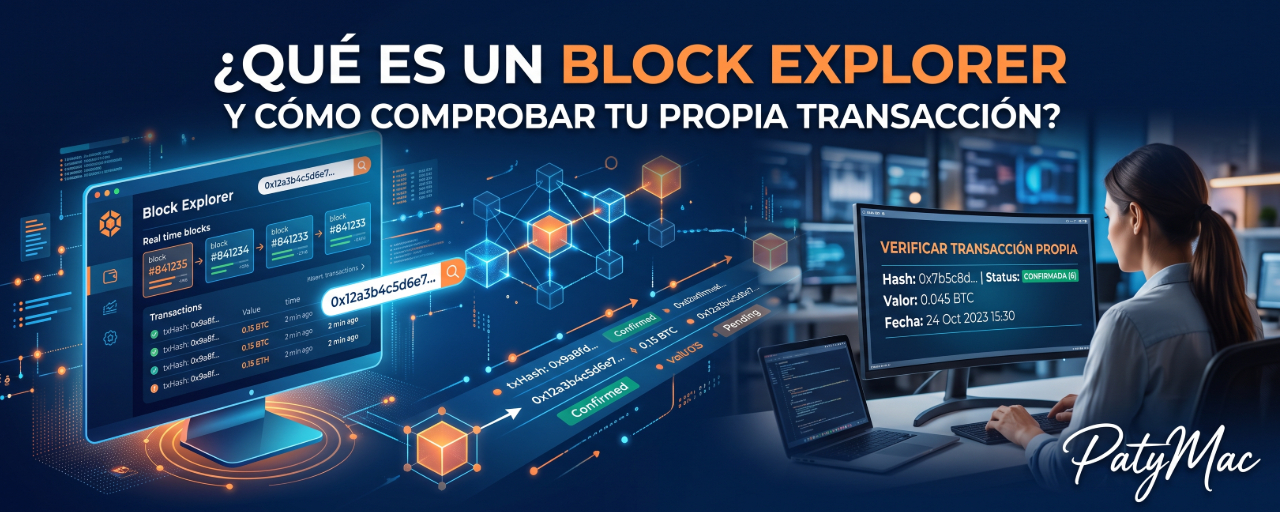
And for that there are Block Explorers, also called block explorers.
They are one of the most useful tools for anyone who uses cryptocurrencies, because they allow you to publicly look up information recorded on a blockchain.
But there is something important:
A Block Explorer is not the blockchain.
A tool that lets you query and visualize information the network records and makes available.
🔎 WHAT IS A BLOCK EXPLORER?
A Block Explorer is a tool that lets you query information from a blockchain.
Depending on the network, we can find information such as:
blocks;
transactions;
public addresses;
transferred amounts;
fees;
dates and times;
a transaction’s status;
number of confirmations;
smart contracts;
tokens;
and other specific data for each network.
In other words:
it’s like a query window into the activity recorded on a blockchain.
It doesn’t mean we can see absolutely everything.
For example, on a public blockchain we can observe an address and its movements, but the address by itself doesn’t necessarily tell us who controls it.
🧩 HOW DOES IT WORK?
Let’s imagine that Patricia sends USDT to someone else.
Simplifying, the operation goes through several stages:
Wallet → transaction → network → validation → block → record
Once the transaction is recorded, you can use the corresponding explorer for that network to locate it.
That’s why it’s so important to know which network the operation was carried out on.
There is no single universal explorer for all blockchains.
For example:
Bitcoin → Bitcoin explorers.
Ethereum → Ethereum explorers.
BNB Chain → BscScan.
Tron → Tronscan.
And there are many other things depending on the network.
💡 A VERY SIMPLE EXAMPLE
Let’s suppose someone tells you:
“I sent you 100 USDT.”
You have a public address and you expect to receive them.
Instead of only relying on a screenshot, you can check the address in the corresponding explorer.
There you could verify:
Receiving address → transaction → asset → amount → status → date → TXID
If the transaction was really recorded on that network, you’ll be able to find public evidence of it.
But pay attention:
for example, if someone sends you a screenshot, that doesn’t necessarily prove they carried out a transfer.
A screenshot can be edited.
A transaction located by its identifier in the explorer allows for a much stronger technical check of what happened.
🧠 WHAT DOES “CONFIRMED” MEAN?
This concept is fundamental.
A transaction can go through different states depending on the blockchain and the explorer.
For example:
🟡 Pending
The transaction was broadcast, but it hasn’t yet reached the expected final state.
🟢 Confirmed
The operation was included and has confirmations according to the rules of that network.
🔴 Failed
The operation did not execute correctly.
But be careful:
“confirmed” doesn’t automatically mean everything went as the person expected.
You need to check which transaction was confirmed, what asset was involved, on which network, which address received the funds, and what the result was.
💰 WHAT CAN I SEE ABOUT A TRANSACTION?
Depending on the blockchain, an explorer may show data such as:
✔ Sender address
✔ Destination address
✔ Transferred asset
✔ Amount
✔ Fee
✔ Date and time
✔ Block
✔ TXID or hash
✔ Status
✔ Confirmations
And on certain networks we can also look up information related to smart contracts and tokens.
⚠️ BUT THERE IS A FUNDAMENTAL DIFFERENCE
A blockchain address does not necessarily equal a civil identity.
We can find:
Address: 0xABC...
and see that that address received a certain amount.
But that doesn’t mean the explorer will say:
“This address belongs to Juan Pérez.”
The blockchain can record an operation.
The legal identification of the person behind that address is another matter.
And here an extremely important difference appears between:
ON-CHAIN INFORMATION
What we can observe and verify technically in the blockchain.
LEGAL IDENTITY
The natural or legal person who legally controls, owns, or is associated with certain assets or rights.
They’re not necessarily the same thing.
⚖️ AND FROM A LEGAL POINT OF VIEW?
This point is especially interesting.
A blockchain record can constitute an element of evidence about certain technical facts:
that a transaction was recorded;
that certain addresses interacted;
that a certain asset was transferred;
that an operation happened on a certain date or block.
But that doesn’t necessarily follow, by itself:
who legally was the owner of the asset.
To establish that, other elements may be needed:
contracts;
exchange records;
receipts;
communications;
client identification;
bank information;
custody records;
devices;
statements;
and other evidence sources.
That’s why:
Blockchain can provide technical evidence. Law must analyze its legal meaning in the specific case.
🚨 CAN A BLOCK EXPLORER BE USED TO DETECT A SCAM?
It can be a very useful tool for investigation.
For example, let’s imagine someone claims:
“I sent the USDT yesterday.”
We can ask for the:
TXID
and look up the transaction.
If there is no corresponding operation, an inconsistency appears that deserves investigation.
But we also shouldn’t jump to conclusions.
It may have been used:
another network;
another address;
another asset;
another identifier;
or a different operation.
That’s why you must verify all the data.
🛑 THE 5 MISTAKES YOU MUST AVOID
1️⃣ Search in the wrong explorer
A transaction made on Tron will not necessarily appear in an Ethereum explorer.
2️⃣ Confusing address with TXID
The address identifies an account/address within the network.
The TXID identifies a specific transaction.
3️⃣ Look only at the amount
You must also check:
asset + network + sender + recipient + status.
4️⃣ Trusting only a screenshot
A screenshot may show incomplete or manipulated information.
5️⃣ Thinking blockchain automatically reveals identity
The blockchain can show activity from a public address.
It doesn’t necessarily reveal who is behind it.
🔐 BLOCK EXPLORER AND PRIVACY
Here another interesting point comes up.
Public blockchains can provide an enormous amount of information.
A person can analyze:
movements;
balances;
frequency of operations;
related addresses;
used contracts;
amounts;
time patterns.
That’s why:
public doesn’t necessarily mean anonymous.
Many blockchains are more accurately described as pseudonymous systems.
The address may be visible even if the real identity of its controller isn’t directly.
🧭 PATYMAC CHECKLIST
Before accepting a transfer as true, check:
☑️ What is the network?
☑️ What is the receiving address?
☑️ What is the asset?
☑️ What is the amount?
☑️ What is the TXID?
☑️ Is the transaction confirmed?
☑️ Does the receiving address match exactly?
☑️ Is the network used compatible with the receiving platform?
And only then:
draw your conclusions.
🎯 INTERESTING QUESTIONS
❓Do I need an account to use a Block Explorer?
Usually not. Public explorers let you query certain information directly.
❓Can I know who owns an address?
Not necessarily. A public address doesn’t automatically equate to a civil identity.
❓Can a confirmed transaction disappear?
Once recorded on a blockchain, the answer depends on the characteristics and rules of that network. We shouldn’t assume all blockchains work exactly the same.
❓Does a screenshot prove a transfer?
Not by itself. It’s much more useful to have the transaction identifier and verify it directly in the corresponding explorer.
❓So can I investigate a transfer on my own?
Yes. And learning to do it is one of the basic skills every crypto user should have.
🔥 FINAL IDEA
For a long time, people heard:
“The blockchain is transparent.”
But transparency without knowledge is of little use.
The real advantage appears when you know:
where to look, what to search for, and how to interpret what you’re seeing.
Because in crypto you don’t always have to ask:
“Did they send me the money?”
Sometimes you can ask something much more specific:
“What is the TXID?”
And from there, start verifying.
📌 CRYPTO GLOSSARY #9
Block Explorer = tool to query information recorded on a blockchain.
And the next concept takes us directly to the next level:
TXID.
Because if the Block Explorer is the window…
the TXID is the fingerprint that lets us find a specific transaction.



#GlosarioCripto #BlockExplorer #Blockchain #CryptoEducation #CryptoSecurity