
🚨 Binance P2P: 3 mistakes that can put you at risk and how to avoid them
P2P trading (Peer-to-Peer) offers a practical way to buy and sell cryptocurrencies directly with other users. But that convenience also requires discipline: an apparently small mistake — such as accepting a payment from a third party or releasing funds without verifying the money — can turn into a financial problem or a difficult-to-resolve dispute.
Binance recommends carefully checking payment details, not accepting payments from third parties, and keeping operations within the platform. �
Binance +1
Next, three common mistakes and a simple way to avoid them.
1️⃣ Accept payments from third parties
❌ The error
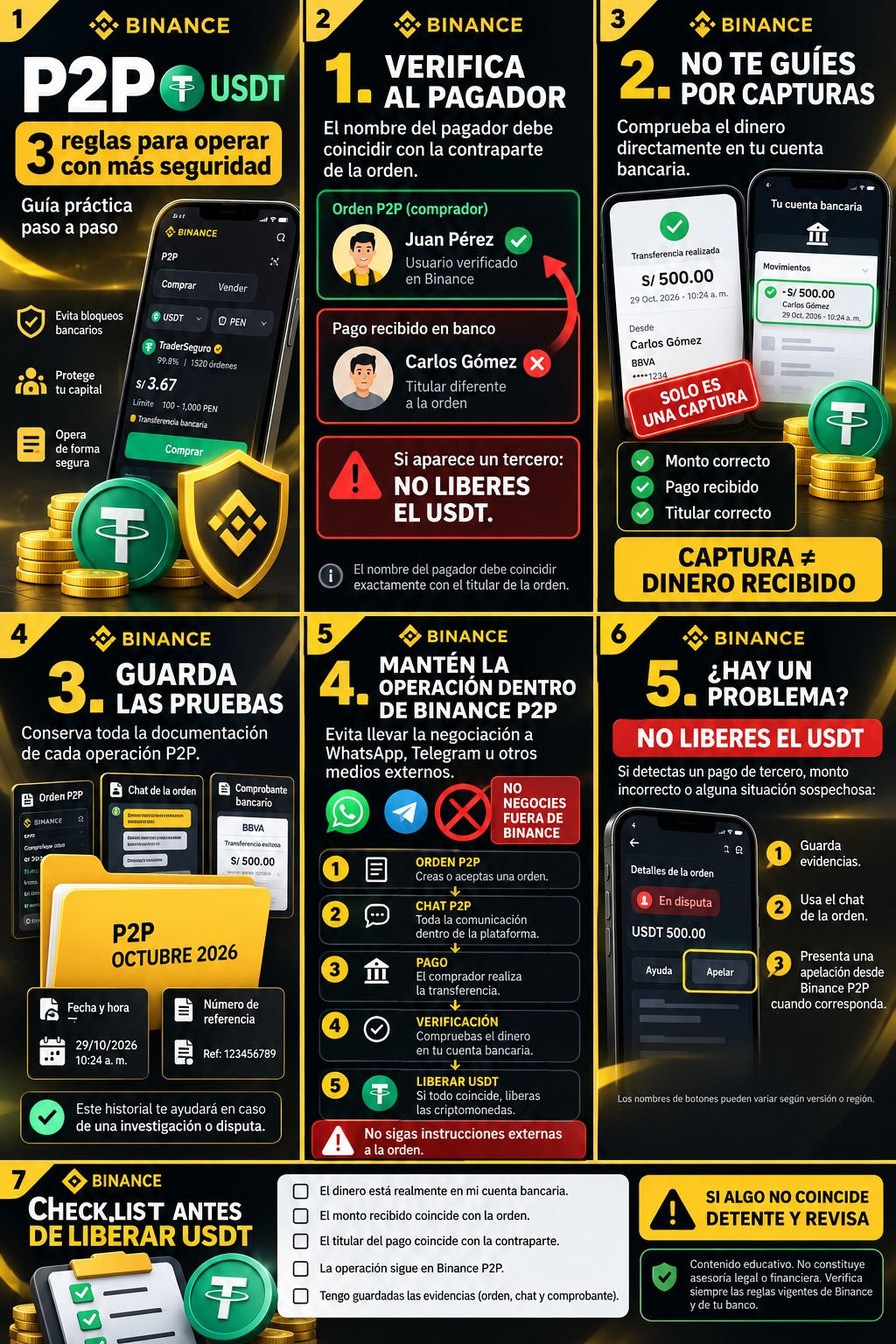
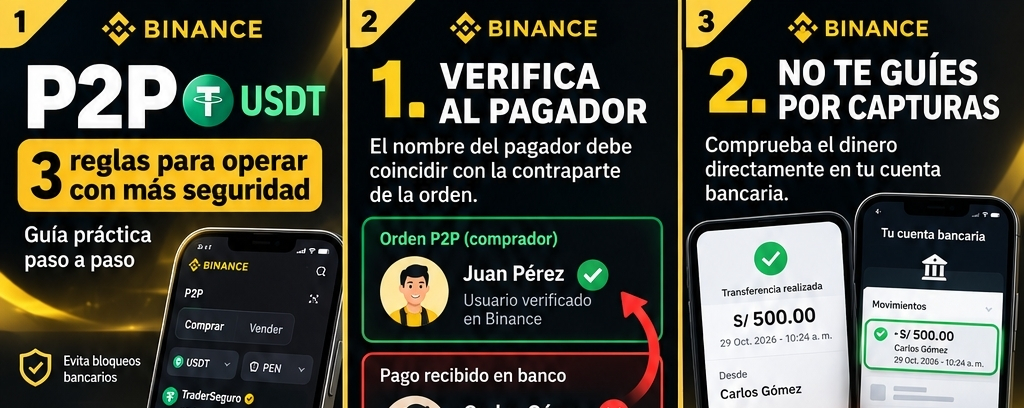
You carry out a P2P transaction with Juan Pérez, but the money arrives from a bank account belonging to Carlos Gómez.
It may seem normal when the buyer says:
“It's my brother's account.”
“My wife will make the payment.”
“My friend is helping me.”
But the problem is that the account holder of the account from which the payment comes does not match the counterparty of the transaction.
Binance states that the payment account details must match the user's verified identity; in case of a discrepancy, its guidelines indicate that the cryptocurrencies should not be released and that a refund/appeal may apply depending on the case. �
Binance +1
✅ What to do?
Before releasing the cryptocurrencies:
1. Check the buyer's name.
2. Check the account holder of the account that made the payment.
3. Check the received amount.
4. If there is a discrepancy, don't release the funds immediately.
📌 Practical example
P2P Order: Juan Pérez — 1,000 USDT
Payment received: Carlos Gómez — S/ 3,500
🚨 Don't automatically continue with the operation.
Keep the proof and use Binance's appeal mechanisms when appropriate. Binance also indicates that, if payment is made from an account whose holder doesn't match, the seller may submit an appeal and follow the procedure indicated by Support. �
Binance +1
2️⃣ Don't save evidence of your transactions
❌ The error
You end a transaction and delete:
Screenshots.
Conversations.
Bank statements/receipts.
Order number.
Date and time.
Payment-related information.
While everything works correctly, it can seem unnecessary.
But if later a dispute arises, having an organized history can help you explain what happened.
Binance recommends keeping relevant evidence when there's a problematic transaction and allows attaching screenshots during an appeal process. �
Binance
✅ A simple solution
Create a folder:
📁 BINANCE P2P — OCTOBER 2026
And within it, he keeps:
📂 Operation 001
Capture the order
Bank receipt
Relevant screenshots from the chat
📂 Operation 002
Capture the order
Receipt
Evidence
That way, you'll have an organized record of your transactions.
3️⃣ Move the negotiation outside of Binance
❌ The error
The buyer or seller tells you:
“Let's talk on WhatsApp.”
O:
“I'll send you my details via Telegram.”
O:
“Make the payment directly and then we'll finish the order.”
Here is an important problem: you take part of the transaction out of the platform environment.
Binance recommends keeping communication within the P2P chat and warns about the risks of negotiating or making transactions outside the platform. �
Binance +1
✅ The rule of thumb
P2P Order → P2P Chat → Payment → Verification → Release.
Avoid moving negotiations to external channels.
And something even more important:
💰 Never release the cryptocurrencies just because they send you a screenshot.
Check directly in your bank account that the money has arrived and that the amount matches the transaction. Binance also warns about fake payment receipts. �
Binance
🛡️ My checklist before releasing a P2P transaction
Before clicking “Release,” ask yourself these questions:
☑️ Is the money really in my account?
☑️ Does the received amount match the order?
☑️ Does the payer's name match the counterparty?
☑️ Is the transaction still within Binance P2P?
☑️ Do I have the important evidence saved?
☑️ Is there any strange sign or pressure to release quickly?
If something doesn't match, stop and review the situation before releasing.
🚨 What if something goes wrong?
Don't try to resolve a suspicious situation by improvising.
Keep the evidence, use the order's chat, and when appropriate, submit an appeal within Binance P2P. Binance has a specific procedure for submitting appeals and attaching information related to the transaction. �
Binance
Official Binance guide: how to appeal P2P orders�
🎯 Conclusion
P2P isn't just about finding a good price. It also involves verifying, documenting, and maintaining traceability for each transaction.
Remember these three rules:
👤 1. IDENTITY
Avoid third-party payments and verify that the data matches.
📂 2. EVIDENCE
Save receipts, orders, and relevant conversations.
💬 3. TRACEABILITY
Keep the operation and communication within Binance P2P.
A secure P2P transaction starts long before receiving the money: it begins by checking who you're negotiating with and ends when you've correctly verified the payment. #P2P #BTC