I thought that staking $ETH i SOL differs only by the yield percentage😅. I went to compare the mechanics—and the difference turned out to be much deeper.
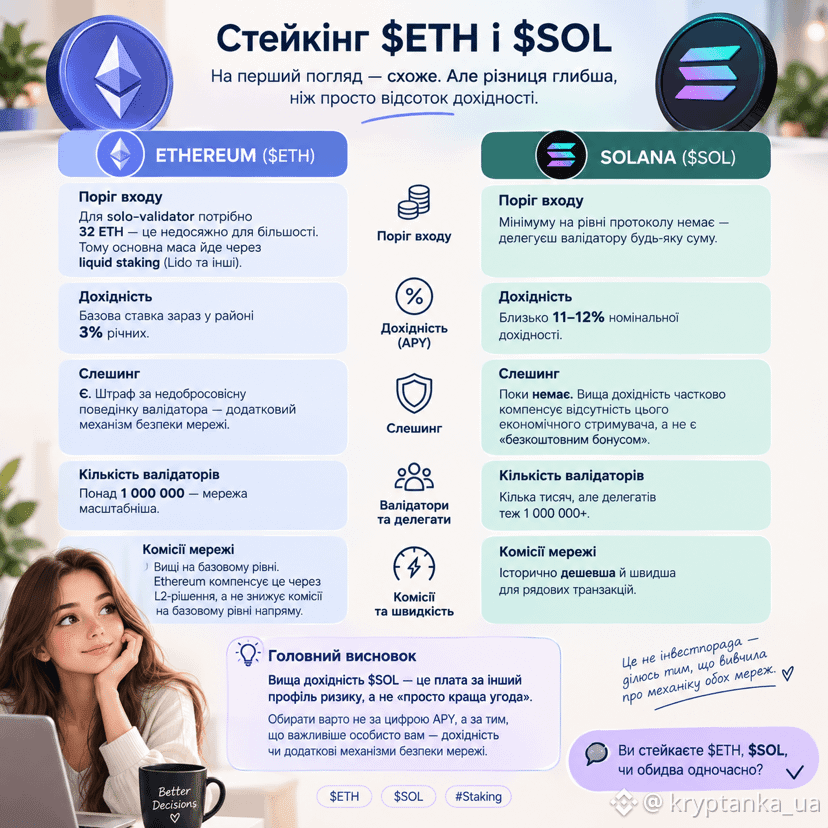
The entry threshold is the first difference. To stake ETH on your own, you need 32 ETH—which is out of reach for most people—so the bulk goes through liquid staking. On SOL, there is no protocol-level minimum: you delegate any amount to a validator.
Yield is also not in Ethereum’s favor: the base ETH rate is around 3%, while SOL offers about 11–12%. But there’s a catch:
— ETH has slashing—a penalty for a validator’s dishonest behavior, an additional security mechanism;
— SOL currently doesn’t have slashing, so the higher yield partly compensates for the absence of this deterrent, not “a free bonus”;
— by number of validators, Ethereum is more scalable—over a million versus a few thousand on Solana.
As for fees: historically, Solana is cheaper and faster for everyday transactions, and Ethereum compensates for that via L2 rather than lowering fees directly.
My takeaway: choose not based on APY numbers, but on what matters more—yield or the network’s security mechanisms.
This is not investment advice—I’m just sharing what I learned about the mechanics of both networks.
Are you staking $ETH , $SOL , or both at the same time?👇
$ETH $SOL #Staking
The entry threshold is the first difference. To stake ETH on your own, you need 32 ETH—which is out of reach for most people—so the bulk goes through liquid staking. On SOL, there is no protocol-level minimum: you delegate any amount to a validator.
Yield is also not in Ethereum’s favor: the base ETH rate is around 3%, while SOL offers about 11–12%. But there’s a catch:
— ETH has slashing—a penalty for a validator’s dishonest behavior, an additional security mechanism;
— SOL currently doesn’t have slashing, so the higher yield partly compensates for the absence of this deterrent, not “a free bonus”;
— by number of validators, Ethereum is more scalable—over a million versus a few thousand on Solana.
As for fees: historically, Solana is cheaper and faster for everyday transactions, and Ethereum compensates for that via L2 rather than lowering fees directly.
My takeaway: choose not based on APY numbers, but on what matters more—yield or the network’s security mechanisms.
This is not investment advice—I’m just sharing what I learned about the mechanics of both networks.
Are you staking $ETH , $SOL , or both at the same time?👇
$ETH $SOL #Staking