# US initial jobless claims fall to 197,000: the four-week average also dips, but revisions can’t be ignored
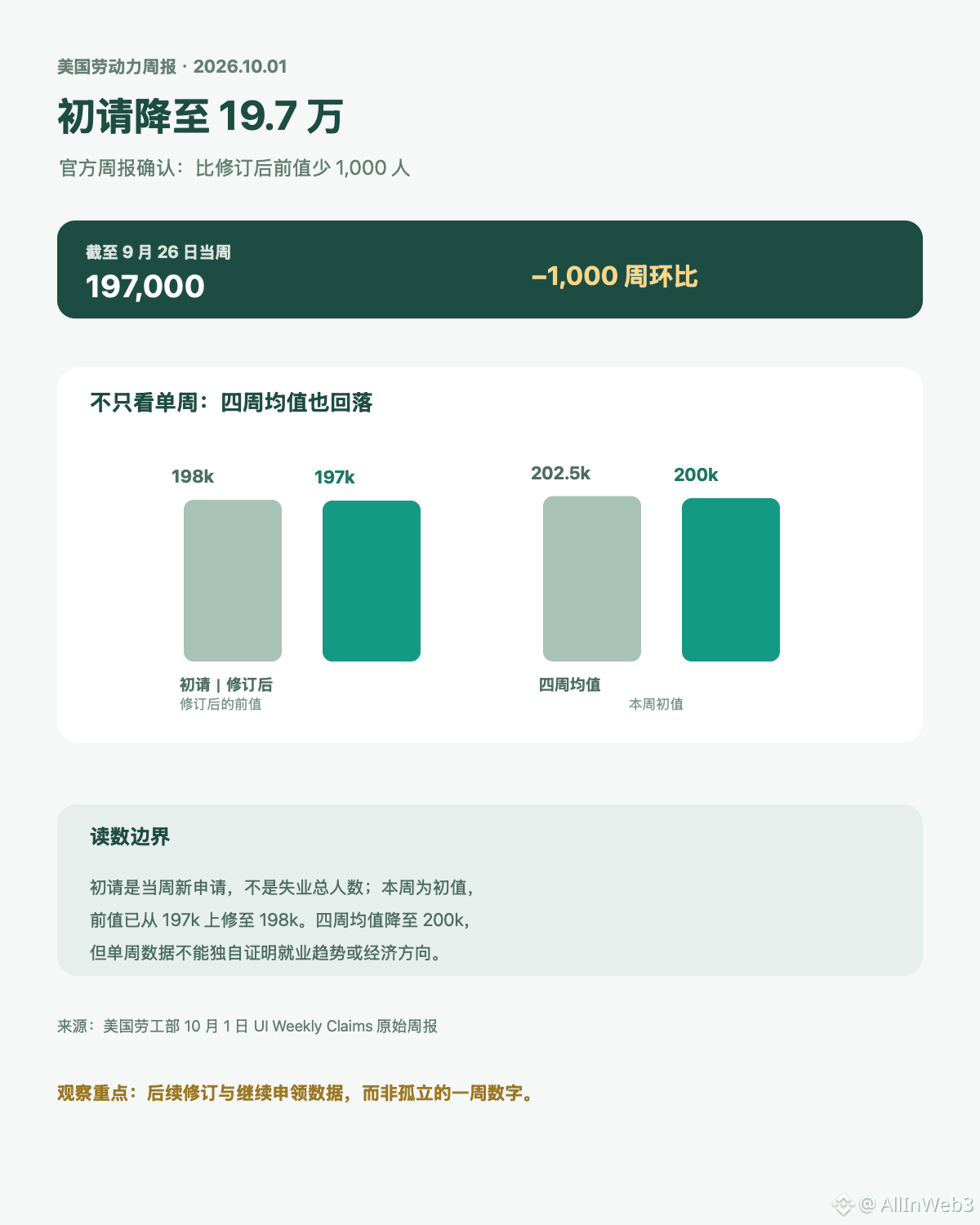
A weekly report released by the U.S. Department of Labor on October 1 shows that, for the week ending September 26, seasonally adjusted initial claims for unemployment insurance totaled 197,000. This is a decrease of 1,000 from the prior week, revised downward. The “falls to” in the headline is supported by the data, but the change is not large. More importantly, the prior week’s figure was revised up from the initially reported 197,000 to 198,000. When comparing week-to-week changes, use the revised baseline rather than the numbers from earlier fast alerts.
A smoother four-week moving average fell to 200,000, below the prior revised 202,500. The direction matches the single-week data. Another continued-claims indicator points to an earlier week as well: for the week ending September 19, seasonally adjusted insured unemployment (continuing claims) was 1.701 million, down 110,000 from the revised 1.712 million. All three measures are moving lower, suggesting that the near-term readings in this weekly report may be understated. They also refer to different statistical weeks and are not the same metric. The Labor Department’s table also lists last year’s comparable week’s seasonally adjusted initial claims at 225,000—this week is lower by 28,000. Year-over-year comparisons provide additional context, but they still depend on seasonality adjustments and the base period.
Be clear about the boundaries of the readings. Initial claims track new applications for unemployment insurance, not total unemployment. This week’s 197,000 is an advance figure and may be revised afterward. Weekly numbers are also affected by seasonality adjustments, holidays, and state-level reporting. Changes in a single week cannot, by themselves, prove that hiring is accelerating, nor can they directly imply a direction for the economy or the market. When assessing employment resilience, keep focusing on subsequent weekly-report revisions, the four-week average, and whether different survey measures—such as the unemployment rate and the nonfarm payrolls—are consistent with each other. When revisiting historical coverage, note that the initial figures reported at the time may differ from the revised values in today’s database.
The Labor Department’s original table also lists: unadjusted initial claims for the current week at 156,738, down 7,979 from the prior week. This measure cannot be mixed with the seasonally adjusted 197,000. Information is current as of 22:40 Beijing time on October 1, 2026. Source: U.S. Department of Labor, “Unemployment Insurance Weekly Claims,” report period ending September 26.
# US employment
A weekly report released by the U.S. Department of Labor on October 1 shows that, for the week ending September 26, seasonally adjusted initial claims for unemployment insurance totaled 197,000. This is a decrease of 1,000 from the prior week, revised downward. The “falls to” in the headline is supported by the data, but the change is not large. More importantly, the prior week’s figure was revised up from the initially reported 197,000 to 198,000. When comparing week-to-week changes, use the revised baseline rather than the numbers from earlier fast alerts.
A smoother four-week moving average fell to 200,000, below the prior revised 202,500. The direction matches the single-week data. Another continued-claims indicator points to an earlier week as well: for the week ending September 19, seasonally adjusted insured unemployment (continuing claims) was 1.701 million, down 110,000 from the revised 1.712 million. All three measures are moving lower, suggesting that the near-term readings in this weekly report may be understated. They also refer to different statistical weeks and are not the same metric. The Labor Department’s table also lists last year’s comparable week’s seasonally adjusted initial claims at 225,000—this week is lower by 28,000. Year-over-year comparisons provide additional context, but they still depend on seasonality adjustments and the base period.
Be clear about the boundaries of the readings. Initial claims track new applications for unemployment insurance, not total unemployment. This week’s 197,000 is an advance figure and may be revised afterward. Weekly numbers are also affected by seasonality adjustments, holidays, and state-level reporting. Changes in a single week cannot, by themselves, prove that hiring is accelerating, nor can they directly imply a direction for the economy or the market. When assessing employment resilience, keep focusing on subsequent weekly-report revisions, the four-week average, and whether different survey measures—such as the unemployment rate and the nonfarm payrolls—are consistent with each other. When revisiting historical coverage, note that the initial figures reported at the time may differ from the revised values in today’s database.
The Labor Department’s original table also lists: unadjusted initial claims for the current week at 156,738, down 7,979 from the prior week. This measure cannot be mixed with the seasonally adjusted 197,000. Information is current as of 22:40 Beijing time on October 1, 2026. Source: U.S. Department of Labor, “Unemployment Insurance Weekly Claims,” report period ending September 26.
# US employment