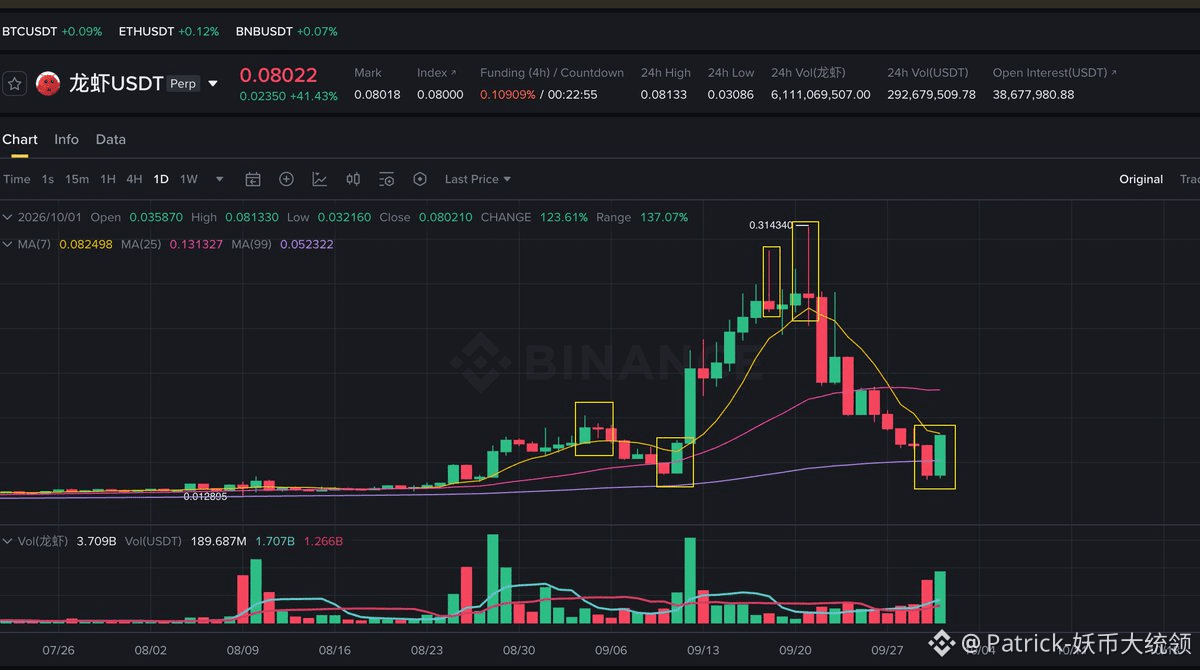
Regarding $龙虾 , I’ll share some ideas. The lobster has been rising and falling for about a month. I divided it into a few stages:
1. Starting on August 22, it began to pull up. At the first yellow box, it started to dump, and it dumped until the second yellow box—roughly at the 0.035 level.
2. After that, it kept pulling up. It ran about 10x, and at the top it probed twice: the two yellow boxes shown in the image.
3. Then it kept dumping, and today it has reached the 0.035 level again, and started to rebound.
If you were the market maker (the “zhuangjia”), you would have two choices:
1.
Spend massive amounts of money to pull it back to 0.3. Along the way, it’s unknown whether any retail traders will jump in. Also unknown: how many retail traders who were trapped in the previous long position would cut their losses, and whether they might take this opportunity to get out at breakeven (only the market maker knows this number).
2. Pull it to a certain high point (this high point isn’t enough to let those who chased it previously get out of their positions), but it still attracts new retail longs. Then you dump it down in one wave and call it a day.
If you were the market maker, which one would you choose?
Of course, the entire process is dynamic and depends on how many retail traders this pull-up wave attracts to board, combined with the data from the previous cycle. The market maker would adjust the strategy dynamically. $龙虾
1. Starting on August 22, it began to pull up. At the first yellow box, it started to dump, and it dumped until the second yellow box—roughly at the 0.035 level.
2. After that, it kept pulling up. It ran about 10x, and at the top it probed twice: the two yellow boxes shown in the image.
3. Then it kept dumping, and today it has reached the 0.035 level again, and started to rebound.
If you were the market maker (the “zhuangjia”), you would have two choices:
1.
Spend massive amounts of money to pull it back to 0.3. Along the way, it’s unknown whether any retail traders will jump in. Also unknown: how many retail traders who were trapped in the previous long position would cut their losses, and whether they might take this opportunity to get out at breakeven (only the market maker knows this number).
2. Pull it to a certain high point (this high point isn’t enough to let those who chased it previously get out of their positions), but it still attracts new retail longs. Then you dump it down in one wave and call it a day.
If you were the market maker, which one would you choose?
Of course, the entire process is dynamic and depends on how many retail traders this pull-up wave attracts to board, combined with the data from the previous cycle. The market maker would adjust the strategy dynamically. $龙虾