

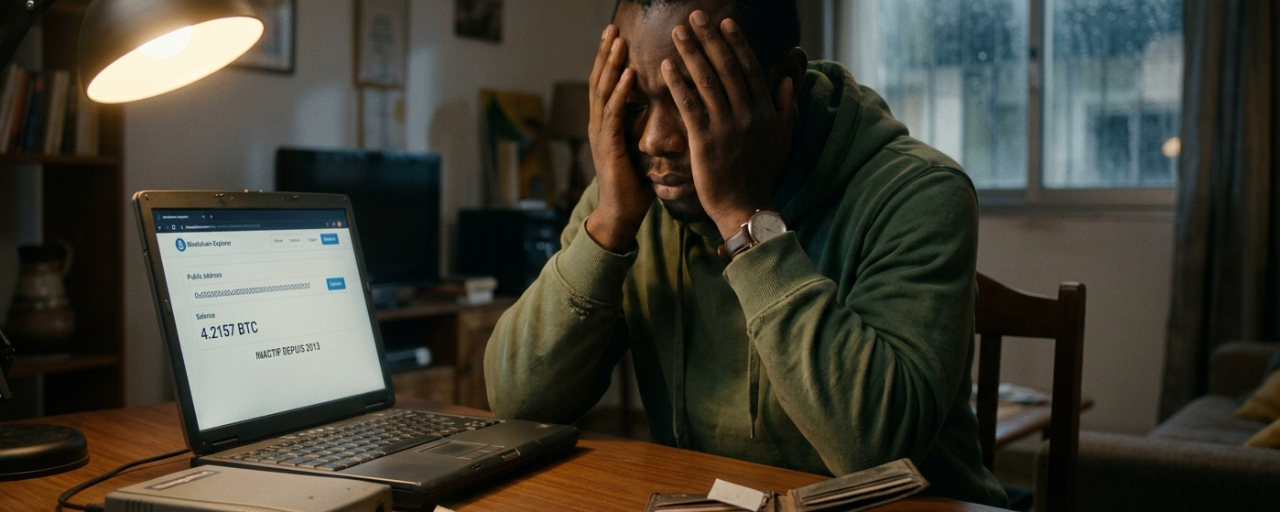
Every time the price of Bitcoin breaks a new record, my stomach knots up.
This isn’t jealousy toward those who succeed. It’s the weight of a memory I’ve been trying to bury for years: that of a wallet created long ago, when BTC was worth almost nothing, stored on an old drive and on a sheet of paper mistakenly discarded during a move.
On the blockchain, the address is public. I can see the funds in a click. They’re intact, frozen in the marble of the decentralized ledger.
But without the 12 recovery words, this money no longer belongs to anyone. It’s lost in mathematical nothingness.
Decentralization offers absolute freedom: you are your own bank. But it demands an unforgiving trade-off: there is no “Forgot password” button, no bank advisor to call, no recourse.
This reality cost me dearly, but it forged my discipline for the rest of my journey:
Rule 3-2-1 for your seed phrase: Keep at least 3 copies of your security keys, on 2 different mediums (durable paper, engraved metal plate), with 1 stored in a separate, secure location.
Zero digital footprint: Never take a photo of your recovery phrase, don’t save it in a Notes file, on Google Drive, or by email. Anything that touches the internet can be hacked.
Think about inheritance: If something happens to you tomorrow, does someone you trust know how to recover your assets—or will you take your savings to the grave?
Today, every Satoshi I hold is secured with the rigor of a state vault. Security isn’t a technical chore: it’s the foundation without which no profit makes sense.
Have you ever lost access to an old wallet or forgotten crypto on a closed platform? How did you secure your access since then?