
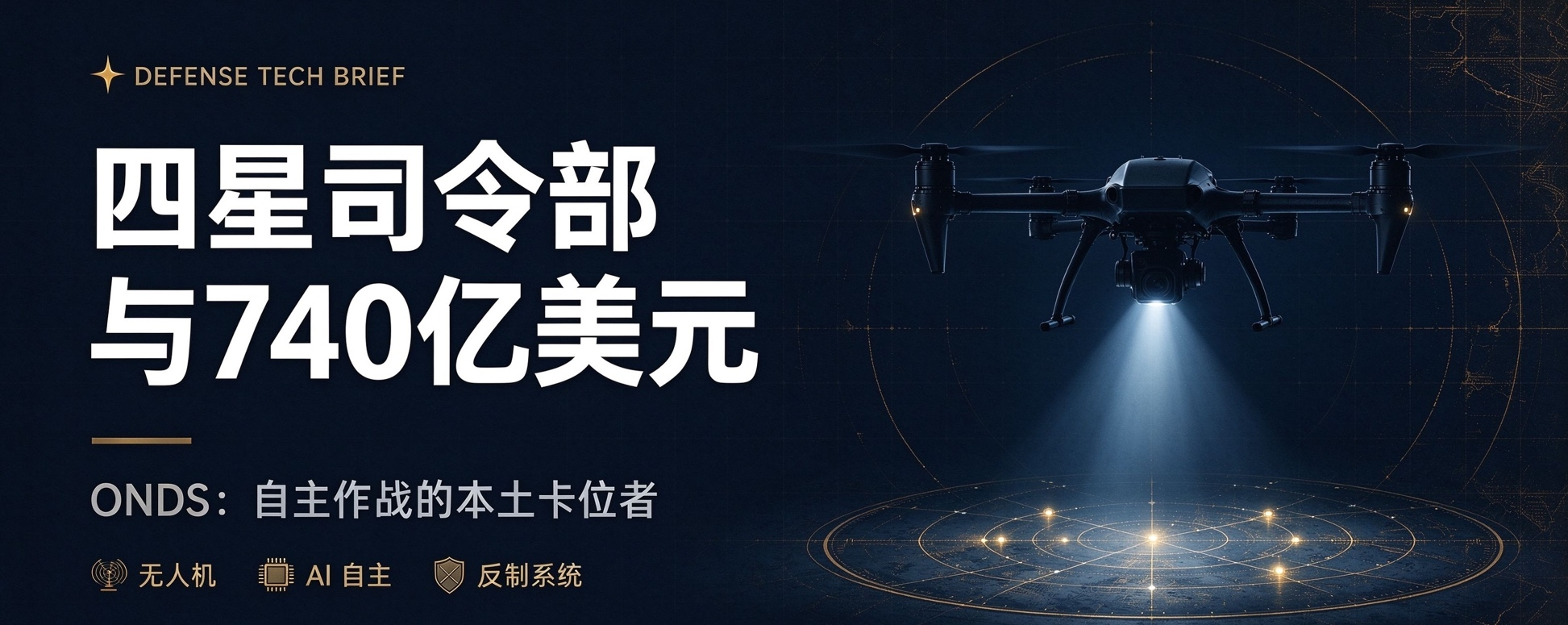

September 30, 2026, in Quantico, Virginia, U.S. Secretary of Defense Hegseth announced the establishment of a new four-star joint operations command—the “Autonomous Operations Command”—at the Marine Corps base. The scope of jurisdiction is clearly spelled out in three areas: drones, artificial intelligence, and command-and-control systems. (Wall Street Journal) puts it more directly: this is about “completely reforming the way the Pentagon procures, tests, and deploys drones and other cutting-edge technologies.”
The supporting numbers are equally striking: the Pentagon is seeking to double spending in the autonomous operations domain and invest $74.0 billion in drone and counter-drone technologies in its budget request.
A four-star command means this has been elevated within the U.S. military to a level on par with Indo-Pacific Command and Strategic Command; $74 billion means this is no longer experimental funding, but recurring defense spending. A top-down budget has directly bent the demand curve for an entire industry. The real question is: whose pockets will those $74 billion in orders end up in?
My answer is Ondas Holdings (Ondas Inc., NASDAQ: ONDS).
I. The Ghost of Verdun: War Has Become a Math Problem Again
To understand the significance of this budget, we need to go back to Verdun in 1916. The German Chief of the General Staff, Erich von Falkenhayn, didn’t plan to capture Paris. Instead, he intended to use concentrated artillery fire to “draw” the French army into a narrow area, then bleed it dry. Over ten months, France and Germany lost 550,000 and 434,000 troops respectively, and neither side won—because the war had devolved from maneuver warfare into pure resource attrition: the side that runs out of blood first surrenders.
The Russia-Ukraine battlefield is replaying the same problem, just with different units of measurement. Today’s “meat grinder” isn’t the Maxim gun; it’s the roughly $500 FPV kamikaze drone sent against an air-defense missile worth hundreds of thousands or even millions of dollars. One drone can take out a tank, a radar system, or an ammunition depot. The exchange ratio is so extreme that traditional defense economics no longer holds.
That’s the underlying logic of “replacing high-cost systems with low-cost ones”: when neither side can win quickly, war becomes a math problem about the cost per unit of destruction. Whoever can use lower-cost units, greater production capacity, and faster replenishment to drag the other side into a war of attrition gains the initiative. The U.S. establishment of an Autonomous Warfare Command and tripling of the budget are, at their core, answers to the same question: how to turn drones from “sensors” into “munitions,” from “support equipment” into “consumables.”
For consumables, the key isn’t how advanced the technology is. It’s three things: low cost, mass production, and reliability. Cheap enough to risk losing, produced at scale enough to risk losing, and reliable enough to use in your own airspace and on the front lines. That’s where the ONDS story begins.
II. Blowback from the Ban: “Domestic Replacement” Goes from Slogan to Mandatory Procurement
You can’t talk about ONDS without talking about DJI.
One set of figures captures the predicament facing U.S. military and public-safety drones: of the 996 police drones used by one Texas police department, 879 were made by DJI. DJI holds about 80% of the U.S. consumer drone market, 92% of the emergency response market, and 90% of the law enforcement market. The National Defense Authorization Act passed in December 2024 requires DJI to prove its products are secure within a year or face a sales ban. Meanwhile, alternatives developed by the Pentagon at a cost of tens of millions of dollars cost 8–14 times as much as DJI’s products and still fall short in performance.
The result of the ban isn’t “successful replacement”; it’s demand spilling over. On one hand, drone operators across the U.S. are frantically stockpiling equipment. On the other, the Pentagon and Congress have been forced to acknowledge that under the NDAA framework, they must support a group of domestic alternatives with auditable supply chains and compliant cybersecurity. This is what the industry calls the Green UAS List: only models on the list can be included in military and federal procurement catalogs.
What is ONDS doing? Its Optimus system is applying for the Green UAS List certification administered by AUVSI to meet the NDAA’s highest standards for cybersecurity and supply-chain requirements. In other words, it isn’t positioning itself in the “drone market” generally, but in the narrow window that remains open for military procurement after policy has shut the door on others.
III. The Shipyard’s Transformation: From Civilian Hangars to Military Countermeasures
In 1941, Shipyard No. 112 in Nizhny Novgorod, Soviet Union, which had originally built river fishing boats, was converted into a tank factory within a month of the German invasion. In 1942 alone, it produced more than 8,000 T-34s and 600,000 rifles. True wartime potential isn’t about how many dedicated defense factories you have; it’s about how quickly your entire industrial base can switch into “war mode.”
ONDS is following this path. Its business is structured around three segments:
• Ondas Autonomous Systems (OAS): The core asset. Its subsidiaries include American Robotics, Airobotics, Apeiro Motion, and 4M Defense, in which it acquired a controlling stake in October 2025 (intelligent mine clearance and underground/ground robotics).
• Ondas Networks: Dedicated private wireless networks for power grids and railways, the traditional industrial foundation of the business.
• Ondas Capital: Established in September 2025, with plans to deploy approximately $150 million to accelerate acquisitions in global defense and security technology.
OAS has two cards in hand, corresponding exactly to the two ends of the $74 billion budget:
1. Optimus System—the first small-drone system certified by the FAA for automated aerial security and data collection in the United States. It takes the form of a “hangar + robotic airport” and supports autonomous takeoff and landing beyond visual line of sight (BVLOS). Originally developed for industrial inspection and public safety, the system is now being sold to the defense sector: in Q2 2025, it received a single $14.3 million order from a major defense customer, the largest order in Optimus’s history. The Dubai government also added $3.8 million to expand its “Drone Box” public-safety network.
2. Iron Drone Raider—an autonomous counter-drone interception platform that physically rams and captures hostile drones. It completed several government-led counter-drone pilot programs in Europe and Asia in 2025.
One side is “building more drones”; the other is “shooting down more drones”—ONDS is betting on both of the $74 billion budget’s priorities.
The changes in the financials tell us more than the PowerPoint slides: Q3 2025 revenue grew roughly sixfold year over year, a record. The company is also expanding production capacity with U.S. partners, appointing a retired Army brigadier general to build military relationships, and making the transition from civilian to military markets. This isn’t a company still selling a dream—the orders have landed, capacity is expanding, and government customers are placing repeat orders.
IV. Why ONDS, Rather Than Another Name
There are plenty of drone companies in the market: Anduril, Shield AI, AeroVironment, Skydio, Teal… So why single out ONDS? Three reasons:
First, focused exposure and strategic positioning. ONDS is one of the few publicly traded companies with “FAA certification + Green UAS application + counter-drone interception systems + domestic U.S. production capacity,” and almost all of its market-cap exposure is concentrated in autonomous systems. Anduril is private, Shield AI focuses more on crewed aircraft and wingmen, while AeroVironment is a traditional missile and large-drone giant whose share price already reflects expectations. The new “Autonomous Warfare Command” variable is not yet fully priced into ONDS’s market cap.
Second, the symmetry of demand. Drones’ biggest enemy on the battlefield is another drone, so both offense and defense need to be built at the same time. Optimus is for “what I use,” Iron Drone Raider is for “what I shoot down,” and 4M Defense handles ground mine clearance. Together, they form a small, closed-loop battlefield robotics suite—not just a single type of platform.
Third, the acceleration of capital deployment. A company with a still-small annual revenue base but record-breaking quarters is setting up a $150 million industry fund and pursuing consecutive acquisitions (Apeiro and 4M Defense), while also benefiting from policy tailwinds at the four-star command level. This is a classic “small scale × high beta” combination.
V. Risks That Must Be Put on the Table
A recommendation is a recommendation, but the risks shouldn’t be hidden:
• This is a small-cap stock with extremely high volatility. ONDS has a small revenue base and is likely not yet consistently profitable. The risk of share issuance and dilution is an ongoing concern, and the stock is highly sensitive to news and interest-rate conditions.
• The $74 billion is a “budget request,” not an appropriation. It can take 12–24 months to go from congressional authorization to actual contracts through the annual appropriations process. Any government shutdown or midterm election results during that period could disrupt the timeline.
• The Green UAS List application is “in progress,” not “approved.” If certification takes longer than expected, the valuation thesis will be reassessed.
• Competitors are pursuing the same opportunity. Anduril and Shield AI have top-tier VCs behind them, and there’s no shortage of contenders for Air Force and Special Operations Command contracts. Whether ONDS can secure a share of the first procurement list for the four-star command needs to be tracked quarter by quarter.
• Crowded trade. Autonomous warfare and counter-drone stocks have been repeatedly hyped over the past 18 months. Positive news often brings sharp volatility, so keep position sizes under control when chasing a rally.
Conclusion
Byung-Chul Han once said that the most frightening thing about drone warfare isn’t that it’s more efficient, but that it makes killing feel like filling out a form—no smell of blood, just KPIs. The remark captures the ethical weight of this industry, but it also points to its commercial weight from another angle: when war decisions no longer require calculating your own casualties, drones stop being “optional equipment” and become “consumables kept in stock.”
The four-star command announced on September 30 puts this trend into the military’s organizational structure; the $74 billion budget request puts it into the national ledger. Over the next decade, whoever can reliably deliver affordable, dependable autonomous robots to the front lines and the rear will capture this structural windfall.
ONDS may not be the most exciting name, but it is one of the few publicly traded companies that currently holds all four cards: “certification + countermeasures + domestic production capacity + repeat orders.” The ghost of Verdun is still with us, and the shipyard transformation continues—and this time, the ticker is ONDS.