【CJ Arbitrage Advanced 09/14】
Many people look at YT first when entering Pendle, because it has high elasticity and plenty of “points/incentive” story. But for arbitrageurs, the first thing to clarify is: what exactly are you buying—principal, future yield, or the pricing discrepancy between the two?
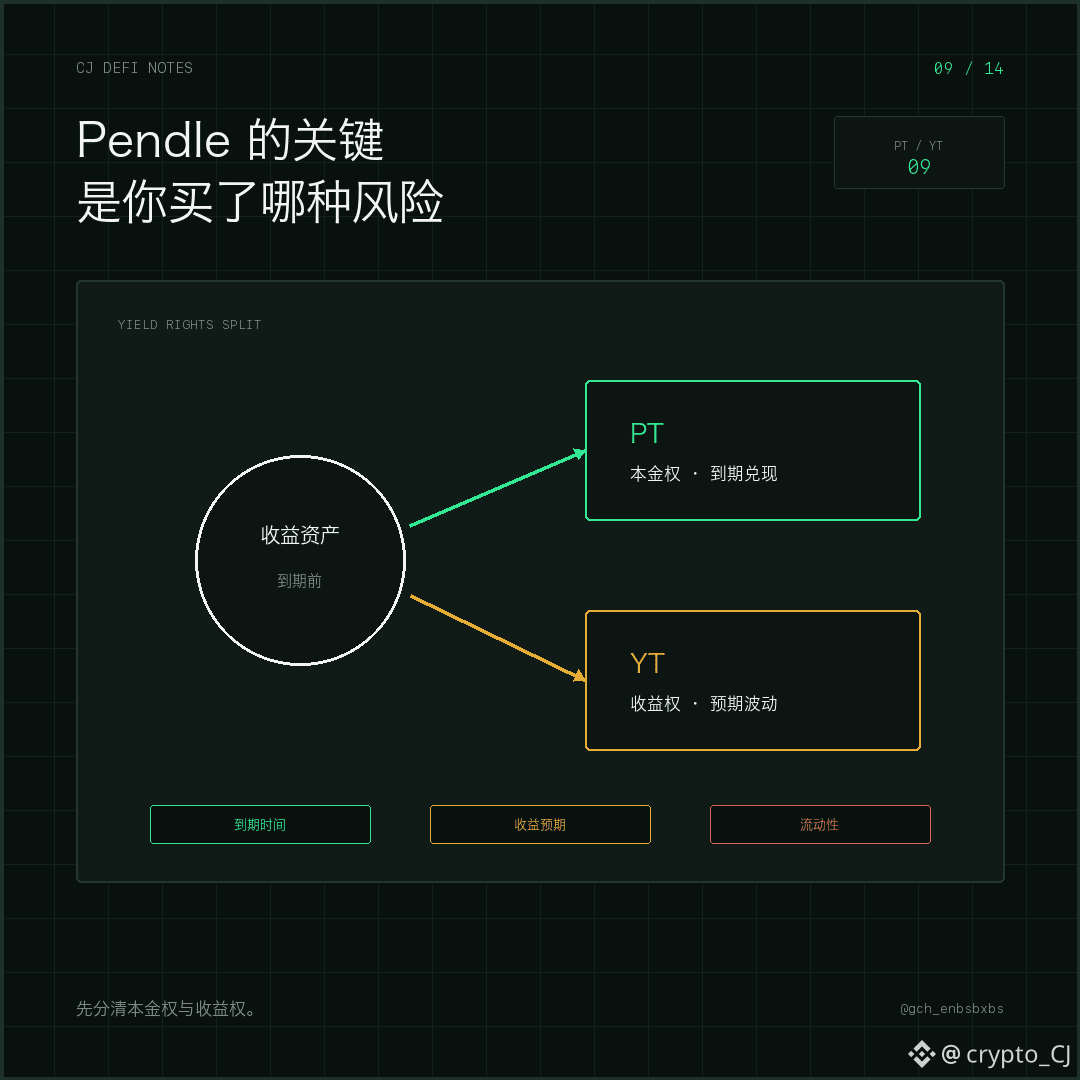
Once the yield asset is split, PT becomes closer to the right to the principal at maturity, while YT captures the yield and incentive expectations before maturity. Buying PT at a discount and holding to maturity means that, in theory, your return comes from the discount gradually converging. Buying YT means you’re pricing future yield, points, or an air-drop expectation. They’re not simply the difference between a “safe version” and a “high-profit version”—they reflect different time horizons, cash flows, and tail risks.
CJ has previously reminded people not to stop at the idea of just buying YT. Between PT, YT, spot, and different pools, there may be hedging or relative value opportunities. When big whales execute large trades through aggregators, they may also briefly “print” a premium/discount. But seeing a 2% deviation doesn’t mean you’re guaranteed to realize 2%—you still need to check routing depth, trading fees, and whether the hedging side can be executed simultaneously.
PT maturity returning is also not a “risk-free” outcome detached from conditions: underlying assets, protocol contracts, redemption at maturity, and liquidity can all go wrong. First map out where the cash flows come from, then talk about the annualized figure shown on the page.
Next article: In the cycle of borrowing at low interest and depositing at high interest, what is usually the most dangerous variable?
#Pendle #Interest Rate Trading
Many people look at YT first when entering Pendle, because it has high elasticity and plenty of “points/incentive” story. But for arbitrageurs, the first thing to clarify is: what exactly are you buying—principal, future yield, or the pricing discrepancy between the two?
Once the yield asset is split, PT becomes closer to the right to the principal at maturity, while YT captures the yield and incentive expectations before maturity. Buying PT at a discount and holding to maturity means that, in theory, your return comes from the discount gradually converging. Buying YT means you’re pricing future yield, points, or an air-drop expectation. They’re not simply the difference between a “safe version” and a “high-profit version”—they reflect different time horizons, cash flows, and tail risks.
CJ has previously reminded people not to stop at the idea of just buying YT. Between PT, YT, spot, and different pools, there may be hedging or relative value opportunities. When big whales execute large trades through aggregators, they may also briefly “print” a premium/discount. But seeing a 2% deviation doesn’t mean you’re guaranteed to realize 2%—you still need to check routing depth, trading fees, and whether the hedging side can be executed simultaneously.
PT maturity returning is also not a “risk-free” outcome detached from conditions: underlying assets, protocol contracts, redemption at maturity, and liquidity can all go wrong. First map out where the cash flows come from, then talk about the annualized figure shown on the page.
Next article: In the cycle of borrowing at low interest and depositing at high interest, what is usually the most dangerous variable?
#Pendle #Interest Rate Trading