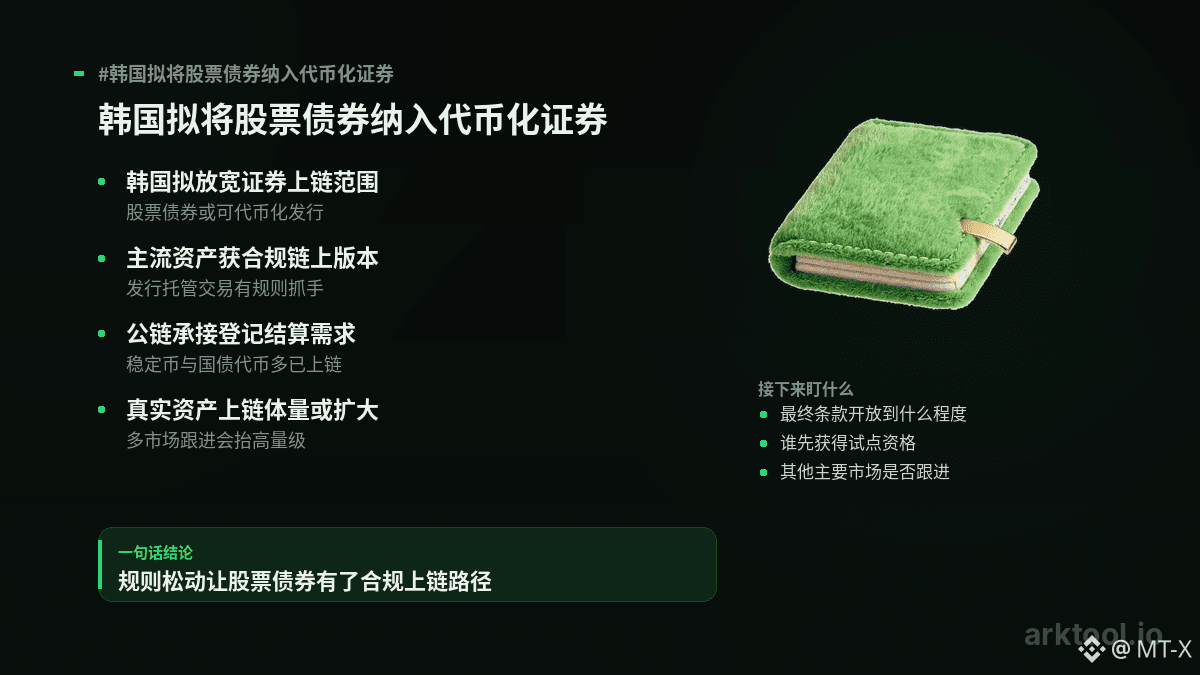
South Korea’s financial authorities plan to broaden the scope of tokenized securities. Traditional securities such as stocks and bonds may, in the future, be allowed to be issued and traded on-chain.
The key lies in the two words “scope.” Previously, the range of assets that tokenized securities could cover was limited, and the boundaries were unclear, making institutions reluctant to enter at scale. Now, by putting stocks and bonds on the table, it effectively acknowledges that mainstream assets can have a compliant on-chain version. Finally, the issuance, custody, and trading processes have concrete rule “handles” that can be discussed in detail.
For $ETH , this is a signal from the demand side. Putting securities on-chain is not just a matter of issuing a token. Behind it all, there needs to be a public chain capable of supporting asset registration, settlement, and compliance tooling. Ethereum has the deepest accumulation in this area. Stablecoins, tokenized government bonds, and fund share tokens mostly run on this chain, and custodians and compliance service providers are familiar with the workflow. Once the rules loosen, the simplest option for South Korean brokers and asset-management institutions running pilots is to connect to this already mature infrastructure. The result is ongoing settlement demand and on-chain activity.
Next, watch three things. First, in the final terms, to what extent will stocks and bonds be opened—will transfers be limited to institutions, or will it be open to a broader range of investors. Second, who gets pilot authorization first—actual actions by financial institutions carry more weight than statements. Third, whether other markets follow suit: if tokenized securities loosen in several major markets at the same time, the volume of truly on-chain assets would not be on the current scale.
#韩国拟将股票债券纳入代币化证券
The key lies in the two words “scope.” Previously, the range of assets that tokenized securities could cover was limited, and the boundaries were unclear, making institutions reluctant to enter at scale. Now, by putting stocks and bonds on the table, it effectively acknowledges that mainstream assets can have a compliant on-chain version. Finally, the issuance, custody, and trading processes have concrete rule “handles” that can be discussed in detail.
For $ETH , this is a signal from the demand side. Putting securities on-chain is not just a matter of issuing a token. Behind it all, there needs to be a public chain capable of supporting asset registration, settlement, and compliance tooling. Ethereum has the deepest accumulation in this area. Stablecoins, tokenized government bonds, and fund share tokens mostly run on this chain, and custodians and compliance service providers are familiar with the workflow. Once the rules loosen, the simplest option for South Korean brokers and asset-management institutions running pilots is to connect to this already mature infrastructure. The result is ongoing settlement demand and on-chain activity.
Next, watch three things. First, in the final terms, to what extent will stocks and bonds be opened—will transfers be limited to institutions, or will it be open to a broader range of investors. Second, who gets pilot authorization first—actual actions by financial institutions carry more weight than statements. Third, whether other markets follow suit: if tokenized securities loosen in several major markets at the same time, the volume of truly on-chain assets would not be on the current scale.
#韩国拟将股票债券纳入代币化证券