
DVA: “A kilowatt by the house works twice.” How solar mining turns excess energy into heat and bitcoins
A new formula for a Ukrainian homestead: Sun • electricity • computing • heat + rewards
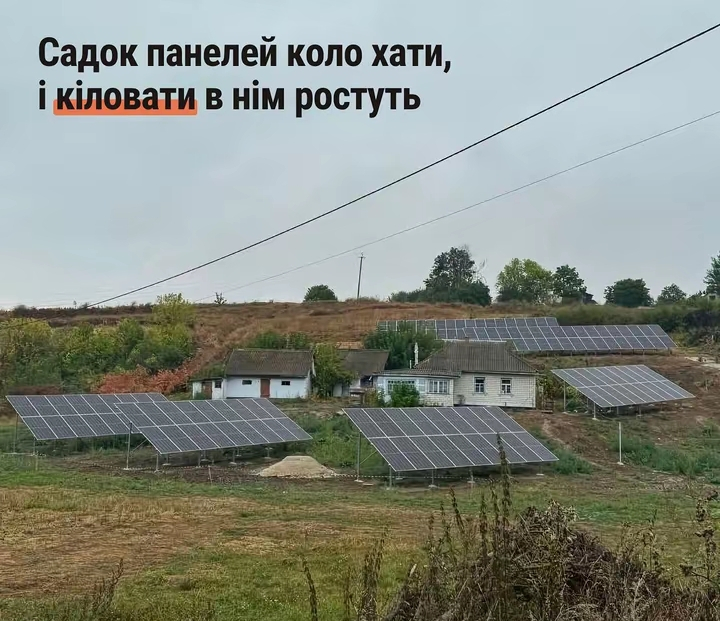
A classic Ukrainian solar “garden” by the house has become a familiar sight—over 86 thousand families generate their own electricity. But the next step turns out to be far more interesting: what to do with the surplus, which on a sunny day exceeds consumption? Sell it back to the grid at a tariff that rarely covers the real cost? Or direct it to where energy turns into computing power, heat, and potential BTC rewards?
This is the model that DVA studies: solar energy • useful consumption • surplus • heat + potential reward in Bitcoin.
Why right now: economics that changed the rules
Electricity is 70–90% of operating costs in Bitcoin mining. For Ukrainian households, the tariff is about 4.32 UAH per kWh ($0.10), which makes conventional mining unprofitable: the cost of one BTC reaches $89,120, while the market price is about $70,524. For businesses with a tariff of ~8 UAH/kWh, the situation is even worse—the cost rises to $165,000.
But there is a critical exception: self-generation with a unit cost below 2 UAH/kWh. That’s exactly where solar energy changes everything. After the system is paid off, solar electricity costs about $0.035/kWh**, and for a modern ASIC such as the Antminer S21 (3,500 W), the difference between grid and solar energy is about **$270 per month in savings on one machine.
Mechanism: how it works in practice
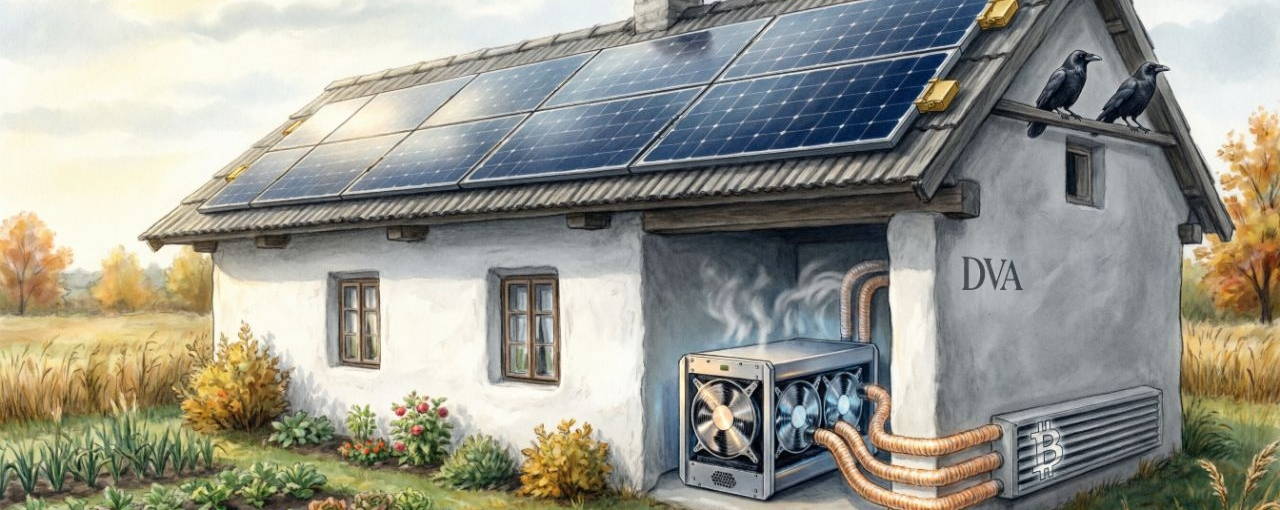
The model promoted by DVA has a clear logic. Solar panels generate electricity that during the day covers the home’s needs, and the surplus powers an ASIC miner. If the mining is successful and a block is found, the miner receives a reward in BTC, which in the mining pool is distributed among participants according to their contribution. In parallel, every watt of electricity that goes into the ASIC ultimately comes out as heat—and that heat can be used for space heating or hot water.
For a home setup of one Antminer S21 (3,500 W) in a “daytime only” mode, you need approximately 11 panels of 400 W each. For 24/7 mining with battery backup for 8 hours—about 28 kWh of battery capacity. The market already offers ready-made solutions: the German company Bison Pro launched the BisonPro Max system, which uses surplus solar energy for mining and recovers heat for buildings, district heating, and industrial scenarios. And the Canadian manufacturer Canaan has brought the concept to commercial scale by supplying equipment for district heating in Scandinavia: 692 units of additional capacity at 8 MW, heating about 2,800 homes.
Heat as a second product: from theory to real numbers
The economics of heat recovery are confirmed by real cases. A homeowner in Vermont (USA) bought one Antminer S21 (3,500 W), connected the exhaust to the heating system, and by December 2025 reduced their heating bill from $407 to $96—after accounting for electricity costs ($529), savings on fuel oil ($285), and BTC rewards ($148). The ASIC produced about 11,940 BTU per hour—equivalent to a resistive heater with 3.5 kW of power—covering 70% of the heating demand.
Globally, Bitcoin mining produces about 100 TWh of heat every year—enough to heat all homes in Finland during the winter. For a Ukrainian village, where the heating season lasts 5–6 months, this aspect becomes especially important: every kilowatt spent on computing comes back as heat.
Flexible load: mining as a power-grid stabilizer
Researchers from Vinnytsia National Technical University proposed a concept for using mining farms as flexible load to balance power systems through the Frequency Containment Reserve (FCR) mechanism. The model involves dynamic allocation of power between selling energy on the market, using it for mining, and shedding it depending on deviations in grid frequency. The key takeaway: during hours with reduced or negative electricity prices, selling under the “green tariff” becomes unprofitable, while directing surplus power to mining provides a more stable income.
For the Ukrainian power system, which faces constant shocks, this means that distributed home mining nodes can become active market participants rather than passive consumers. The open-source Project Solar Mining initiative (launched in March 2026) already automates this process through Home Assistant: the software tracks solar generation in real time and starts NerdQAxe++ miners only when there is a surplus.
A candid look: risks and limitations
The “kilowatt works twice” model is not a guarantee of profit. The outcome depends on ASIC efficiency (modern models reach less than 20 J/TH), network difficulty (which increases every two weeks), pool fees, and the BTC price. Equipment ages quickly: new, more efficient miners push out previous generations, reducing their profitability. In addition, hybrid battery-based systems have higher initial costs, though they provide autonomy during outages.
DVA conclusion
A Ukrainian village has already proven that it can be the foundation for distributed generation. The next step is to make this generation multifunctional. A solar “yard” by the house that produces electricity in the daytime, computes hashes day and night, and heats the home in winter—this isn’t fantasy but an engineering and economic reality. The only question is how many Ukrainian families are willing not just to be consumers (or even prosumers), but active nodes in the energy and computing network.
The sun shines for free. Computation creates value. Heat stays in the house. The formula is simple—and that’s why it works.