



This National Day I didn’t go out to play. Since I had some free time this morning, I’ll do a quick recap.
Over the past few days, MOVR’s price action really has been a bit outrageous.
More importantly, this time I’m not explaining only after it already surged.
Earlier I made a trading plan for MOVR, and this round I also hit all of the take-profit levels.
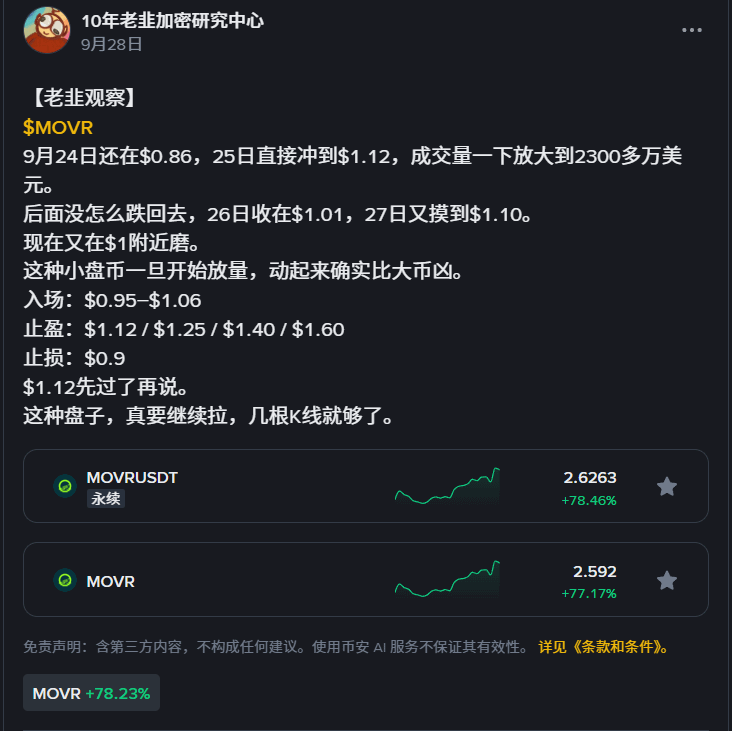
So this time, I’m not going to talk about “whether it can still be chased.” I’ll just break down this run of the market:
A small-cap coin that previously not many people paid attention to—why did it suddenly start accelerating continuously?
1. First layer of logic: MOVR is no longer the original MOVR.
In July this year, Moonbeam officially announced that MOVR would migrate from the original Moonriver/Polkadot ecosystem to Base.
This migration is 1:1— the original MOVR can be converted to the ERC-20 MOVR on Base. This thing itself didn’t happen only on September 30. The official migration deadline for individual wallets was actually July 31.

So if someone simply explains this rally as “the September 30 migration deadline,” that logic isn’t complete.
What’s truly worth noting is:
After the migration is completed, MOVR’s trading and liquidity environment changes.
It starts entering Base—the EVM ecosystem where capital and applications are more active right now.
This gave the market a reason to re-price MOVR.
Second, the real breakout point is that the trading volume moves first
Just look at MOVR’s historical data and it’s obvious.
On September 10, MOVR closed at only about $0.71.
By September 23rd and 24th, the price had gradually returned to around $0.86–$0.90.
The close on September 28 was about $0.97.
During this time, it doesn’t actually look like anything particularly outrageous.
What’s truly worth noting is the trading volume.
On September 28, trading volume was at the level of a few million USD; then it suddenly started to expand.
On September 29, the trading volume had already reached about $22M.
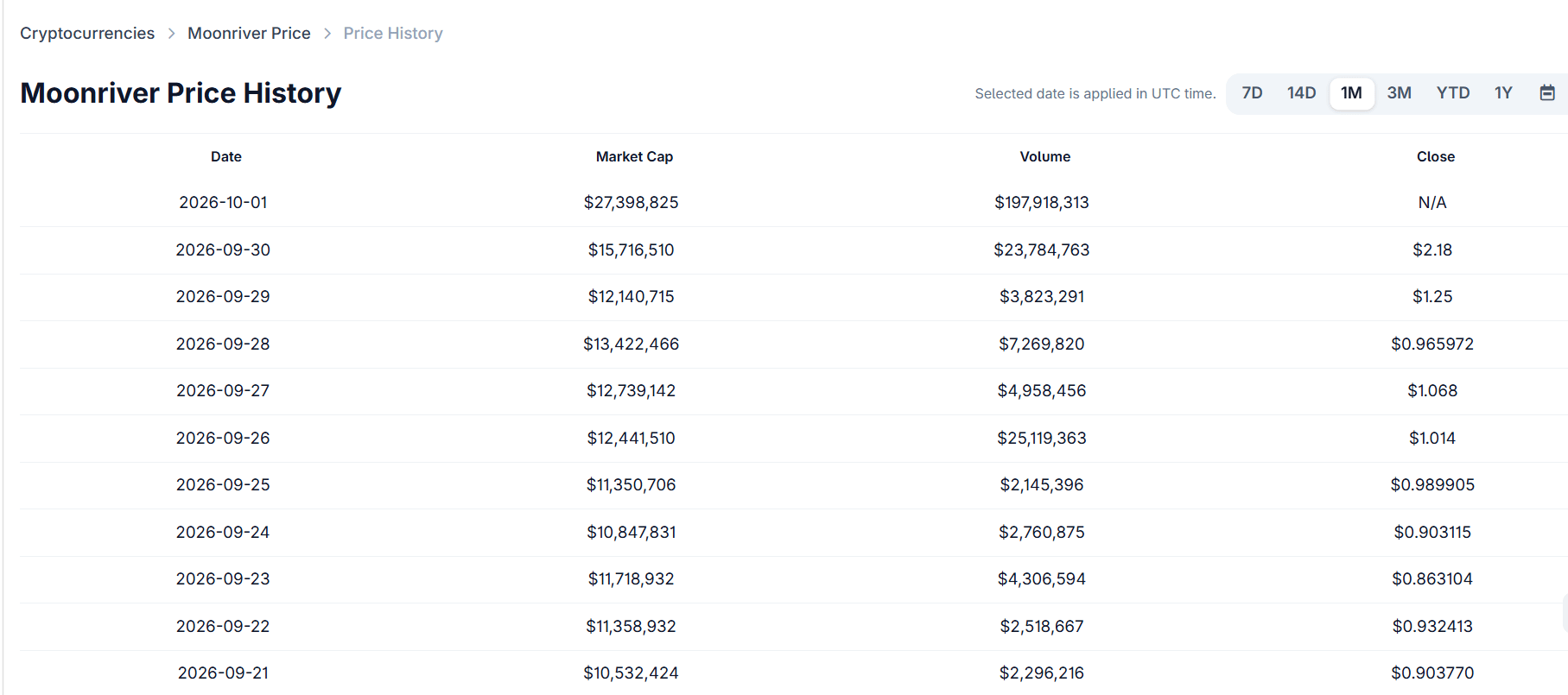
So it means:
Before the price goes fully crazy, the capital has already pushed up the trading volume first.
This is often more important than chasing after a single huge bullish candle.
Third, the market cap is simply too small
This is a very important point of this MOVR cycle.
In mid-September, MOVR’s market cap was only around the $8M–$10M range.
What does a volume like this imply?
You don’t need tens of billions in capital.
Even without needing a few billion USD.
As long as the market suddenly shows a concentrated buying wave, it’s enough to cause extremely large price fluctuations.
So small-cap coins have a very typical characteristic:
When it’s going up, it looks especially easy.
But the same is true the other way around:
When it’s going down, it’s also especially easy.
That’s also why you can’t just look at the percentage increase for this kind of coin.
A 30% gain doesn’t mean it’s expensive.
A drop of 30% doesn’t mean it’s cheap.
What you should really look at is:
Has the trading volume kept up, has the money continued to flow in, and after the price rose, did new buyers step in to take over?
Fourth, the third signal: large addresses begin to increase their holdings
That’s also what makes this cycle interesting.
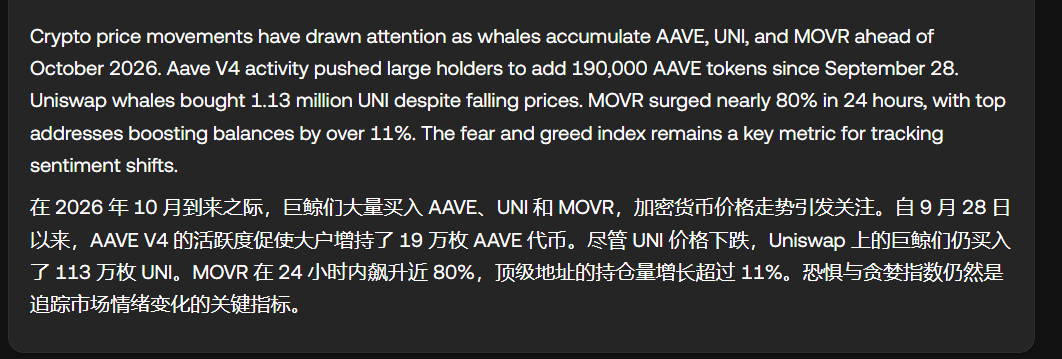
Market data reports for September 30 show that during MOVR’s rally, the balance of the Top 100 addresses increased by more than 11%.
This means that at least from on-chain address data, the MOVR holdings of large addresses have clearly increased.
What’s truly worth noting is:
When the price breaks out, trading volume expands, and large-address balances increase—several signals happen within roughly the same time window.
This is much more meaningful than a standalone news headline like “a whale buys a coin.”
…and then the most疯狂 (most wild) phase appears
When a small-cap coin finishes:
Long consolidation → trading volume expands → breakout → large addresses increase their holdings
After that, a second phase is likely to appear.
The first batch of capital made money.
The second batch of capital sees the breakout and starts chasing.
The shorts start to cut losses.
More and more traders start to pay attention to this coin.
So the rally goes from:
Capital drives the move
Gradually it becomes:
Capital + trend + sentiment all pushing together.
That’s also why the pace of the rise after MOVR is clearly faster than before.
Before September 29, it was a small coin that most people wouldn’t even look at.
Once it breaks out, it suddenly appears on a lot of the biggest gainers lists and comes into traders’ focus.
At this point, the price rising itself becomes new advertising.
Six, so what is this MOVR cycle truly worth learning?
What’s really worth remembering is that these conditions all appear at the same time:
① Small market cap
② There are clear structural catalysts
③ The price hasn’t been fully “front-run” and completely traded up within a period of time
④ Trading volume suddenly surges
⑤ On-chain large addresses show changes
⑥ After the breakout, a trend starts to form
Only when this kind of combination appears is it worth pulling a niche coin out and studying it closely.
Instead of seeing a coin up 50% today and then going find a story for it.
These two trading logics are completely different.
Seven, why was I able to eat all of the take-profits this time?
Actually, there’s nothing magical about it.
The key isn’t predicting how high MOVR will ultimately go.
Rather, it’s:
Set your risk in advance, then let the market run on its own.
I had set tiered take-profit levels for MOVR earlier.
Once the price reaches a certain level, take some of it.
Then at the next position, take another portion.
So even if MOVR later continues to go crazy, there won’t be the problem of “knowing in advance that you should have taken everything at the peak.”
The hardest part of trading isn’t finding the coin that goes up the most.
Rather, it’s:
When you truly encounter a coin that’s going absolutely crazy, can you still take profits according to your plan?
This time with MOVR, I went through the entire process step by step.
Finally
This MOVR cycle has already proven something:
A coin that’s truly worth researching in advance doesn’t necessarily start out in the #1 spot on the gainers list.
Sometimes what’s actually more worth looking at is:
The price hasn’t fully moved yet, but the fundamentals have changed, trading volume becomes abnormal, and capital on-chain starts to move in this small-cap coin.
Of course, the biggest risk of this approach is also very clear.
Small-cap coins can rise very fast, and fall just as fast.
So if I see a similar structure in the future, I won’t just chase it directly because “it might be the next MOVR.”
I’ll first look for:
Event → Market cap → Trading volume → On-chain capital → Price structure
Can all five of these line up at the same time?
If it doesn’t line up, I’d rather miss it.
Because real opportunities don’t need you to prove you’re right by chasing the top.