

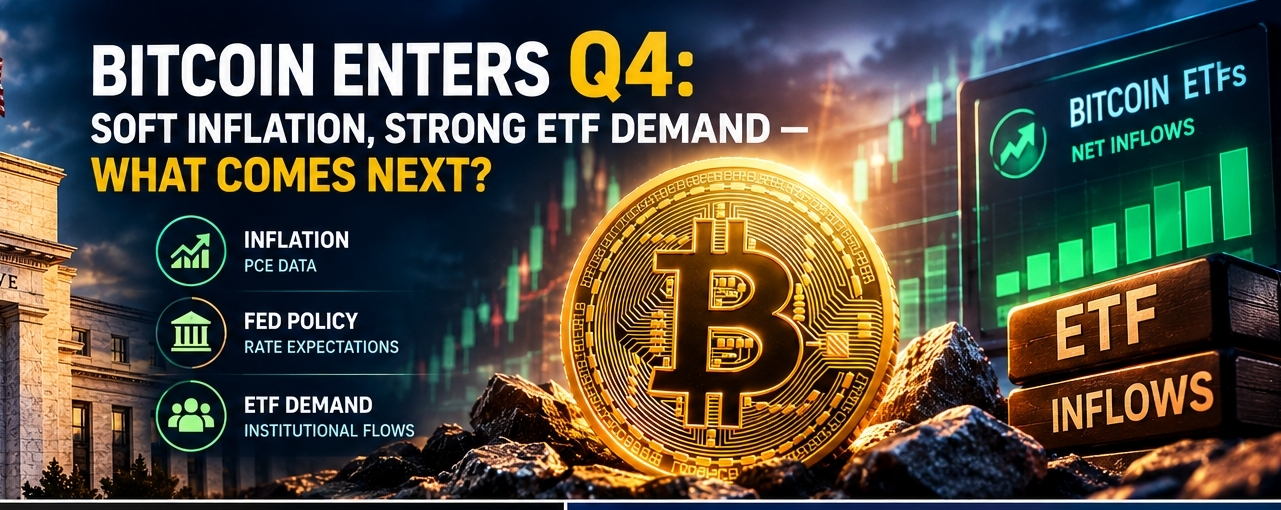

Bitcoin is entering the fourth quarter with a market that is being pulled in two different directions.
On one side, U.S. inflation data came in softer than expected. On the other, Treasury yields remain elevated, keeping pressure on risk assets. At the same time, institutional demand through U.S. spot Bitcoin ETFs has remained an important part of the market story.
So the key question for Q4 is not simply whether Bitcoin can move higher.
The bigger question is whether improving macro conditions can combine with sustained spot demand strongly enough to support the next phase of the market.
1. Softer PCE Gives Markets Some Breathing Room
The August U.S. Personal Consumption Expenditures (PCE) report provided a more supportive signal for risk assets.
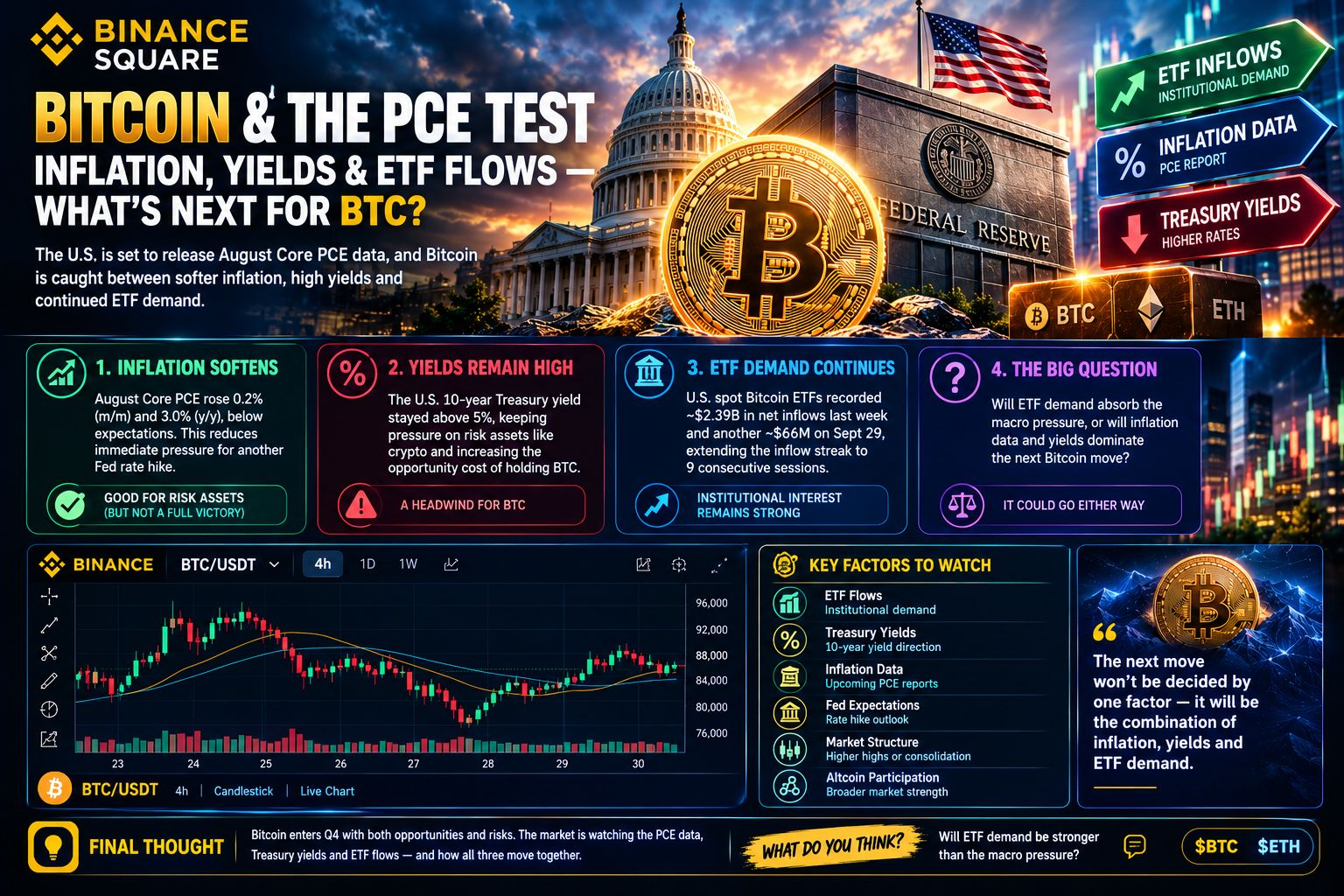
Headline PCE increased 0.3% month over month, while core PCE rose 0.2%. Annual core PCE was reported at 3.0%, below economists' expectations.
The softer inflation reading reduced some expectations for another Federal Reserve rate increase in October.
For Bitcoin, this matters because monetary policy and liquidity conditions can influence how investors position in higher-risk assets.
However, one softer inflation report does not remove the broader inflation problem. Core inflation remains above the Federal Reserve's 2% target, meaning future inflation data will still matter.
2. Treasury Yields Remain a Major Variable
The positive reaction to the PCE data was not enough to remove the pressure coming from the bond market.
U.S. Treasury yields remained elevated, with the 10-year yield moving above 5% during the latest session.
Higher yields can increase the opportunity cost of holding assets that do not provide traditional interest income. This can create a challenging environment for Bitcoin and other risk assets.
That means Q4 could become a battle between two forces:
Lower rate-hike expectations vs. elevated Treasury yields.
If inflation continues to cool and yields eventually move lower, financial conditions could become more supportive for crypto.
If yields remain high or rise further, Bitcoin could continue experiencing periods of volatility even when ETF demand remains positive.
3. ETF Demand Is Still an Important Signal
Institutional Bitcoin demand has remained one of the strongest structural themes of 2026.
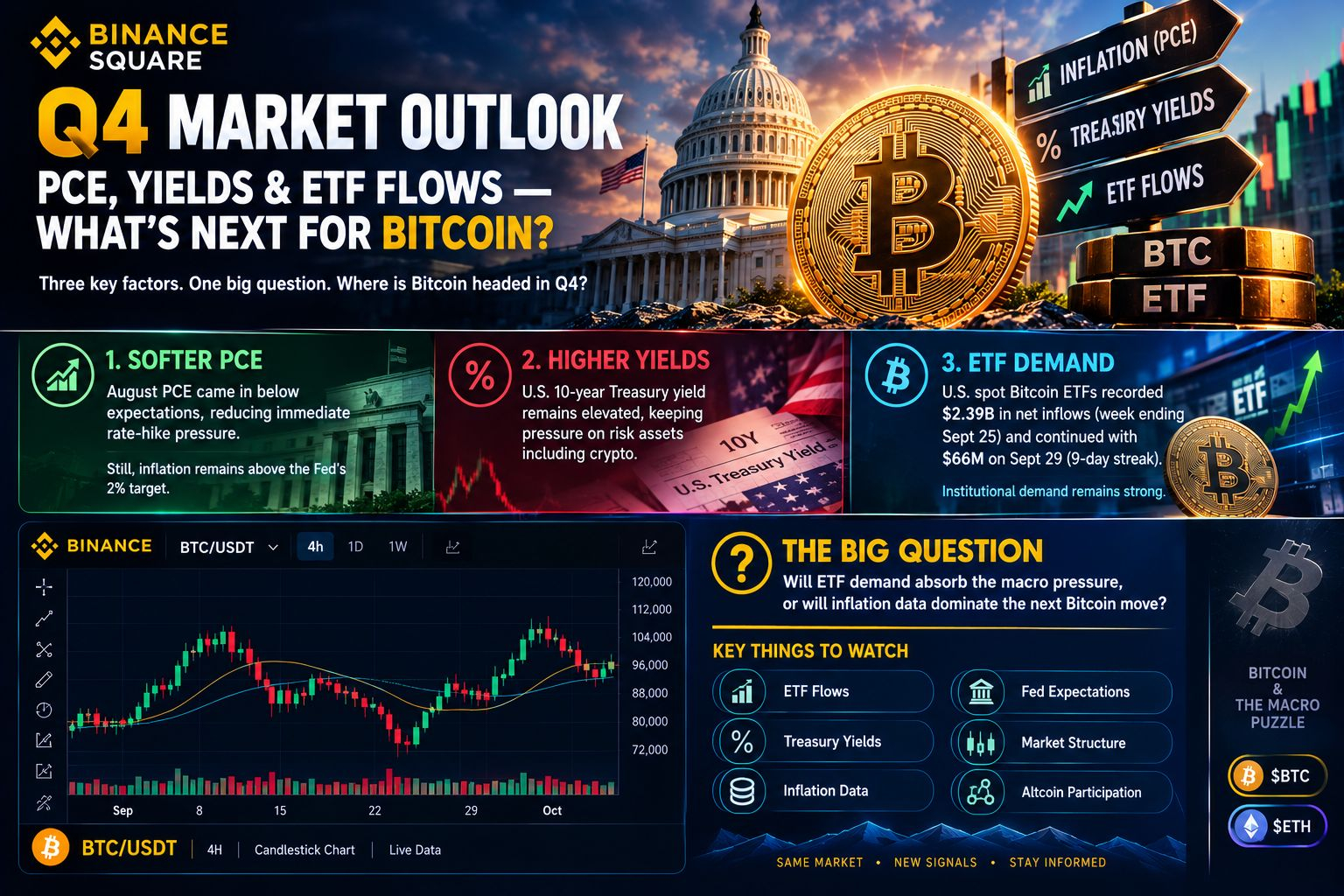
U.S. spot Bitcoin ETFs recorded approximately $2.39 billion of net inflows during the week ending September 25, according to market data reported by multiple outlets.
The inflows showed that institutional demand has not disappeared even during periods of Bitcoin price weakness.
More recently, U.S. spot Bitcoin ETFs recorded another net inflow of roughly $66 million on September 29, extending the reported inflow streak to nine trading sessions.
But ETF inflows should not be interpreted as a guarantee that Bitcoin will rise.
Price can still move lower despite positive fund flows because markets are influenced by leverage, derivatives positioning, macroeconomic conditions, profit-taking and broader liquidity.
The important signal is whether strong ETF demand continues while Bitcoin maintains its market structure.
4. Bitcoin's Next Phase May Depend on Spot Demand
One interesting feature of the current market is the difference between institutional demand and short-term price action.
Bitcoin has been trading around the low-to-mid $80,000 area while institutional flows have remained positive.
That creates an important observation:
Capital can be entering the market without immediately producing a sustained price breakout.
This may indicate that existing selling pressure is absorbing part of the demand.
For traders and investors, the relationship between ETF flows and price action may therefore be more useful than looking at either metric independently.
If ETF inflows continue while Bitcoin begins establishing higher highs and higher lows, market structure could become stronger.
If inflows weaken while price continues struggling, the market may remain vulnerable to another consolidation phase.
5. What About Ethereum?
Ethereum is entering Q4 with a different setup.
ETH has also benefited from strong quarterly performance, but its price action has not been identical to Bitcoin's.
The key areas to watch include ETH relative strength against $BTC , ETF flows, derivatives positioning and whether capital begins rotating more broadly into large-cap altcoins.
Ethereum can benefit from improving liquidity conditions, but it also faces competition for investor attention from Bitcoin and other major crypto assets.
For that reason, $ETH is worth monitoring alongside $BTC rather than assuming that Bitcoin's strength will automatically translate into equal performance across the market.
6. What I Will Be Watching in Q4
Instead of focusing on a single price target, these are the signals that could provide a clearer picture of the market:
1. Bitcoin ETF flows
Are institutional inflows continuing, accelerating or fading?
2. Treasury yields
Does the 10-year yield begin moving lower, or does it remain elevated?
3. Inflation data
Do upcoming inflation reports confirm the softer trend?
4. Federal Reserve expectations
Do markets continue reducing expectations for additional rate hikes?
5. Bitcoin market structure
Does BTC establish higher highs and higher lows, or remain range-bound?
6. Altcoin participation
Does strength remain concentrated in Bitcoin, or does broader participation develop.
Final Takeaway
Bitcoin enters Q4 with both supportive and challenging signals.
Softer-than-expected inflation has reduced some immediate pressure around further Federal Reserve tightening, while continued ETF demand suggests institutional interest remains present.
At the same time, elevated Treasury yields and inflation that remains above the Fed's target mean the macro environment is not completely clear.
For me, the most important combination to watch is simple:
ETF demand + Treasury yields + Bitcoin market structure.
If these three signals begin moving in a more supportive direction together, the market could enter a different phase.
If they remain mixed, consolidation and volatility may continue.
Crypto markets can change quickly, so the live chart and latest data should always be checked before making any trading decision.
What do you think matters more for Bitcoin in Q4: continued ETF demand or the direction of U.S. Treasury yields?
DYOR. This article is for market education and discussion, not financial advice.

