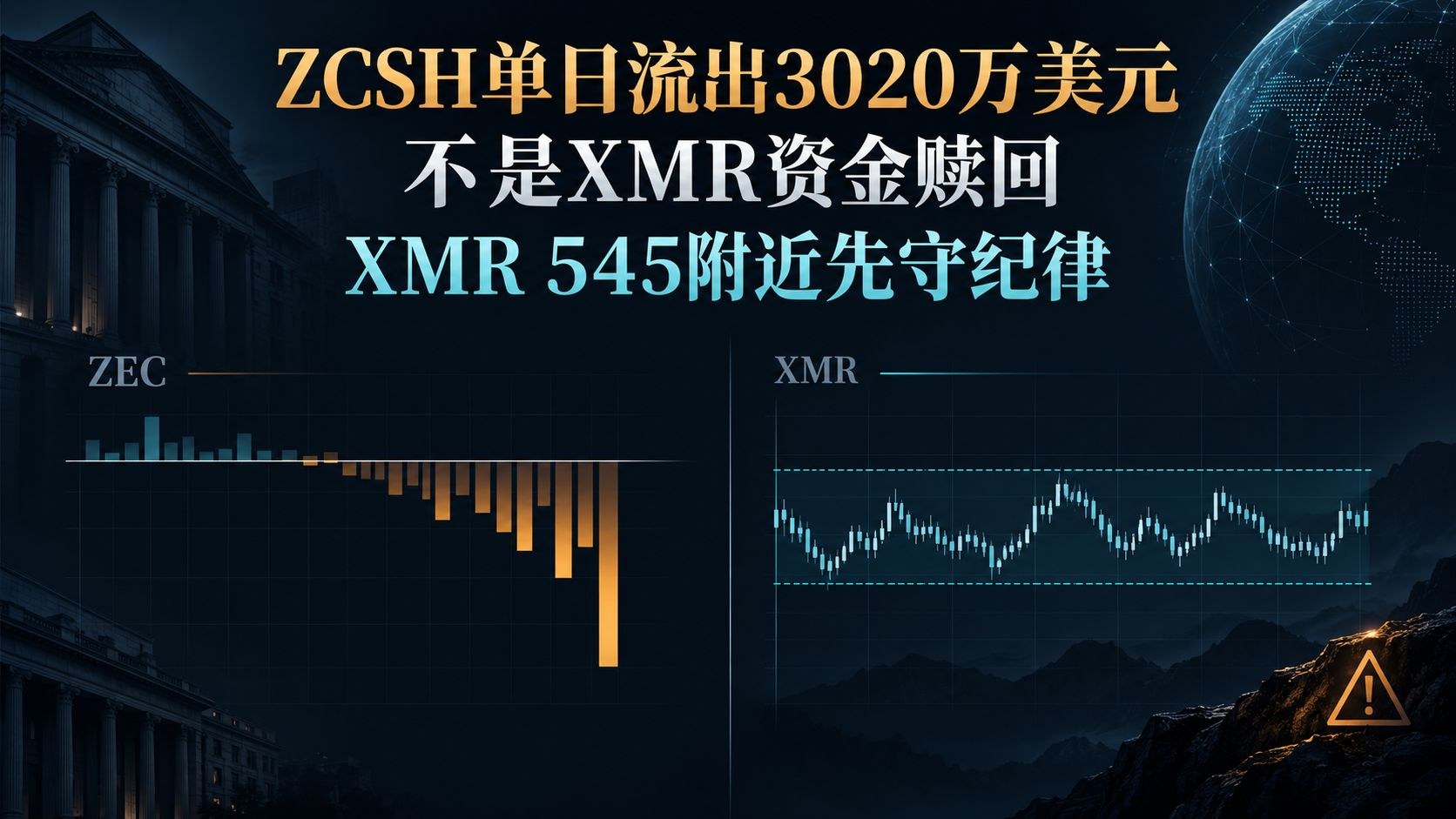
ZCSH daily outflow of $30.2 million | This is not an XMR redemption | Around $545, I’ll stay disciplined
My stance is cautious: I won’t mix two coins from the same privacy niche into a single pot of money. Farside’s Zcash fund flow report has just been updated with the September 30 data: ZCSH saw a $30.2 million outflow that day; September 29 was zero flow; and September 28 had a $8.1 million outflow. These figures are reported in fund share subscriptions/redemptions denominated in USD. They do not mean equivalent spot holdings in the market were immediately sold, and certainly cannot be framed as “institutions are redeeming XMR.” The ZCSH prospectus archived by the U.S. SEC is very clear: the fund holds ZEC, and the shares give investors exposure to ZEC. It is not a Monero fund, and there is no XMR subscription/redemption line in the table. This boundary of assets matters more than overlaying two price charts.
Why would XMR traders still care about this message? Privacy coins can share part of the same risk preference. A shift in capital within ZEC products could change traders’ short-term pricing for the sector, and it might even trigger cross-coin de-risking. But that’s an assessment of potential transmission paths—not verified outflows of XMR funds. Conversely, if someone concludes that XMR fundamentals are deteriorating just from a single day’s ZCSH outflow, I won’t go along. Monero’s demand, liquidity, and tradable venues need to be validated separately—especially since thin order books in smaller coins can amplify sentiment into price volatility. One-day flows from institutional products can also be revised or restated, so you can’t only watch a single-day number and assume a long-term trend.
How has the market reacted? At the time of writing, Kraken’s XMR/USD was around $544.98, trading within a 24-hour range of $536.22 to $548.63. After opening near $544.84 that day, it basically churned in place. What I see is absorption within the range; it doesn’t prove that ZCSH outflows caused an XMR drop, let alone that XMR has already moved to an independent bearish thesis. If the $548.63 upper edge can’t hold with increased volume, chasing longs risks buying near the top of the range. If the $536.22 lower edge breaks, then you have to admit that risk appetite is contracting. Separate data observation from causal judgment.
If I were trading this myself: I would not participate. I’d only consider a lightly sized spot long after confirmation, with zero leverage. Only if XMR/USD reclaims $549 and then retests without breaking it would I place a trial position using no more than 0.25% of total funds: first target $560—cut the position in half on touch; second target $572—trim the remaining position. After entry, if price falls back to $542, I’d cut with a stop loss and I would not move the stop downward. If it first breaks below $536, and fund data shows a clearly renewed outflow along with XMR weakening on its own volume, I would cancel the long plan and stay flat, waiting. If after the breakout it still can’t hold above $549 for 24 hours, I would close all remaining positions. These numbers are conditions, not executed trade records, and not guaranteed prices.
Information cross-check: Farside Zcash ETF Flow, the SEC ZCSH prospectus, and the live Kraken XMR/USD quote. #XMR #ZEC
The above is for personal market observation only and does not constitute investment advice.
My stance is cautious: I won’t mix two coins from the same privacy niche into a single pot of money. Farside’s Zcash fund flow report has just been updated with the September 30 data: ZCSH saw a $30.2 million outflow that day; September 29 was zero flow; and September 28 had a $8.1 million outflow. These figures are reported in fund share subscriptions/redemptions denominated in USD. They do not mean equivalent spot holdings in the market were immediately sold, and certainly cannot be framed as “institutions are redeeming XMR.” The ZCSH prospectus archived by the U.S. SEC is very clear: the fund holds ZEC, and the shares give investors exposure to ZEC. It is not a Monero fund, and there is no XMR subscription/redemption line in the table. This boundary of assets matters more than overlaying two price charts.
Why would XMR traders still care about this message? Privacy coins can share part of the same risk preference. A shift in capital within ZEC products could change traders’ short-term pricing for the sector, and it might even trigger cross-coin de-risking. But that’s an assessment of potential transmission paths—not verified outflows of XMR funds. Conversely, if someone concludes that XMR fundamentals are deteriorating just from a single day’s ZCSH outflow, I won’t go along. Monero’s demand, liquidity, and tradable venues need to be validated separately—especially since thin order books in smaller coins can amplify sentiment into price volatility. One-day flows from institutional products can also be revised or restated, so you can’t only watch a single-day number and assume a long-term trend.
How has the market reacted? At the time of writing, Kraken’s XMR/USD was around $544.98, trading within a 24-hour range of $536.22 to $548.63. After opening near $544.84 that day, it basically churned in place. What I see is absorption within the range; it doesn’t prove that ZCSH outflows caused an XMR drop, let alone that XMR has already moved to an independent bearish thesis. If the $548.63 upper edge can’t hold with increased volume, chasing longs risks buying near the top of the range. If the $536.22 lower edge breaks, then you have to admit that risk appetite is contracting. Separate data observation from causal judgment.
If I were trading this myself: I would not participate. I’d only consider a lightly sized spot long after confirmation, with zero leverage. Only if XMR/USD reclaims $549 and then retests without breaking it would I place a trial position using no more than 0.25% of total funds: first target $560—cut the position in half on touch; second target $572—trim the remaining position. After entry, if price falls back to $542, I’d cut with a stop loss and I would not move the stop downward. If it first breaks below $536, and fund data shows a clearly renewed outflow along with XMR weakening on its own volume, I would cancel the long plan and stay flat, waiting. If after the breakout it still can’t hold above $549 for 24 hours, I would close all remaining positions. These numbers are conditions, not executed trade records, and not guaranteed prices.
Information cross-check: Farside Zcash ETF Flow, the SEC ZCSH prospectus, and the live Kraken XMR/USD quote. #XMR #ZEC
The above is for personal market observation only and does not constitute investment advice.